To avoid these ads, REGISTER NOW!

Hanging sheetrock from these rafter ties?

clonedad

Member
Joined
Feb 27, 2022
Messages
7
Looking to finish the upstairs of a 20x28 2 story garage, with the potential of this floor being an apartment one day if need be, so it would need to meet residential code.

Looking to do the ceiling with drywall/insulation. 2x8 Rafters are 16 on center. 2x4 rafter ties that span around 12-14 feet. Supported by suspended strong back in the center. Roof is a 4/12. Rafter ties are hung 11” up from the top of the walls, with the top of the ridge being about 3’8” from the top of the walls.


Can I hang half inch drywall from these rafter ties w/ insulation? Or would the weight somehow compromise the function of the rafter ties? I know 2x4's probably aren't supposed to span this far, but does the strongback cut the span requirements in half?
 
To avoid these ads, REGISTER NOW!
OP
C

clonedad

Member
Joined
Feb 27, 2022
Messages
7
They should be supported from the peak, sounds like they are. That makes it two 7' spans. No problem with that
Yes, there is a strong back that is supporting them from the peak halfway through.
 

K'ledgeBldr

Well-known member
Joined
Aug 22, 2011
Messages
1,925
Location
Johns Creek, GA
Nope, not happenin'!
2X4 ceiling joists/16"o/c have a max span of 10-9 for SP and SPF (which yours appear to be). The strong back/catwalk is to keep the joists in an upright/straight orientation. Any connection from the strongback to the ridge "may" help with keeping the ridge level- but that it. All the connections I'll presume are just nails, and are most likely in shear. The ridge itself is to support the roof- not roof and ceiling.

If they were 2X6, the span would be no problem- provided they a supported on each end by bearing directly on the wall.
 

billconner

Well-known member
Joined
Jul 20, 2021
Messages
6,963
Location
Thousand Islands NYS
Same answer as I gave on thebuildingcode.com.

Check the 2x4 hangers. A lot depends on those. I might add some more 2x4 hangers or steel - chain, cable, all-thread. Like like just 2 or 3, and with sheetrock that's a lot of load maybe 6 or 8 nails in shear.
 

billconner

Well-known member
Joined
Jul 20, 2021
Messages
6,963
Location
Thousand Islands NYS
I would just add that it would be fine and not questioned to sheetrock the rafters, so with same load, I don't see a problem of a little less sheetrock supported from the rafters.

It does all depend on the verticals.
 

Bert_

Well-known member
Joined
Dec 24, 2016
Messages
9,717
Location
NW Iowa
Any connection from the strongback to the ridge "may" help with keeping the ridge level- but that it. All the connections I'll presume are just nails, and are most likely in shear. The ridge itself is to support the roof- not roof and ceiling.

That's backwards. Those 2x4's can't and won't support any load from the ridge.
 
OP
C

clonedad

Member
Joined
Feb 27, 2022
Messages
7
I've posted this a few places, and it's interesting all the differing opinions I've gotten!

What would be the best way to get a ceiling up in this situation if I can't hang drywall from those 2x4's? Would I need to run 2x8's across the width of the building sitting on top of the walls & hang the ceiling to that? Not sure how I would get them up in there, & I would have to notch them.
 
Last edited:

billconner

Well-known member
Joined
Jul 20, 2021
Messages
6,963
Location
Thousand Islands NYS
If the rafters are sized correctly, adding 2x6 (11'-11") or 2x8 (15'-1") ceiling joists - I'd set them against strong back - no reason to set on top plate.

I'd guess you could remove strong back and set new joists flush with 2x4. or remove 2x4s.

You might look at steel joists - like a 2x6 stud. Lighter and easier to man handle into position.

And I guess you could reinforce strong back - add a beam. Very light load plf - maybe 100 pounds - but still a 28' heavy piece to "slip in" there.

Always options.
 

Bert_

Well-known member
Joined
Dec 24, 2016
Messages
9,717
Location
NW Iowa
I looked at some span tables, at 16" spacing can go 8' and support a 10 psf dead load. OP says 12-14' supported in the middle so 6-7' span. I don't see any problem with that. Make sure each rafter tie is supported from the peak.
 

Uncle murph

Well-known member
Joined
Jan 28, 2021
Messages
1,462
Location
Harford county
Looking to finish the upstairs of a 20x28 2 story garage, with the potential of this floor being an apartment one day if need be, so it would need to meet residential code.

Looking to do the ceiling with drywall/insulation. 2x8 Rafters are 16 on center. 2x4 rafter ties that span around 12-14 feet. Supported by suspended strong back in the center. Roof is a 4/12. Rafter ties are hung 11” up from the top of the walls, with the top of the ridge being about 3’8” from the top of the walls.


Can I hang half inch drywall from these rafter ties w/ insulation? Or would the weight somehow compromise the function of the rafter ties? I know 2x4's probably aren't supposed to span this far, but does the strongback cut the span requirements in half?
Love the fact that this starts with pictures,and yes,you should be able to drywall the ceiling as long as you’re halving the span of the 2x4s with a attachment to the ridgeboard.
 

mike93lx

ALLIANCE MEMBER
Joined
Dec 9, 2013
Messages
37,487
Location
Richmond, VA
If 2x6's would work, I think I would just swap them out. It would also give you a chance to make sure it is dead flat, if you didn't do that with the 2x4's
 

jkuro

Well-known member
Joined
Apr 28, 2009
Messages
552
You will need to replace the rafter ties/ ceiling joists to carry the load of the drywall. You said 12-14 foot span for the joists. Lets use 13 foot. At 13 foot with a 20lb live load for gypsum board you will need 2x6 douglas fir or yellow pine, 2x8 with hemlock fir or southern white pine. This is on 16 inch centers.

The board down the middle is called a catwalk. Its only purpose is to keep the joists from twisting. Just reuse it if you replace the rafter ties.
 

PoorUB

Well-known member
Joined
Mar 29, 2021
Messages
11,627
Location
Fargo, ND
I would leave the existing collar ties up temporally. Sister in 2x6 or 2x8 cutting the ends to meet the angle of the rafter the use 1/2" plywood, construction adhesive and screws to tie it all together. Once you have the larger collar tie in place, then rip out the old 2x2 collar tie and plywood in the other side.

You may be able to do one collar tie at a time, rip the old one out, then put in the new using plywood plates to tie it together. Then move on to the next.
 

Bert_

Well-known member
Joined
Dec 24, 2016
Messages
9,717
Location
NW Iowa
Everyone is missing the fact that they are or can be supported from the ridge. That cuts the 14' span in HALF.

A 2x8 is GROSS overkill
 

mike93lx

ALLIANCE MEMBER
Joined
Dec 9, 2013
Messages
37,487
Location
Richmond, VA
Everyone is missing the fact that they are or can be supported from the ridge. That cuts the 14' span in HALF.

A 2x8 is GROSS overkill
Hard to tell, but that doesn't look like a ridge beam to me. Looks like a board. Not sure if you can hang the ceiling from it
 
To avoid these ads, REGISTER NOW!

jkuro

Well-known member
Joined
Apr 28, 2009
Messages
552
Everyone is missing the fact that they are or can be supported from the ridge. That cuts the 14' span in HALF.

A 2x8 is GROSS overkill
You can't support it from the ridge board. A ridge beam yes. Also look at a span chart if you think 2x8 is over kill.
 

Bert_

Well-known member
Joined
Dec 24, 2016
Messages
9,717
Location
NW Iowa
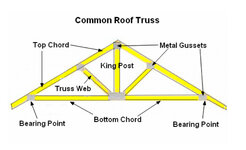
Rafters with a ceiling joist can handle a ton of weight from the peak. The top cords are in compression, pushing out on the walls, and the tie keeps them together. It is broken up into triangles which are an extremely strong shape. The only time a ridge beam is needed is when you try to remove the ties, it removes the bottom of the triangle and loses most of the strength.

Go look at a manufactured roof truss if you don't understand it. Many residential sized trusses are made completely from 2x4's, because the span is broken up many times. When you study one you will notice that all the web members are transferring the force back to the peak.
 
Last edited:

mike93lx

ALLIANCE MEMBER
Joined
Dec 9, 2013
Messages
37,487
Location
Richmond, VA
Go look at a manufactured roof truss if you don't understand it. Many residential sized trusses are made completely from 2x4's, because the span is broken up many times. When you study one you will notice that all the web members are transferring the force back to the peak.
Sure, engineered trusses can do this. This isn't that though, so they aren't quite the same thing. It may end up being fine, but someone shouldn't think they can field assemble something that looks similar and get the same results.
 

jkuro

Well-known member
Joined
Apr 28, 2009
Messages
552
A catwalk is for the purpose of walking on. The framing shown in the picture for stiffening the 2x4s is a strong back
OK, you got me, catwalk is slang. But it is not a strongback. It is bridging. There should be a ceiling below and the 2x above keeping the joists from twisting.
 

Bert_

Well-known member
Joined
Dec 24, 2016
Messages
9,717
Location
NW Iowa
Sure, engineered trusses can do this. This isn't that though, so they aren't quite the same thing. It may end up being fine, but someone shouldn't think they can field assemble something that looks similar and get the same results.
Engineered trusses can go much, much wider than this. The concept is the same, physics don't change. The difference is the connections and grade of lumber are unusually better for a truss, but we aren't trying to clear span 100' either.
 

PoorUB

Well-known member
Joined
Mar 29, 2021
Messages
11,627
Location
Fargo, ND
Everyone is missing the fact that they are or can be supported from the ridge. That cuts the 14' span in HALF.

A 2x8 is GROSS overkill

Go look at a manufactured roof truss if you don't understand it.
I am not missing it!

These are not engineered trusses. Engineered trusses would have "W" bracing from the rafter to the collar tie.

Did you miss the point that if the hang the center of the span to the peak, the collar tie will have more stress on the joint where the collar tie meets the rafter? That connection is marginal at best already.

My suggestion of replacing the colar ties with 2x6 or 2x8 material and using plywood on both sides of the connection solves the poor collar tie/rafter connection and also does not require a center hanger.
 

pattenp

Well-known member
Joined
Jun 4, 2008
Messages
10,175
Location
Virginia - USA
OK, you got me, catwalk is slang. But it is not a strongback. It is bridging. There should be a ceiling below and the 2x above keeping the joists from twisting.
In the picture what I see is a strongback. There is a vertical member laying along side of the flat horizontal member laying on top of the 2x4 rafter ties. Look up a diagram of framing a strongback.
 

3onthetree

Well-known member
Joined
Nov 14, 2018
Messages
191
I've posted this a few places, and it's interesting all the differing opinions I've gotten!
You don't need opinions. Even got the 'ol "collar tie" thrown in as usual. All you need is the answer in black & white. It's real easy, it's in the code book. The math has been done for you. The thickness of the drywall is negligible.
Nope, not happenin'!
2X4 ceiling joists/16"o/c have a max span of 10-9 for SP and SPF (which yours appear to be).
^^ said early on. Just look at IRC Table R802.5.1(1) and you will confirm this info.
- You need 2x6 ceiling joists to make that span for a ceiling.
- You need 2x8 ceiling joists if you want storage capability.
There are some other things you should look at like the fastening to the rafters, and whether your rafters even qualify for the span by having raised rafter ties, if you want to look at it.

The flat 2x's in the shape of an 'L' or 'T' in the middle of the rafter ties, if nailed to each one, is a strongback. It does NOT split the span in half. It is used for lateral bracing of the building ends back to the roof diaphragm. You don't need to attach vertical purlins from this strongback to the ridge board. You only see those added later in old garages with 2x4 rafter ties, just to keep them from sagging from all the storage put up there. If you do add purlins they then have the potential to put unaccounted for load on the rafters above. It does NOT create a truss by connecting your ceiling joists with a "king post truss shape" to the ridge board.

If you plan on using this space, your insulation and attic venting would be good to get right while you close it in now.
 

Bert_

Well-known member
Joined
Dec 24, 2016
Messages
9,717
Location
NW Iowa
I am not missing it!

These are not engineered trusses. Engineered trusses would have "W" bracing from the rafter to the collar tie.

Did you miss the point that if the hang the center of the span to the peak, the collar tie will have more stress on the joint where the collar tie meets the rafter? That connection is marginal at best already.

My suggestion of replacing the colar ties with 2x6 or 2x8 material and using plywood on both sides of the connection solves the poor collar tie/rafter connection and also does not require a center hanger.
There are many ways to make a truss and you can make a truss by hand The W webbing is just one, most W trusses have more than just a w. More like vWv as they get wider.

The only part I'll agree with is that all the connections should be checked. There is a lot of spreading force on the ties and they need to be nailed well. Especially with the raised ties.

I have a garage that is 28' wide. It has hand made rafters in the so called "king post" design. The bottom cords are 2x6 that run 28' supported in the center by a web to the peak, so two 14' spans. It has a ceiling of t&g 1x6's. That building is over 100 years old and the ceiling is dead flat.
 

mike93lx

ALLIANCE MEMBER
Joined
Dec 9, 2013
Messages
37,487
Location
Richmond, VA
Engineered trusses can go much, much wider than this. The concept is the same, physics don't change. The difference is the connections and grade of lumber are unusually better for a truss, but we aren't trying to clear span 100' either.
I know they can. I totally understand the concepts of trusses and the engineering that go into them

We don't have to argue about this. I am making my suggestions, you are making yours. The OP can decide which path, if either, to take.
 

PoorUB

Well-known member
Joined
Mar 29, 2021
Messages
11,627
Location
Fargo, ND
There are many ways to make a truss and you can make a truss by hand The W webbing is just one, most W trusses have more than just a w. More like vWv as they get wider.

The only part I'll agree with is that all the connections should be checked. There is a lot of spreading force on the ties and they need to be nailed well. Especially with the raised ties.

I have a garage that is 28' wide. It has hand made rafters in the so called "king post" design. The bottom cords are 2x6 that run 28' supported in the center by a web to the peak, so two 14' spans. It has a ceiling of t&g 1x6's. That building is over 100 years old and the ceiling is dead flat.
My point was you were going on about engineered trusses, and in the OP's case they are not trusses, it is a stick framed roof., so engineered trusses have nothing to do with the conversation.
 

Bert_

Well-known member
Joined
Dec 24, 2016
Messages
9,717
Location
NW Iowa
My point was you were going on about engineered trusses, and in the OP's case they are not trusses, it is a stick framed roof., so engineered trusses have nothing to do with the conversation.
There isn't anything magical about a truss. The same physics apply whether it's home built or engineered and put together in a factory. When you build it on site it has to have a bigger margin for error but again we are talking about a 20' wide building, not a big deal in the first place.
 

FredWanaker

Well-known member
Joined
Mar 27, 2021
Messages
1,470
Location
NorCal
instead of trying to guess which answer is correct, just hire a local PE to take a quick look. They will either say yes, no, or for $350 I'll do a quick solution for you. Since you aren't making other changes, there isn't a lot of work for a PE to do. Then apply for a permit to convert the space and you'll have an engineering drawing in case anyone wants to see it. Last time I had something like this it cost me $200 to pay a PE to do a quick drawing and stamp it.

If you have access to the original blueprints when it was built, as it look fairly new, it may already have the loading calculations on it which would give you a definitive answer.
 

PoorUB

Well-known member
Joined
Mar 29, 2021
Messages
11,627
Location
Fargo, ND
There isn't anything magical about a truss. The same physics apply whether it's home built or engineered and put together in a factory. When you build it on site it has to have a bigger margin for error but again we are talking about a 20' wide building, not a big deal in the first place.
No arguement from me, other we are not talking about an engineered trusses.
 

Dig Doug

Well-known member
Joined
Apr 16, 2018
Messages
1,102
i would add a 2x4-
king post or a couple truss webs to your collar ties and proceed as planned!

it’s way over kill to add both

just make sure you do some electrical rough in prior to hanging the drywall, adding later will be a HUGE pain in the ****…

it doesn’t need to be re Engineered just shorten the span up on the 2x4 CT and roll on !

5A3D6937-9732-4AFE-8864-2B3935BABCA9.jpeg
 
To avoid these ads, REGISTER NOW!
Top Bottom