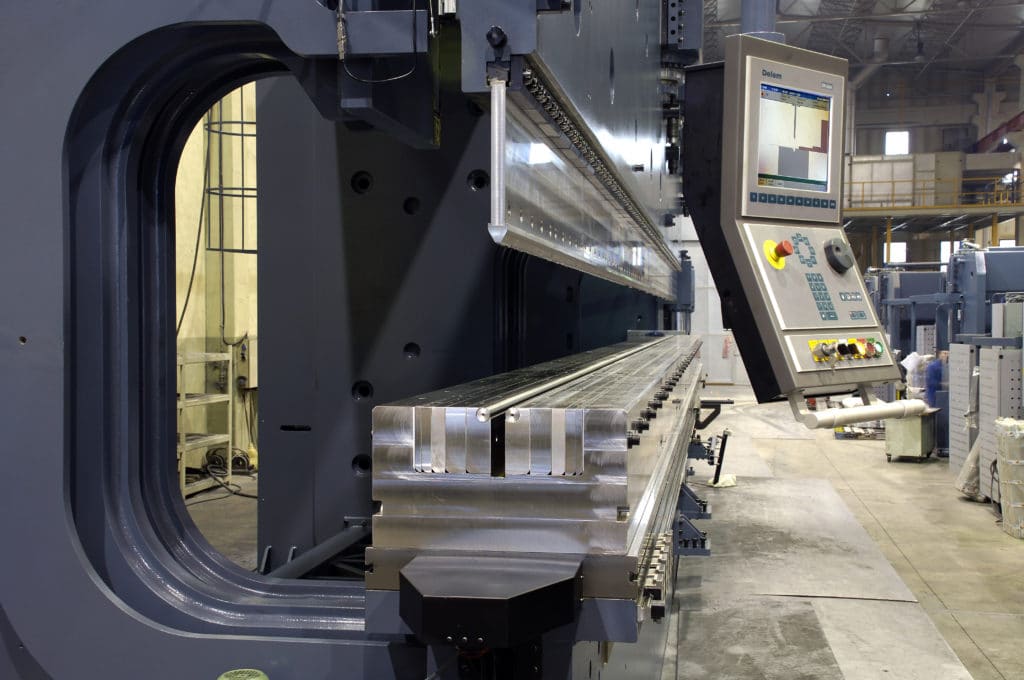
Just because we are on the subject, worth discussing some of the fundamentals.
You will notice that large press brakes usually have a 4 sided die. The upside is you can move the 2 points that support the edge of the bend (again, see round additions to SWAG in video above). The dowsnside of that is with typical 8" wide dies you can't get any closer than about 4 1/2" between opposite direction 90 degree bends. To do that in big breaks you can get narrow dies that fit into 8" base. The grooves in "normal" V dies are usually 85 degree - allowing for spring back. Not sure what angle the Chinese HF one is, but that would be first question to have answered before buying and trying.
There are a LOT of punch and die combinations to do all that can be done:
For all the power a press brake has to offer, its interchangeable punches are truly the most important element of the overall machine. A punch without a die, however, is frankly not much more than a fancy paperweight.

www.rmtus.com
The kick with all fixed geometry V dies is that they WILL leave a mark where edges of V push and slide along the material being bent. The usual rule of thumb is called "rule of 8" that means die width should be 8x material thickness, but you can quickly see that is pretty narrow. If you use wider V you get a radius on what you assume would be the "flats" beside the bend. The break tooling business solves that with rotary dies the do not slide material
The other big factor is the shape and tip radius of the punch. Again, see the SWAG video and you can see how the flame cut edge of his material became a stress riser that the sharp edged punch started a crack from.
Lots to read, lots to learn but extremely useful and satisfying to be able to make what you want/need in house


 www.harborfreight.com