To avoid these ads, REGISTER NOW!

Heat Pump Diagnosis

sourdough

Well-known member
Joined
Dec 3, 2012
Messages
132
Location
Pe Ell, WA
Not my problem but a problem for my BIL.

He has a Trane (don't know mod/ser #) that runs the condensing unit when the t-stat is set to "heat", but the condensing unit will not run when set to "cool". I suggested it might be a problem with the t-stat heat-off-cool switch.

He had an HVAC tech out today ($180 for the visit) that determined the t-stat is fine but it needs a new TXV.

I have done A/C work for years before retiring but have no experience with heat pumps. I know how they work in theory, swapping the condenser for the evaporator depending upon the mode.

Is there a separate TXV for the heating and cooling sides of the system?

Is there a separate liquid line solenoid valve for each side with a separate LPS?

He won't even let me look at it because he is convinced that the 5-ton 3-year-old unit needs an entire service inspection, even though one was performed 2 years ago when he bought the house. The heat pump (with aux electric heat for cold OSA temps) worked fine throughout the last winter.

I know all of you techs are going to want to know the nomenclature from the data plate, but I don't have it.

Opinions welcome.
 
To avoid these ads, REGISTER NOW!

mwchase

Member
Joined
May 10, 2014
Messages
17
It most likely does have an outdoor txv along with indoor txv.
I cannot speculate what the hell is going on through a message board description.

I have replaced a few Trane indoor expansion valves in the last couple years that were less than 3 years old. Should have parts warranty but probably not on labor.
 

bazar01

Well-known member
Joined
Jan 30, 2009
Messages
326
Location
Leesburg, GA
Not my problem but a problem for my BIL.

He has a Trane (don't know mod/ser #) that runs the condensing unit when the t-stat is set to "heat", but the condensing unit will not run when set to "cool". I suggested it might be a problem with the t-stat heat-off-cool switch.


Opinions welcome.

Can you explain more the statement "but the condensing unit will not run when set to cool"

So the condensing unit just will not run, meaning, the compressor and the condenser fan won't even run in cooling mode or it is just not cooling and it is stuck in heating mode even when the compressor and fan are running?
 
OP
S

sourdough

Well-known member
Joined
Dec 3, 2012
Messages
132
Location
Pe Ell, WA
The condensing unit just will not run in cooling mode, meaning, the compressor and the condenser fan won't even run in cooling mode.
 

bazar01

Well-known member
Joined
Jan 30, 2009
Messages
326
Location
Leesburg, GA
The condensing unit just will not run in cooling mode, meaning, the compressor and the condenser fan won't even run in cooling mode.

TXV wll not prevent the compressor and fan from running the condenser in cooling mode if it is bad. It will either be stuck open\closed or lost charge on the sensing bulb causing abnormally low or high system pressures.

I would speculate that it is a control issue. You may be correct on the thermostat heat-off-cool-auto switch.
 

Milton Shaw

Well-known member
Joined
Feb 11, 2011
Messages
4,836
Thermostat or wiring to the thermostat seems to me to be the problem. The heat pump works in heat pump mode by the activation of the reversing valve with the compressor and fan. That is about the only difference from cooling operation. If the outdoor unit works in heat than something in the control setup is keeping it from operating in cooling.
 
OP
S

sourdough

Well-known member
Joined
Dec 3, 2012
Messages
132
Location
Pe Ell, WA
Thanks for the responses. I would "assume" that a tech would first check out the power/controls/wiring before declaring a TXV to be bad.

Are there liquid-line solenoid valves and low-pressure controls on these units for pump-down?
 

pop pop

Well-known member
Joined
Apr 1, 2010
Messages
2,859
Location
Virginia
Diagnosed as TXV cause that is worth more to the repairman. While he's at it he'll check out a few wires and boards and possibly the thermostat. It's a control problem, not a refrigeration problem.
 

sms1974

Well-known member
Joined
Jul 9, 2014
Messages
210
Location
Grafton Ohio
If it doesn't run it's an electrical issue, could be a control or thermostat...

If it's only 3 years old... It could be one of the newer "Hyperion" models which uses an electronic TXV which if it's not working properly the control in the air handler would keep the outdoor unit from running... The early production "Hyperion" units had a lot of issues... There relatively easy to troubleshoot and there is a work around to get them up and running, if this is what they have...

If it's an older model with a mechanical TXV there pretty easy to change, any good tech should be able to do it under an hour... Did one today in about 45 min, pump the unit in to it's self, change valve, perform evacuation, open lines... Easy cheesy
 
Last edited:

cdndewey

New member
Joined
Jul 17, 2014
Messages
3
If it doesn't run it's an electrical issue, could be a control or thermostat...

If it's only 3 years old... It could be one of the newer "Hyperion" models which uses an electronic TXV which if it's not working properly the control in the air handler would keep the outdoor unit from running... The early production "Hyperion" units had a lot of issues... There relatively easy to troubleshoot and there is a work around to get them up and running, if this is what they have...

If it's an older model with a mechanical TXV there pretty easy to change, any good tech should be able to do it under an hour... Did one today in about 45 min, pump the unit in to it's self, change valve, perform evacuation, open lines... Easy cheesy

I have to be doing one on a Lennox HP in the near future. I understand pumping the unit into itself, while leaving a slight positive pressure and changing the TXV. But how do I evacuate after installing the TXV and opening the vapour and liquid line block valves.
 

sms1974

Well-known member
Joined
Jul 9, 2014
Messages
210
Location
Grafton Ohio
Do your evacuation while the lines are still closed. Just like if it were a replacement system with the condenser still charged.
 

LS6 Tommy

Well-known member
Joined
Dec 27, 2013
Messages
26,162
Location
Northern NJ
After you've pumped the system down into the outdoor coil, replace the bad components. Leave the service valves closed, hook your gauges & vacuum pump up to the service ports. They're always open to the line set. Perform your leak check, evacuate to specs, open the valves. Start the system & adjust your refrigerant charge if needed.

Tommy
 
OP
S

sourdough

Well-known member
Joined
Dec 3, 2012
Messages
132
Location
Pe Ell, WA
The tech had to order the TXV; install date is 7-28.

Nomenclature:

Trane XB-13 230V
Mfr. Date 10-2007
Mod# 2TWB3030A1000AA
Ser# 7422P2JF4
R-22 6 lbs. 7 oz.
10* subcooling

I downloaded the Trane product data. This is a 2.5 ton unit (XB-13 series units range from 1.5 - 5 tons).

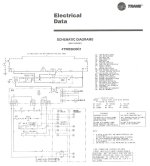
I found it strange that the schematic for this unit has no low-press cutout switch whereas all other 6 units in this series do. I also cannot find the coils for contacts K1/K2.

I cannot find a refrigerant circuit diagram for this unit.

Will be very curious to see what happens when the TXV is replaced.
 

Attachments

  • Trane Heat Pump 001.jpg
    Trane Heat Pump 001.jpg
    99.7 KB · Views: 8
To avoid these ads, REGISTER NOW!
OP
S

sourdough

Well-known member
Joined
Dec 3, 2012
Messages
132
Location
Pe Ell, WA
Thanks, Tommy. Sounds as if you are quite familiar with these HP's.

If there is/are no liquid-line solenoid(s) present, adding a LPCO would only prevent admitting air/moisture if a leak was present on the suction/low side. It would be a good indicator of a system leak if the LPCO had CI/CO setpoints and the system was short-cycling on that control.
 

Full Throttle

Well-known member
Joined
Nov 8, 2011
Messages
285
you have a controls problem. the Y terminal powers the compressor contactor for both heating and cooling, the O terminal toggles the reversing valve from cool to heat. So if the compressor runs in heat it should run in cool.
 

Full Throttle

Well-known member
Joined
Nov 8, 2011
Messages
285
Thanks, Tommy. Sounds as if you are quite familiar with these HP's.

If there is/are no liquid-line solenoid(s) present, adding a LPCO would only prevent admitting air/moisture if a leak was present on the suction/low side. It would be a good indicator of a system leak if the LPCO had CI/CO setpoints and the system was short-cycling on that control.

this is a residential system, liquid line solenoids have never been used in residential and most commercial in the 17 yrs I have been in the trade, you are re-engineering the wheel.

the unit did not come with a low pressure switch cause its an XB model or builders grade, bottom of the line, built and sold as cheap as it can be, no bells and whistles, tassels or frizzies.

If the tech came out and diagnosed a bad txv, he must have seen it run thats just common sense. Where you there when the tech came? was anyone, did they see here it run?
 
OP
S

sourdough

Well-known member
Joined
Dec 3, 2012
Messages
132
Location
Pe Ell, WA
I think you should call a pro

IMO, LS6 Tommy answered the Q very well.

I'm old school, but in my day compressor discharge/suction service valves had 3 positions: backseat, open, and frontseat.

Backseat: system open for operation, not open to atmosphere.

Open: compressor and line open to atmosphere.

Frontseat: compressor isolated, system open to atmosphere.

Anyone of my age should understand how that works when replacing parts.

I'm not proficient enough about heat pump valving to comment further.
 
Last edited:

Full Throttle

Well-known member
Joined
Nov 8, 2011
Messages
285
It's called a king valve...and still used today.

your heat pump valves are open or closed, the gauge taps @ the valve are to access the line-set and evap section for service.

and my comment wasn't to you...I quoted another poster, unless you have a few screen names
 
OP
S

sourdough

Well-known member
Joined
Dec 3, 2012
Messages
132
Location
Pe Ell, WA
It's called a king valve...and still used today.

your heat pump valves are open or closed, the gauge taps @ the valve are to access the line-set and evap section for service.

and my comment wasn't to you...I quoted another poster, unless you have a few screen names

I realize that, sir. If one does not have a liquid line solenoid valve for pumpdown, then a king valve must be used to isolate. And unless I am totally mistaken, king valves have no gauge ports. At least in my day...

Didn't realize I upset anyone's day by butting in... until now.

Carry on...
 
Last edited:

joel63

Well-known member
Joined
Oct 9, 2012
Messages
1,909
Location
Central FL
I realize that, sir. And unless I am totally mistaken, king valves have no gauge ports. At least in my day... True

Didn't realize I upset anyone's day by "butting in"... until now.

Carry on...

Service valves (with 3 positions) and King valves are 2 different components.
 

Full Throttle

Well-known member
Joined
Nov 8, 2011
Messages
285
I realize that, sir. If one does not have a liquid line solenoid valve for pumpdown, then a king valve must be used to isolate. And unless I am totally mistaken, king valves have no gauge ports. At least in my day...

Didn't realize I upset anyone's day by butting in... until now.

Carry on...

you didnt upset my day...but you replied to something I said to another poster I wanted to make sure you understood it was not directed to you.

You are correct about King valves and gauge ports. If you will notice I specified a heatpump service valve, to clear up the when valve is shut the gauge port is open to lineset and evap. My reasoning for pointing this out is after it was described the other poster still did not understand.
 

LS6 Tommy

Well-known member
Joined
Dec 27, 2013
Messages
26,162
Location
Northern NJ
Thanks, Tommy. Sounds as if you are quite familiar with these HP's.

If there is/are no liquid-line solenoid(s) present, adding a LPCO would only prevent admitting air/moisture if a leak was present on the suction/low side. It would be a good indicator of a system leak if the LPCO had CI/CO setpoints and the system was short-cycling on that control.

Most LPCOs aren't there for anything other than loss of charge protection. They usually shut the compressor down at around 20 Psig. Since the system would have to be at 20 Psig or less for the LPCO to open, you would probably have a pretty good leak. Even though theoretically at 20 Psig the system pressure is above atmospheric pressure, so there shouldn't be any intrusion, an LPCO wouldn't necessarily prevent atmosphere intrusion, nor will a LLSV. LLSVs are used to prevent refrigerant migration in the off cycle. I wouldn't consider one to be a device to allow a pump down.


Tommy
 
Last edited:
OP
S

sourdough

Well-known member
Joined
Dec 3, 2012
Messages
132
Location
Pe Ell, WA
Talked to my SIL this afternoon. She said the tech was there this morning and replaced the TXV and the "governor". Huh?

That's a new one on me. Total bill for 2 trips (they are pretty rural), parts, and a routine servicing was about $485.

Anyhoo, the A/C is working, it's 93 today, and they are happy.
 

Full Throttle

Well-known member
Joined
Nov 8, 2011
Messages
285
governor???? I would have to inform you to have him call and speak to the service manager about the governor issue?/?
 
OP
S

sourdough

Well-known member
Joined
Dec 3, 2012
Messages
132
Location
Pe Ell, WA
governor???? I would have to inform you to have him call and speak to the service manager about the governor issue?/?

Well, that would be like pulling teeth with them.

I even asked if the term was "capacitor" but was assured it was not.

Their bucks, not mine. They have a 41' boat (new $350K) that is over 18 years old that has been sitting in a marina (since he had a few "minor" strokes) wherein they have been paying registration, moorage, power (bilge pump), bottom cleaning, and other fees for 3 years and he won't budge from his inflated asking price ($225K) to get it sold and be out from under it. Stubborn pride.

Go figure...
 
To avoid these ads, REGISTER NOW!
Top Bottom