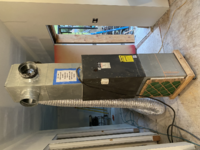
In our new home construction (Virginia and Maryland), we absolutely do not run the HVAC equipment until after 2nd coat paint has been applied. Even with filters applied at the return locations and a filter at the unit, it still craps up the ductwork, equipment, and can affect the heat exchanger. Our heating contractor voids the warranty if they discover their equipment has been started up and used before completion of 2nd coat. After 2nd coat paint, we apply filters to all of the return grilles and a filter at the unit; these get changed weekly as needed.
We use this type of large propane construction heaters. Typically two heaters per home are used.
When it comes to durability and effective propane heating, it's hard to beat the 200,000 BTU/hr "Hot Box." It's unique, efficient design forces the heat downward, keeping your work area warmer. The CH-250 is also the toughest heater in its class and is available with your choice of 10', 25', 50'...

flameengineering.com
We provide each home site with a large 425 lb(?) temporary propane tank with a two-way splitter off the tank. One line goes to a temp heater placed in the basement on the concrete slab. The other goes to a temp heater placed on the first deck; it is absolutely imperative that several sheets of drywall or durrock be placed between the the heater and wood subfloor to prevent catching the subfloor on fire.
We crack open windows in the basement (1-2"), and crack open windows on the 2nd floor (same 1-2").
The linked heaters have an adjustment lever so the flames can be turned down to a nice gentile heat. We run them unattended from late afternoon (when drywall crew leaves) till morning when they return. This keeps the home easily in the 50-60F range
These units generate a lot of moisture since all products of combustion are discharged to the room. This is way it is important that basement and 2nd floor windows are cracked open allowing an upward draft to be created. The air flow and not just the elevated temperatures is what dries the drywall mud. Do not open first floor windows (our houses are basement, first floor, second floor, and sometimes finished attic). We do the same on our 3 and 4 story townhouses except those you can typically get by with just one heater on the ground level.
Lastly, we install our attic blown in insulation the day after the drywall is hung and prior to finishing of the drywall. This reduces the heat loss thru the 2nd floor ceiling.
I don't like the kerosene torpedo heaters. They stink badly and the smell lingers. Most of the units you cannot turn down the flame so you bake the house which leads to cracked drywall mud as it cures way too fast. Lastly, many of those units have a tank which is seamed horizontally at the halfway point; I have seen too many leak at that joint spilling fuel and creating a hazard.
Good luck!


 ‘S
‘S