To avoid these ads, REGISTER NOW!

Heating a house under construction with kerosene torpedo

William Bertholf

New member
Joined
Dec 2, 2021
Messages
1
Location
Queensbury
I am considering using a 125,000 BTU kerosene fueled torpedo heater in the basement (concrete floors) of a new house under construction in order to heat the whole house which needs to be sheetrocked and taped and sealed in January of 2022. First floor is 1000 square feet and second floor is also 1000 square feet, a raised cape. Is it safe to run a torpedo heater all night in the basement unsupervised, with no one in the building, in order to keep temperature at 50 degrees F or higher when the sheet-rockers and mudders arrive in the morning? Will 125,000 BTU's be enough?
 
To avoid these ads, REGISTER NOW!

duneslider

Well-known member
Joined
Jan 20, 2013
Messages
2,272
Location
Riverton, Utah
H2O is a by product of heating with propane and Kerosene. It isn't ideal to add more moisture to the house, especially when you are trying to get drywall mud to dry. I would think that the heater in the basement would not heat the whole house very well.

Around here, the good builders rent a forced air heater that they use to heat the houses during drywall. Most builders run the furnace and the crappy builders don't do anything and make the drywall guys rent propane heaters to run while they work. I have felt running the furnace works fine as long as you swap the filters daily and turn it off during sanding and cover the return air vents with filters until the house is cleaned well. I have had good success with this method.
 

240sxguy

Well-known member
Joined
Jan 6, 2009
Messages
1,158
Location
Madison, wi
I wouldn't trust leaving a torpedo heater running. Also as mentioned above, that's going to add an enormous amount of humidity and carbon monoxide.
 

Walkers

Well-known member
Joined
May 17, 2021
Messages
3,912
Location
Cave Creek Az
If you are ready for sheet rock your HVAC should be in and ready for gas/power. I would just rig power and fuel to your new system rather than run a torpedo.
 

PoorUB

Well-known member
Joined
Mar 29, 2021
Messages
11,730
Location
Fargo, ND
If you are ready for sheet rock your HVAC should be in and ready for gas/power. I would just rig power and fuel to your new system rather than run a torpedo.
That is absolutely the last thing I would do!! Why fill your duct work and a new furnace full of drywall dust?!

Who is doing the heating? Perhaps they will rent or loan you a shop heater you can set on a temporary stand and run the venting out a window. We did this all the time when I worked for an HVAC company. If natural gas isn't available have a propane company set a temporary tank.
 

gmcgeo

Well-known member
Joined
Mar 11, 2019
Messages
3,701
If you are ready for sheet rock your HVAC should be in and ready for gas/power. I would just rig power and fuel to your new system rather than run a torpedo.
yeah bad idea, this is why when i ran the gas company i would not hook up the furnace untill the house was complete!
 

yeldogt

Well-known member
Joined
Jan 2, 2012
Messages
18,184
You should have the HVAC system in place ... make sure the proper filter are in place. You need proper heat .. My contractors normally have the system turned down in the morning ... minimize the air flow while working
 

Walkers

Well-known member
Joined
May 17, 2021
Messages
3,912
Location
Cave Creek Az
While there may be valid reasons for not wanting to run your new HVAC while under construction there are far more valid reasons for not running a torpedo, or portable heaters unattended, the biggest being burning it to the ground. It happens every year, multiple times, in every state.
Whichever method you decide on, make sure you read the instructions and heed them f they say not to run unattended. Also, make sure your insurance coverage is active for the new structure.
 

RivennHewn

Well-known member
Joined
Jun 4, 2011
Messages
10,387
Location
PNW
To do it right, you need an indirect heater. Usually diesel powered.
Don’t void the warranty on your new furnace by filling it with construction dust.
And don’t use propane or kerosene. They add more moisture.
 

PoorUB

Well-known member
Joined
Mar 29, 2021
Messages
11,730
Location
Fargo, ND
You should have the HVAC system in place ... make sure the proper filter are in place. You need proper heat .. My contractors normally have the system turned down in the morning ... minimize the air flow while working
The proper filter will not do ****! Mostly because nobody will change it. Also the drywall guys will not shut down the unit while sanding. You would not believe the mess drywall dust makes in a furnace. It pretty much destoys them.

We had a builder have us replace a brand new furnace because his guys ran it during construction. He wouldn't pay until we swapped it out. We took it back to the shop, tore it completely a part, washed it all out and put in one of his next homes!

Just don't do it!

One or two room remodel is a lot different from a whole new house, as for producing dust.

I would go out and buy a shop heater, use it during construction and sell it or throw it away before I ran the furnace I was intending to heat my house after I moved in.
 

nadogail

Well-known member
Joined
Jan 23, 2009
Messages
32,062
Location
Coronado, CA
As a teenager in Anchorage, middle 1950's, I remember construction sites wrapped in plastic sheeting and heated with Diesel burning forced air heaters. The heaters did not make the job sites warm but they were less frigid. Ventilation was not a problem, it was still drafty.
 

larry4406

Well-known member
Joined
Jan 27, 2006
Messages
19,644
Location
Northern Virginia
In our new home construction (Virginia and Maryland), we absolutely do not run the HVAC equipment until after 2nd coat paint has been applied. Even with filters applied at the return locations and a filter at the unit, it still craps up the ductwork, equipment, and can affect the heat exchanger. Our heating contractor voids the warranty if they discover their equipment has been started up and used before completion of 2nd coat. After 2nd coat paint, we apply filters to all of the return grilles and a filter at the unit; these get changed weekly as needed.

We use this type of large propane construction heaters. Typically two heaters per home are used.

We provide each home site with a large 425 lb(?) temporary propane tank with a two-way splitter off the tank. One line goes to a temp heater placed in the basement on the concrete slab. The other goes to a temp heater placed on the first deck; it is absolutely imperative that several sheets of drywall or durrock be placed between the the heater and wood subfloor to prevent catching the subfloor on fire.

We crack open windows in the basement (1-2"), and crack open windows on the 2nd floor (same 1-2").

The linked heaters have an adjustment lever so the flames can be turned down to a nice gentile heat. We run them unattended from late afternoon (when drywall crew leaves) till morning when they return. This keeps the home easily in the 50-60F range

These units generate a lot of moisture since all products of combustion are discharged to the room. This is way it is important that basement and 2nd floor windows are cracked open allowing an upward draft to be created. The air flow and not just the elevated temperatures is what dries the drywall mud. Do not open first floor windows (our houses are basement, first floor, second floor, and sometimes finished attic). We do the same on our 3 and 4 story townhouses except those you can typically get by with just one heater on the ground level.

Lastly, we install our attic blown in insulation the day after the drywall is hung and prior to finishing of the drywall. This reduces the heat loss thru the 2nd floor ceiling.

I don't like the kerosene torpedo heaters. They stink badly and the smell lingers. Most of the units you cannot turn down the flame so you bake the house which leads to cracked drywall mud as it cures way too fast. Lastly, many of those units have a tank which is seamed horizontally at the halfway point; I have seen too many leak at that joint spilling fuel and creating a hazard.

Good luck!
 

Uncle murph

Well-known member
Joined
Jan 28, 2021
Messages
1,484
Location
Harford county
I am considering using a 125,000 BTU kerosene fueled torpedo heater in the basement (concrete floors) of a new house under construction in order to heat the whole house which needs to be sheetrocked and taped and sealed in January of 2022. First floor is 1000 square feet and second floor is also 1000 square feet, a raised cape. Is it safe to run a torpedo heater all night in the basement unsupervised, with no one in the building, in order to keep temperature at 50 degrees F or higher when the sheet-rockers and mudders arrive in the morning? Will 125,000 BTU's be enough?
I personally would not leave a torpedo running unattended unless I was actually TRYING to burn the place down.
 

yeldogt

Well-known member
Joined
Jan 2, 2012
Messages
18,184
Understand the concern .... have the main return open and a modified filter system on it. That's my normal solution ... you also have to be on it.

My current project I was lucky as the drywall went up last winter and the radiant was in place ... floors don't make the dust as before. But all summer I had the AC running with the modified return in the basement crawl.

I don't have the house returns in place
 

Sumboodie

Well-known member
Joined
Mar 20, 2021
Messages
10,762
Location
AK
As a teenager in Anchorage, middle 1950's, I remember construction sites wrapped in plastic sheeting and heated with Diesel burning forced air heaters. The heaters did not make the job sites warm but they were less frigid. Ventilation was not a problem, it was still drafty.
Still do that now.
 
To avoid these ads, REGISTER NOW!

Steve_P

Well-known member
Joined
Sep 15, 2010
Messages
5,188
They did this in the house down the street from me, during the day, and when the builders came back later that afternoon, it was on fire. Yes, maybe they were idiots, but there's no way I'd leave a kerosene heater unattended.
 

larry4406

Well-known member
Joined
Jan 27, 2006
Messages
19,644
Location
Northern Virginia
1638556007339.png
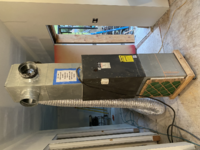
this seems like the right tool. seen them used by tent rental companies and construction firms for keeping sites warm. set it outside, flex duct it in.
With over 25 years in residential construction, I have never seen these used.

Every builder in my area uses the propane heaters I linked to. I had a 5 year stint doing commercial construction and I saw those drywall firms using external gas fired ducted units similar to what u3b3rg33k linked if not even larger.
 

gmcgeo

Well-known member
Joined
Mar 11, 2019
Messages
3,701
With over 25 years in residential construction, I have never seen these used.

Every builder in my area uses the propane heaters I linked to. I had a 5 year stint doing commercial construction and I saw those drywall firms using external gas fired ducted units similar to what u3b3rg33k linked if not even larger.
same, i have set sooooo many tanks in the winter for the external gas ducted units
 

Rusty Musket

Well-known member
Joined
Apr 5, 2012
Messages
434
Location
Pacific Northwest
While you might be able to adequately protect a simple forced-air HVAC system from sheetrock dust using lots of filters and cleaning the ducts out afterwards it is much more difficult to protect a complex system like the Mitsubishi units I am using that include both ceiling and floor-mount units. Getting sheetrock dust inside these units is not advisable. I borrowed a 60amp electric space heater from my HVAC contractor that can keep the jobsite warm enough through the winter to assist with drywall and paint curing as well as insure that the pipes don't freeze during construction.


tempImagebpxTHr.png
 

larry4406

Well-known member
Joined
Jan 27, 2006
Messages
19,644
Location
Northern Virginia
Most production new housing you don’t have permanent power or natural gas till way after the drywall is done. Thus the propane heat. Zero leverage on utilities so you find other ways to keep project going.
 

PoorUB

Well-known member
Joined
Mar 29, 2021
Messages
11,730
Location
Fargo, ND
Funny, every new house I ever installed HVAC the first thing installed was the main panel. There might be only one breaker feed a temp power outlet, but it was there ASAP.
 

u3b3rg33k

Well-known member
Joined
Dec 18, 2017
Messages
4,051
With over 25 years in residential construction, I have never seen these used.

Every builder in my area uses the propane heaters I linked to. I had a 5 year stint doing commercial construction and I saw those drywall firms using external gas fired ducted units similar to what u3b3rg33k linked if not even larger.
can't speak for residential, but when a contractor was doing a new duct bank/steam tunnel/water main (i forget what it was, maybe a few of them) for the local hospital in the middle of winter, they had a few of those and a 1000 gallon propane tank delivered to keep it all warm. I assume it was because those push fresh air down into the work area, so no one asphyxiates.
 

larry4406

Well-known member
Joined
Jan 27, 2006
Messages
19,644
Location
Northern Virginia
Funny, every new house I ever installed HVAC the first thing installed was the main panel. There might be only one breaker feed a temp power outlet, but it was there ASAP.
We do the same as soon as the structure is weather tight (roof on, house wrap on, windows in) we install the service and meter can and get it inspected. Then you wait for the mercy of the power company to run the service - sometimes 2-3 months later.
 

Juiced06GTO

Well-known member
Joined
Jun 1, 2014
Messages
356
Location
Sutton, MA
Look up Frostfighter Heaters, specifically an IDH250, then find a rental company that still has one. They are ducted 250k btu diesel fired, but indirect heat. Place it outside and duct the two outlets in, one on first floor one on second floor. They also make a 500k btu which is overkill for your house but may be more available and you can place a thermostat in the building and it will auto cycle the heater on and off. Make sure you have a dedicated 20A outlet for it and make sure she stays full of treated diesel and you'll be good to go!
 

bighouse01

Well-known member
Joined
May 21, 2009
Messages
293
Location
NY
I ran a torpedo in my remodel while I was there working. I was 25yo, tight money, sheetrocked and taped by myself. You gotta do what you gotta do. I only ran it while I was there. Not ideal, but it worked.
 

duneslider

Well-known member
Joined
Jan 20, 2013
Messages
2,272
Location
Riverton, Utah
Just because "we have been doing it this way for 30 years" doesn't mean it is the right way. Houses are getting tighter and tighter which means it is getting harder and harder to dry them out during the construction process. More and more problems are being created as a result of moisture and doing it like we have been doing it for 30 years.

Propane heaters put out at ton of moisture and don't help the drywall mud dry faster. Forced air of some sort really is the best way to go. We will start seeing more and more of them, even in residential construction. It will take an especially long time for production builders to get on board. The cost isn't really that bad to rent them for the short period they are needed.
 

sixty4

Well-known member
Joined
Dec 1, 2007
Messages
1,424
Location
CT

larry4406

Well-known member
Joined
Jan 27, 2006
Messages
19,644
Location
Northern Virginia
Appears OP has not returned since shortly after his first posting.

The alternate forced air units are nice - if you also have power which often is not there timely during new construction.

Not sure on the rental costs on the forced air machines. I am sure if they were cheaper then every builder would be using them.

We have not had issues with moisture from propane construction heaters in our new homes. We are energy star compliant and build very tight homes.

YMMV
 

ripperd

Well-known member
Joined
Jul 2, 2014
Messages
2,048
Location
Twin Cities, MN
So here in the cold north I am in a new development neighborhood so I watched probably 20 houses get constructed. Any of them constructed during the winter they had propane torpedo with a 250gal tank. I don't think they were any kind of forced air. They did have some kind of thermostat. You could hear them kicking on and off. Usually they had them aimed into the garage, with the garage temporarily sealed off with plastic. They were not particularly quiet. I talked to the construction rep and he was saying the overall cost adder to build one in the winter with breaking up the frost to dig the basement/footers and do all the temporary heating was nearly 10k on a ~550k home.
 

Juiced06GTO

Well-known member
Joined
Jun 1, 2014
Messages
356
Location
Sutton, MA
You can purchase the 500k btu indirect forced air heaters, either diesel or NG/LP burners for just over 6K, or rent them for the season for about 3k, about 1200 if you go month to month, thats up here in New England anyhow. You do need a dedicated 20A outlet for them, but the benefits are no fumes, longer run times, ability to thermostatically control them, and quiet inside the building. They really are pretty nice, we have lots of builders using them now, even on relatively small residential builds.
 
To avoid these ads, REGISTER NOW!
Top Bottom