To avoid these ads, REGISTER NOW!

Heating the floor or no?

4x4Pete

Well-known member
Joined
Aug 26, 2019
Messages
791
Location
Stroud
I had similar requirements when I built my shop. It is small though, 30x32x12.5. Well insulated and sealed, 2"xps under the slab, 6"+ slab thickness. I could have put any system in that I wanted as I was in the trade. I decided on a natural gas fired radiant tube. For what it cost to install and no worries about what I might decide to do in the shop in the future made the decision easy. I am considering getting a bigger lathe and mill so the option to bolt them down is important. I keep the temp at 65-68 all winter as I like to jump back onto a project when I have time. That could mean every evening or maybe once or twice a week. I also really don't like cold tools. A forced air gas heater will heat the space quickly, but not the tools in the tool box. Mini splits might be good but I'm lazy and hate dealing with dirty greasy evap coils and air filters, there'sa good chance maintenance would suffer. I figured keeping the place warm 24/7, having the option to drill wherever I wanted, and no need to deal with dirty air filters left me with only one choice. I'm completely pleased with the tube heat. Serviced once a year and there's been no issue in the past 6 years. Combustion air is ducted outside, which makes the unit really quiet. It does have the odd expansion creak when heating, but since it is on maintaining a steady temp it doesn't run all that much.
Everything has it's pros and cons, you have to decide what suits your needs (and possible future needs) best. Good luck with your decision.
 
To avoid these ads, REGISTER NOW!

nh_yota

Well-known member
Joined
Mar 10, 2015
Messages
4,076
Location
Seacoast New Hampshire
What do you mean when you say one bay will be used for storage? Are you talking about open storage or piling up a bunch of boxes? Radiant heat is useless if it's covered up with stuff.
 

ericm

Well-known member
Joined
Apr 17, 2016
Messages
1,963
Location
Southern Oregon
Good stuff. I'm reading all the replies and taking in as much as I can.

Solar is certainly something I've considered, but I never thought that would provide adequate power for a mini-split unit? I'm not nearly educated enough to even know the power demand of a mini-split yet, nevermind the Solar infrastructure required to power it. I do know my garage roofline is oriented East/West with the the largest roof area exposure sloping unobstructed towards the southwest facing the longest sun exposure. it's almost tropically warm in the summer, but I'm not sure if the cloud and rain that's typical from late Fall to early Spring would make solar take a lot more time to pay off!?

You can use the PVwatts tool from NREL to get an idea how much solar you can put on your roof and how much power it would make. Hopefully it has data for Canada.

The problem with solar is that you're using the most power for heat in the winter when there's the least sun. We have 1:1 net metering here so I can build up credits during the summer to offset my use in the winter. The exact nature of the metering you have will have a big effect on the payback time.


The payback calculators I have seen on line all assume 2-3% inflation for power prices. But here it's gone up 71% in the last five years. The more it goes up the shorter the payback period.

There are mini splits that will take power directly from solar cells and line power, and switch between them as needed. But I'd need a big array to power them in the winter. They'd be much more useful for cooling in summer.
 
OP
C

canuck1

Member
Joined
Sep 8, 2025
Messages
14
What do you mean when you say one bay will be used for storage? Are you talking about open storage or piling up a bunch of boxes? Radiant heat is useless if it's covered up with stuff.
That bay is primarily to replace the small garden shed we took down where the new garage is now planned. Typically lawn mower, garden tools & supplies as well as a few extra square feet to store our patio heaters and other furniture over winter. Most of the gardening supplies will be on open shelving against the walls, tools hung on pegboard hooks but wicker furniture, lawn mower and battery powered o_O snow blower will take up most of the open floor space in that bay. I don't think I need to heat it for comfort though, it's not a work space per se. It's separated from my workshop by a wall and a single door. That's why I was asking about turning down or off heat to certain zones. It's use might change though, so prepping for radiant floor heat seems pragmatic. You never know! I've roughed out the tubing plan into 2 zones; my workshop with my wife's parking bay (because they have no barrier between them) and the storage/garden bay which I'd prefer to set for minimum heat. I don't know if this is a realistic plan or not yet.

Sean
 
OP
C

canuck1

Member
Joined
Sep 8, 2025
Messages
14
The problem with solar is that you're using the most power for heat in the winter when there's the least sun. We have 1:1 net metering here so I can build up credits during the summer to offset my use in the winter.

Thanks for the interesting insight. We have the same 1:1 'self-generation' ratio as you've described. Unless your elevation is significantly higher than sea level, I'd bet our climate conditions are pretty close too. Are you able to supply enough power to the grid in summer to cover the cost of heating over winter?

Sean
 

ericm

Well-known member
Joined
Apr 17, 2016
Messages
1,963
Location
Southern Oregon
Thanks for the interesting insight. We have the same 1:1 'self-generation' ratio as you've described. Unless your elevation is significantly higher than sea level, I'd bet our climate conditions are pretty close too. Are you able to supply enough power to the grid in summer to cover the cost of heating over winter?


I'll be able to answer that in a year! We moved in and the solar was turned on last fall, just in time for winter.

So far the panels are not keeping up with what the PVwatts model says we should get. But we have some shading from a tree we'd like to keep, and we may have had more cloudy days than normal.

Since the house is basically new (we kept only the existing basement and apartment over the garage), sizing the solar was a guess. I had them put about as much as would reasonably fit on the house without too much shading. I'm hoping they'll offset 100% of the house use. If the house is really efficient they could offset some of the shop use too, but that seems unlikely at this point. I can put panels on the shop if I want more.
 

ipgenie

Well-known member
Joined
Jan 29, 2020
Messages
561
Location
Idaho
I put a DIY system on my shop roof. It's a 4/12 pitch so not ideal but has worked well enough for us. It also gave me a reason to extend the building so I'd have more roof space. Break even was right at 5 years with our 1:1 net metering.

We have moved most of our driving to electric with an EV and a plug in hybrid. 90% of our heating is electric, even the floor heat is mostly done with electric resistance heat and if needed a propane boiler will supliment it. We added some mini splits and besides the heat we now enjoy some AC during the hotter months. The floor heat keeps the tile comfortable. I considered the direct to solar minis, but the math didn't work for us. It's better to export the excess solar and then buy it back as needed. The upfront cost of the solar minis was a lot more than the Senville and Pioneer units, especially when doing the install yourself.

So far we have covered our electric use year round with solar. You might be able to also sign up for time of use rates which credits you at a higher rate during peak times. Our peak times used to be during daylight hours so that was in our favor. Last year those times changed. We don't produce a lot of electricity during the winter due to weather and snow cover on the panels. A steeper roof would help.

I'm using resistance heat in the shop this year, but am working on putting a mini split out there so the consumption to heat it will be less next year. I have never needed AC in the shop. It usually stays in the 70s all summer.
 

NitroGarage

Well-known member
Joined
Mar 2, 2016
Messages
203
Location
Cleveland, OH
Insulate the slab like your going with radiant, set in the pex loops.
Make your mind up later. (after your disappointment with conventional thinking)
The insulated slab will benefit any type of heating and dropping in the pex is pennies in the overall budget. 👍
This 1000% and I give almost everyone this same advice. The tubing is the least expensive thing you will buy when it comes to the floor, maybe the vapor barrier plastic, but other than that there's no reason not to. You can't put it in after the pour unless you pour it again, so it's literally at the top of the list when it comes to "while you're in there you might as well" new construction options IMHO.
 

Jackfre

Well-known member
Joined
Dec 26, 2010
Messages
4,408
Location
N CA
Not to confuse the issue but if you are going to do the rough-in for the loops you might look at a loop for snow melt on the apron on the driveway. The system gets a bit more complicated, but it is nice when you open the door and there is a bit of pavement.
 
Last edited:
  • Like
Reactions: T45
OP
C

canuck1

Member
Joined
Sep 8, 2025
Messages
14
I will thank everyone for the solar advice. I'm very interested in how it would work but right now I'm really focussing on the details of utilities and forms as well as gravel base, radiant tubing and insulation.

I've read a ton of threads here on the yes/no argument about insulation under the entire slab vs additional concrete under the lift columns instead. I'm planning to consult a structural engineer but I can also see examples of others who've done it both ways. Anybody got the credentials to settle this debate? :unsure:

Sean
 
To avoid these ads, REGISTER NOW!

ericm

Well-known member
Joined
Apr 17, 2016
Messages
1,963
Location
Southern Oregon
I will thank everyone for the solar advice. I'm very interested in how it would work but right now I'm really focussing on the details of utilities and forms as well as gravel base, radiant tubing and insulation.

I've read a ton of threads here on the yes/no argument about insulation under the entire slab vs additional concrete under the lift columns instead. I'm planning to consult a structural engineer but I can also see examples of others who've done it both ways. Anybody got the credentials to settle this debate? :unsure:

Sean

You can use loadcalc.net or similar to model the building's heat requirements with and without slab insulation.
 

The Metric System

Well-known member
Joined
Apr 28, 2025
Messages
268
How about both? I have heated floors in my shop (propane boiler) and keep it at 12 deg C all winter. If I'm out there working for a while or painting, etc. that needs higher temp, I have a 5000W electrical heater that will bump the temp a few degrees in less than an hour.
This is the best setup IMO.

Use the in-floor heat to maintain the base load and keep the space from going to ambient, then have a forced-air system to provide rapid heating as needed.

If you use a minisplit as the forced-air option you get AC and humidity control as part of the bargain. A lot of people who say they don't need/want these functions still end up using them once they are available.
 

The Metric System

Well-known member
Joined
Apr 28, 2025
Messages
268
I've read a ton of threads here on the yes/no argument about insulation under the entire slab vs additional concrete under the lift columns instead.
We did both, it wasn't too hard.

The entire slab is insulated with 2" rigid board, in our predetermined lift pier locations we built a deeper foam box to provide additional concrete thickness.
 

theoldwizard1

Well-known member
Joined
Feb 22, 2011
Messages
43,126
Location
SE MI
What I'm wondering about is whether or not hydronic in-floor heat is the best solution for someone like me who is not retired (yet) and only gets into the garage after work or weekends. Wouldn't it make more sense to simply have an efficient space heating option that gave me heat quickly, when I needed it?
In floor heat is the MOST CONFORTABEL form of heat ! If your feet are warm, you are warm.

A couple of negatives
  • expensive to install
  • slow recovery (if you turn it off completely and the concrete drops to the temperature of the ground beneath, it will take hours to get back to a comfortable temperature)
 
OP
C

canuck1

Member
Joined
Sep 8, 2025
Messages
14
We did both, it wasn't too hard.

The entire slab is insulated with 2" rigid board, in our predetermined lift pier locations we built a deeper foam box to provide additional concrete thickness.
So you just cut the foam out around the perimeter of where the lift column bases would sit and allowed the slab depth there to extend down to bear on the compacted gravel base? How much of an area did you go beyond the column base perimeter? That's one idea I'm exploring right now. My bases are 20" x 14" so I'm thinking about cutting an opening in the insulating foam of 36" x 24". No foam or PEX, only mesh and rebar in the footing under the columns (extending out into the surrounding slab). That way if we pour level to 5" thick everywhere else, it will be 7" thick in that void in the foam under where the columns will sit? It takes me a while. I don't think in 3-dimensions very well!

Sean
 

MN_Electrican

Member
Joined
Sep 9, 2025
Messages
5
Location
Central MN
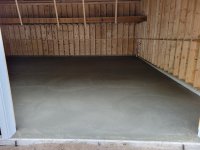
from what i can remember it was 2" thick foam board under the slab with poly. i cant remember what mil. 2" foam on the exterior foundation down to the footings. they cut the side foam at a 45* angle at the top but its hard to tell in that picture. i cant remember how much deeper they went under the lift post areas. manufacture recommended at least 6"? I also have a mezzanine in the front which you can see for extra storage, theres 2 holes cut out of the foam for the support beams that came later.
 

Sumboodie

Well-known member
Joined
Mar 20, 2021
Messages
10,669
Location
AK
I had similar requirements when I built my shop. It is small though, 30x32x12.5. Well insulated and sealed, 2"xps under the slab, 6"+ slab thickness. I could have put any system in that I wanted as I was in the trade. I decided on a natural gas fired radiant tube. For what it cost to install and no worries about what I might decide to do in the shop in the future made the decision easy. I am considering getting a bigger lathe and mill so the option to bolt them down is important. I keep the temp at 65-68 all winter as I like to jump back onto a project when I have time. That could mean every evening or maybe once or twice a week. I also really don't like cold tools. A forced air gas heater will heat the space quickly, but not the tools in the tool box. Mini splits might be good but I'm lazy and hate dealing with dirty greasy evap coils and air filters, there'sa good chance maintenance would suffer. I figured keeping the place warm 24/7, having the option to drill wherever I wanted, and no need to deal with dirty air filters left me with only one choice. I'm completely pleased with the tube heat. Serviced once a year and there's been no issue in the past 6 years. Combustion air is ducted outside, which makes the unit really quiet. It does have the odd expansion creak when heating, but since it is on maintaining a steady temp it doesn't run all that much.
Everything has it's pros and cons, you have to decide what suits your needs (and possible future needs) best. Good luck with your decision.
Don't think I've ever seen a mill or lathe bolted to the floor.
 

Sumboodie

Well-known member
Joined
Mar 20, 2021
Messages
10,669
Location
AK
In floor heat is the MOST CONFORTABEL form of heat ! If your feet are warm, you are warm.

A couple of negatives
  • expensive to install
  • slow recovery (if you turn it off completely and the concrete drops to the temperature of the ground beneath, it will take hours to get back to a comfortable temperature)
Ideally have an air heater for quick recovery. I'm planning to put a Hot Dawg or whatever for use in fall and spring or to boost temps when the door is open too long.
 

MN_Electrican

Member
Joined
Sep 9, 2025
Messages
5
Location
Central MN
This is exactly the kind of feedback I was hoping for. Thanks to all who posted their experience (including ballpark $$). I'm installing a BendPak 10APX 2-post lift, so placement of everything around where the lift will go (in all 3 dimensions) is critical. I agree that it makes sense to install the pex, then figure out what heating options cost (gas boiler or air-water heat pump), then decide whether it's worth it. I'll continue construction process as if I'm installing hydronic floor heat (including pex and manifold so it's possible to pressure test with air before pouring concrete. The heating method decision can wait.

I'm in the aggregate business, so there will be plenty of well-compacted gravel installed before the vapor barrier and 2" WPS insulation is installed. The plan is for the slab to be insulated around the edges as well. I'm having trouble visualizing what that looks like from the outside, so share pics if you've got them. I'd hate it if I had to stare at the brightly colored insulation if it's visible!

There's no wall between my workshop and where my wife's car will park. This is all part of my evil master plan to banish her car to the elements when I need the extra working space :devilish: Is it possible to keep different areas of the same slab at different temps? I don't know if it's worthwhile to leave some floor areas set at a minimum temp while my workshop is warmer? The total square footage of the slab is just under 1300 sq. ft. Maybe it's simpler/more efficient to just leave it all the same temp?

Sean
a used to work at a landscaping supply store that did decorative ironwork so there was a welding area separate from the retail space. the gal that worked in the office which was located in the NW corner of the building would get cold in the winter, it had a couple windows and naturally colder due to the "normal" direction of the wind in the winter. we heated the whole place with an outdoor wood boiler. hot water came into the building at around 180* and would go to the mixing manifold and send water out into each tubing loop zone in the floor. I think there was close to a dozen in that building and IIRC it was around 100* outgoing to keep the building at 70*. her office zone was mixed a little hotter to compensate for her likes/ heat loss difference
 
To avoid these ads, REGISTER NOW!
Top Bottom