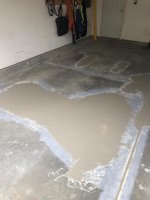
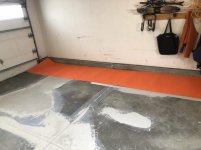
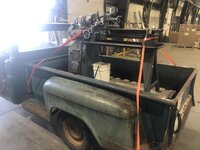
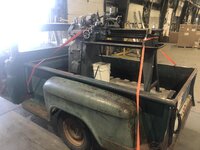
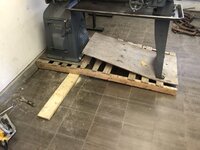
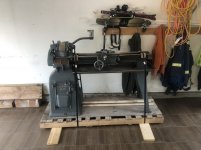
I finally finished the South side of the garage with epoxy grout, which thus (finally) enabled me to offload the heavy 10 lathe which has been sitting in the back of my ‘62.
This was a job I had put some thinking behind. I used 700 lbs for shipping but I suspect this may have ignored the weight of the cast iron base. If anyone knows the weight of a South Bend Heavy 10 with cast iron pedestal please let me know!
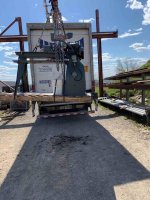
When I loaded this at the shipping depot I first had them load with the headstock at the back of the truck hoping to keep the heavy side more accessible for offloading. As many of you will guess - this bottomed out the suspension on my 62. I had the offload, spin 180, and load again with the headstock up by the cab. This did a much better job of distributing the load of the front and rear axles. My father-in-law tells stories of loading 2000 lb bulls into these half-tons with side rails, so I figured I was well within the capacity of the truck. My journey, mind you, had me driving through a city at highway speeds vs back roads and rural highways. Anyway the truck did its job perfectly, and I hardly even noticed the load.


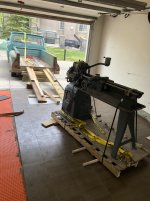
I had thought about several options to offload, but decided that ramps and rollers was the easiest in terms of equipment, running around sourcing things, and cost. I needed to buy some 3” angle and 2x10’s but these will be used for future projects so there isnt any regret cost. I also bought some 1-1/2” birch dowels. More on this later.
For those that are curious the pressure treated 2x10’s were $40 CAD each...ouch! [emoji30]
I did manage to scoop some free dunnage from the lumber shop which helped me block up my ramps.
I backed into my garage apron which resulted in 18” drop over 8’ which is about 11 degrees.

I removed my tailgate and blocked up the ramps to arrest the suspension drop. I thought about jacking up the front of the truck and deflating tires onto axle stands but everything looked ok in terms of bed slope (slightly to rear) and stability.
i used a pry-bar to lift the rear of the pallet and then pry up the headstock end to het my dowels places under the skid.
I wrapped the bed and pedestal with slings and used a 3,500 lb ratchet strap over the cab and under the truck to the frame. I was concerned with a “runaway” but also knew that at my ramp angle the tension here was approx 20% of the weight (so say 200 lbs).
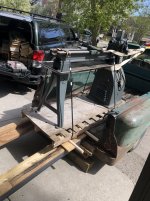
The lathe rolled down the bed of the truck beautifully despite my old, cracked, twisted, and rotten (original) pine deck boards.
One I dropped off the bed onto the ramp on the headstock I stalled out a bit. As I mentioned I chose birch dowels instead of steel. I did this because I was wanted to avoid chipping my tile with a drop or rolling over a leading edge with and lippage. Maybe this speaks to a weakness of tile floor, but in fairness I didnt put it to the test - and most likely I would not have had an issue.
Anyway as you will see my ramp didnt have any support in the middle and as the headstock rolled over onto the ramp I believe the dowels had some weight from the center 2x4 on the pallet that caused them to deflect...which halted my gravity powered motive force.
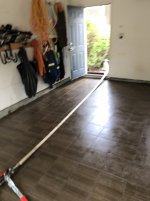
I had planned for this and rigged up a sling over some HSS square tubing that I placed across my man-door along with a come along. Now this is something that I was very careful with and really on tensioned up to “help” but primarily used my crowbar from the rear to get past this sticking point. When it moved, it MOVED and my safety strap did its job. From that point forward I would move in 6” increments and just push the lathe to get it rolling and then slow it down as it reached the end of my safety strap.
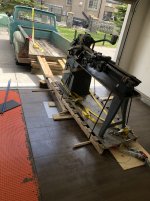
And then let the kids have some fun while I cleaned up.

Its nice to have the lathe in the garage and now I am getting started on the North end of the garage.
Sent from my iPhone using Garage Journal