An answer for Hiball
Repairing and restoring old equipment can be expensive indeed. That does not stop people from restoring old cars, old planes, boats. It all depends on the amount of money and time the person is willing to expend, or invest, in doing so. If the equipment is worth restoring, the person might be willing to do it and expend more money than he would fixing average equipment. If the equipment is nothing special, then the person might just forget about it.
I did mention on the post that having an u-cup made to a particular size could be expensive. Even if he is not changing the size of the u-cup, it is possible to change the material from leather to urethane if he does not find a suitable replacement in leather. And this alternative should not cost an arm and a leg.
I do not recommend removing metal from the cylinder as cylinder walls are thin enough already. For this same reason I do not recommend inserting a liner either as this requires boring the cylinder. If the inside diameter is increased (or reduced) by removing (adding) metal, then other parts will have to be modified to maintain the tolerances set by the manufacturer. This can be expensive if the person does not own a lathe, for example, to do this work himself.
The cyanoacrilates or super glues have been around for many years. Eastman Kodak was the first to sell cyanoacrylates in 1958. Nowadays there are many companies selling different grades of super glues for different applications, so this is a proven technology. Super glues are not just the basic glues, like Crazy Glue, sold at drugstores, there are many high quality formulas been sold but they can be expensive in relation to the amount sold per package. Certainly these high quality instant glues are more expensive than epoxies per ounce. And you can use super glues to make laminates by using tissue paper which is perfect for small repairs, or building up parts, in most types of plastic (not all) components.
So how long will these super glues last adhered to the cylinder surface depends first, on the quality of the glue used and second, on how well the surface was prepared. A sloppy surface preparation produces sloppy results like everyhing else that is not done right. Cyanoacrilates are acrylic resins that set hard so it all depends on how long acrylics in general last, on how long it takes for them to decay or degrade naturally. I certainly believe that done right, the super glue could stick indefenitely to the cylinder wall.
About a year and a half ago I myself used a super glue to fill some pits, caused by rust, in a rear drum brake cylinder. Certainly, brakes see more intense use per day than what a jack used occasionally sees. So I did this just to check the longevity of such a repair. I check the condition of this cylinder about every three months and to this date it has performed as good as a new cylinder with no leakage whatsoever and no peeling of the filler super glue. And remember that brakes get hot and that brake fluid is a more "aggresive" liquid than hydraulic oil so the glue repair is being tested in harsher conditions than what you get in a jack.
As for the extension of the damage in the jack's cylinder, the super glue will cover it with no problem because of its superior adhesive qualities and because it behaves like a hard plastic or acrylic, not as a soft filler like many epoxies would. The super glue will retain the hard shape it gets after sanding. Also, super glues are easier to sand than epoxies and the edges feather nicely, unlike epoxies, so the transition from metal to super glue is seamless. From the point of view of the u-cup, it would feel the same sliding over steel as sliding over super glue. So the size of the damaged area does not affect the performance of the super glues.
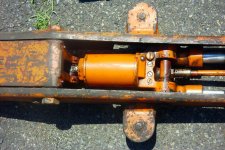
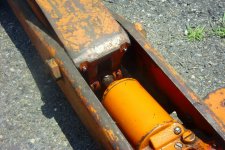
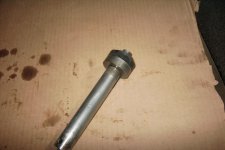
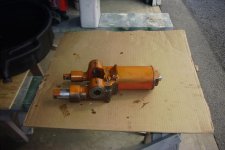
I have repaired damages as extensive as the one shown on the pictures and they are still working perfectly. But the sanding procedure has to be done right, with fine grit paper taped around a round tube or pipe, as I mentioned on a previous post, and not with car engine hones with the usual 220 grit stones.
Epoxies are usually somewhat soft and flexible and for that reason they are harder to sand. And, if thickened epoxies are used instead of liquid epoxies, these thicked epoxies are somewhat porous because of the filler materials used to thicken them. This porosity makes them less suitable for this repair application. I do know of some epoxies that are really hard and not flexible at all, like "MARINE TEX," that are used for marine applications, like boat repairs but if you were not using that type of epoxy you were not going to have good results. The only problem is that these high strenght epoxies are still harder to sand than super glues although they should produce a surface finnish close to that of the super glues if sanded correctly.
I have used epoxies a lot but for this particular type of repair I do not recommend them. Also, if the epoxy has ammonia in its formulation, as many of them do, the metal under the epoxy might rust as ammonia is highly corrosive to bare steel. If the metal under the epoxie rusts, the epoxy filler will fall off.
Do I recommend this alternative super glue repair for every jack? Certainly not, I would only recommend this if the jack is worth saving for some special reason. I would not waste my time doing this to a cheap china made jack.
The best alternative to repair this jack would be to find a used cylinder in good condition. If he is not able to find a replacement cylinder, I am suggesting him a relatively cheap alternative to repair the pitted cylinder, a repair that I believe can last a long time. It is up to him to decide if he is willing to try it or not.
Since this jack belonged to his grandfather, he may be more inclined to fix it due to sentimental issues more than the actual monetary value of the jack. He can always throw it away or give it to someone else interested in repairing it if he decides not to fix it.