Wow, thanks for all the great info guys -- much, much appreciated.

In regards to some of the items, see below:
1. See pictures below. Panel is recessed. It's the main panel -- no sub-panels exist. Power feeds through outside garage wall (brick) to inside wall (sheetrock) where panel is located. Panel and circuit manufacturer is Square D. Service is 200 amps. And I have 5 free slots open for new circuits.
That's all good, except maybe the part about having only five open branch breaker slots available. That's not a whole lot for a "generously" equipped garage. If you figure two circuits for your general-purpose 120V outlets, and two more for your lighting, you no longer have room for even one dual-pole 240V breaker for a compressor, or a welder, or whatever.
2. Not sure if you can tell in the pictures above, but I have 3 circuits labeled "garage recepts" -- 17, 19 & 25. Given the limited number of receptacles, I'm certain they are shared to some degree but I haven't did a test to know specifics. If by some small miracle, they are truly garage receptacles only I was thinking maybe I could just use these existing circuits and divide the loads out appropriately between the 3 circuits. Does that sound reasonable?
I strongly suggest that you put some serious effort into tracing out those circuits and identifying ALL the loads on them. For that matter, it would be a good idea to do this for ALL the branch circuits, on general principles: Make up a "cheat sheet" using your word processor or spreadsheet program, unambiguously identifying and listing EVERY individual load on every breaker, then print it out and tape it to the inside of the panel door. You'll thank yourself 1,000 times over in the future.
Anyway, getting back to the topic at hand, depending on exactly what you find, you MAY be able to "free up" at least one or two of those existing breakers so that they can indeed be dedicated to the garage; and that in turn might make all the difference in terms of having "enough" circuits, and thus being able to avoid the need for a sub-panel.
Note that this MAY involve re-assigning some of the loads among the various existing breakers (especially if you currently "share" one or more breakers between house loads and garage loads). The specifics of this can get complicated in a hurry, and are completely dependent on just what the existing situation REALLY is; so I won't go into much more detail here, save to say that there IS a "right way" and a "wrong way" to do this (which means, firstly, NEVER "double up" multiple branch circuit wires on a single breaker).
OTOH, it MIGHT be simpler/easier to just go ahead and install a sub-panel, and be done with it.
3. Love the linked switches! I definitely will be going with something like that. It keeps it to a single gang which I prefer. Have you actually used them?
I started out with X-10 many years ago, but got frustrated with the **** quality control and general lack of reliability. I'm just now transitioning to Insteon, in both houses (the Shore house will likely get done first, as I am in the midst of re-doing it post-Sandy).
Any special quirks or wiring secrets?
Not really. It's designed for easy retrofitting; so all "conventional" wiring techniques are still appropriate. That said, if you KNOW going in that you're going to be using Insteon, the wiring can actually become simpler, particularly as compared to conventional "3-way" and "4-way" switching setups.
If you want 4 lighting "zones", how would you go about wiring?
Any light (or group of lights) that you want to INDIVIDUALLY control requires a load controller, such as the aforementioned wall switch or keypad OR a hardwired control module such as:
http://www.smarthome.com/2475SDB/In...ontrol-In-Line-On-Off-Switch-Dual-Band/p.aspx
which can be hidden away out of sight.
CONTROL modules (such as, again, that wall switch or keypad) can be placed anywhere, and need only a simple two-wire (plus ground, of course) connection to the main electrical system. They do not NECESSARILY need to also be connected directly to a load (tho' of course they can be, if also being used as load controllers, which is often the case).
Once everything is wired up, you create "virtual links" between the various devices via a series of one-time button-press sequences. Once that is done, these "links" are stored in non-volatile memory, and do not need to be repeated (unless you want to change something, of course). These "links" can be both "overlapping" and "redundant" to some degree, as desired; hence you can establish various "scenes", each of which get activated with a single button-press.
4. I've seen the Liftmaster 8500's and really like the idea of them. Currently I have a Liftmaster 3850 belt drive on the 2 car bay and don't really like it. To me, it sounds like it struggles to get the door up/down.
That shouldn't be. IIRC, the Liftmaster 3850 is rated at 3/4 HP, which should be more than enough for even the largest/heaviest residential garage door. I would strongly suggest that you check the balance on your door, to ensure that the counterbalance springs are really doing their job. The GDO itself really should NOT have all that much load on it.
5. I'm okay with minor sheetrock repair/patchwork. I just wanted to be clear my garage wasn't studs only and I didn't want to redo a ton of work if it could be avoided. If things become unreasonable, I am open to exposed conduit, but only as a last resort.
That really shouldn't be necessary; and I, for one, generally dislike the look of exposed conduit, surface-mount switch/outlet boxes, etc., in residential garages. Beyond its propensity to be a world-class dust-catcher, it will near-certainly wind up being "in the way" of something you want to do later, such as mounting wall cabinets or shelving.
6. I can start a new thread for lighting discussion, but am curious your thoughts on a better light configuration. Is it based on install ease, better lighting, etc?
Primarily the latter. As you have it set up in your sketch, most of the light is in exactly the WRONG places -- i.e., directly over the vehicles. Just how often do you need to brightly illuminate the roofs of your cars, as opposed to the areas where you will REALLY be working (which are nearly always around the perimeter of the vehicles)?
You don't want to use either of those, or anything like them.
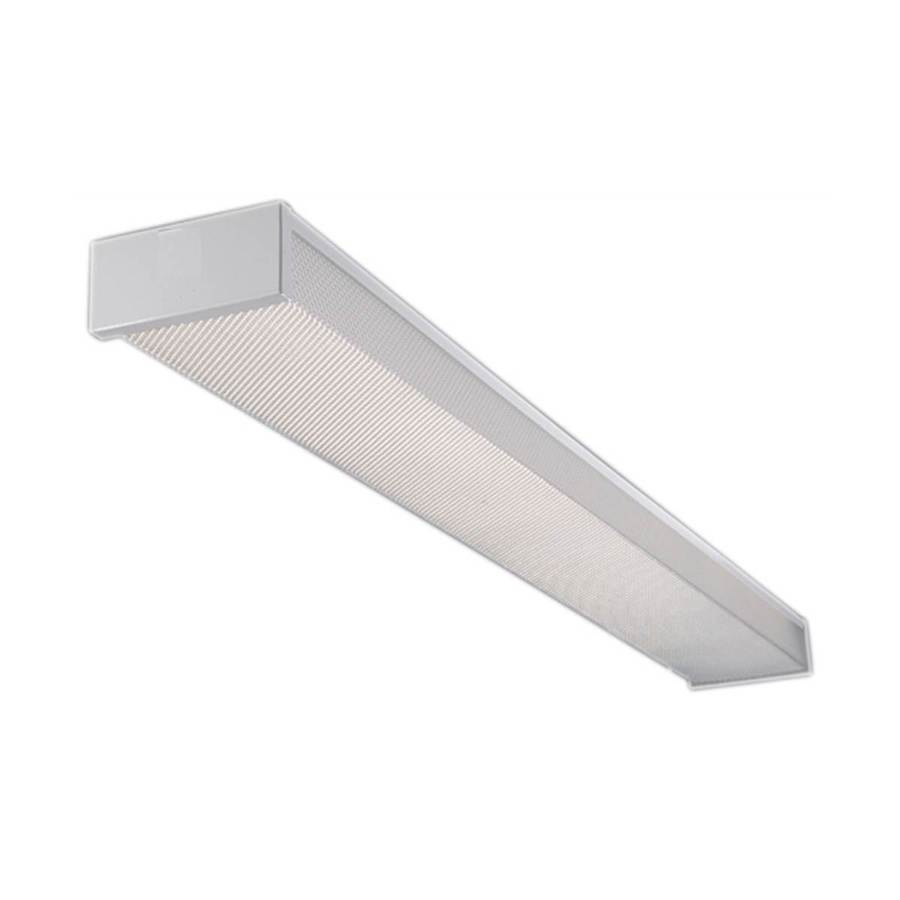
Assuming this is a conventional residential garage, your ceiling height is presumably no more than 9-10 feet. Given that, the reflectors on those H.D. "shop lights" are actually counterproductive, as they will effectively restrict the distribution of the light out to the sides of each fixture, causing you to need still more fixtures (each spaced more closely to the next one) in order to avoid spotty uneven lighting. Also, odds are that fixture is NOT rated for direct surface contact, due to heat-disspation issues; hence, they would NEED to be suspended via the supplied chains -- which further exacerbates the light-distribution problem, by lowering the effective mounting height. And finally, you do NOT want to use ANY "plug-in" shop light anyway, because this would require the use of GFCI outlets, which both raises costs AND can create problems (GFCIs and fluorescent loads sometimes don't mix very well).
The 8-foot "tandem" fixtures from Lowe's are SOMEWHAT less problematic, but still far from ideal. You're not really saving any money (as shown previously, suitable twin-tube fixtures can be had for little more than half what these things cost; so you can afford to use twice as many of them). But you ARE giving up quite a bit of flexibility in terms of both fixture placement and switching. In a sense, it's an answer to a question that doesn't need asking. The ONLY thing it has going for it is slightly easier installation, due to needing only half as many electrical connections. But it would be silly and short-sighted to let that tail wag the dog, as it were.
Use twin-tube four-foot fixtures similar to what I cited earlier, and be done with it.
[The BBS software is nattering at me that the message is too long. So I'm breaking it here. Continued in next message...]