To avoid these ads, REGISTER NOW!

Help me with my knurling...

Stick

Well-known member
Joined
Dec 12, 2007
Messages
2,302
Location
Alaska
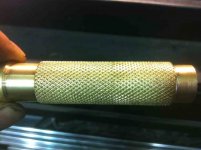
Playing around with the lathe at work today making some tools and I tried to knurl a handle I was putting together.
ImageUploadedByTapatalk1362174678.399934.jpg

I've got deep knurling going one way, and really shallow knurls going the other direction. Is this just a simple problem with tool height, or is there something else that's going on?
 
To avoid these ads, REGISTER NOW!

Regnar

Well-known member
Joined
Oct 9, 2010
Messages
461
What kind of knurler did you use? If it was a fixed style with 2 rollers you either have the wrong height or 2 different rollers installed.
 
OP
S

Stick

Well-known member
Joined
Dec 12, 2007
Messages
2,302
Location
Alaska
Fixed style knurler, both rollers have the same number of teeth. I tried to eyeball height as best as I could. Is there a good way to check the tool height in relation to the workpiece so I don't make the same mistake next time? All of the tooling is on Alora BXA toolholders so height adjustments should be easy to take care of.
 

zkling

Well-known member
Joined
Jan 23, 2007
Messages
16,939
As Regnar said, your tool height is not on center with the lathe, causing more pressure to be put on one roller than the other. That is giving you the nonuniform pattern in different directions.

A real quick way to check tool height is to put a center in the tail stock, bring it close to the cutting tool holder. Loosen the top handle on the tool post so it will swing and use the pointed end of the center to set height. Now this is assuming the lathe is tuned and the tail stock is inline with the spindle.

What type of lathe are you using?

Here is a good little write up on knurling.

http://www.proshoppublishing.com/articles_knurling.html

Also diameter of the work can play a part into knurling, as mentioned in the above article. May want to check that, but it really looks like your problem is not being on center.
 
Last edited:

rlitman

Well-known member
Joined
Oct 18, 2010
Messages
24,600
Location
Long Island
Yep, it sounds like a height issue.

With the lathe off, release the tool in the BXA and loosen the height adjustment nut to lower the knurler until it is below center. Hold the knurler up with your fingers and move the cross slide in until it makes firm contact with the workpiece on both rollers. Then turn the lever and lock it in place. Now you can adjust the nut so it is returned to that height the next time.

If that doesn't work out well, take into consideration how it deflects under force. The knurler will tip back under force, which will increase the impression of the lower wheel, and reduce the impression of the upper wheel. So, if you start with it centered, you may have to drop it a few thousandths of an inch to get it just right, but if you make the adjustment under pressure like I described above, you should have it so that when it deflects under force, it moves towards being centered.

Finally, always knurl with oil. Never knurl dry.

Anyway, it looks like you're off to a good start.
 
Last edited:

Regnar

Well-known member
Joined
Oct 9, 2010
Messages
461
Yep, it sounds like a height issue.

With the lathe off, release the tool in the BXA and loosen the height adjustment nut to lower the knurler until it is below center. Hold the knurler up with your fingers and move the cross slide in until it makes firm contact with the workpiece on both rollers. Then turn the lever and lock it in place. Now you can adjust the nut so it is returned to that height the next time.

This is the way I use to do it when I used a fixed knurler. Now I use sissor type and well lets just say set up is much easier and you can knurl longer pieces. With a fixed you will notice at the extreme ends it will be deeper while the middle is barely deformed. I really loved it when I was making 50 Hawaiian Slings out of 5/8 aluminum rod. All the knurling turned out beautiful.
 

Regnar

Well-known member
Joined
Oct 9, 2010
Messages
461
I also forgot to mention. Do your first spin by hand. If it looks uneven it will still look uneven under power and more pressure. Your off to a great start. Most have a hard time getting the knurler to follow it own path and it usually looks like a mess.
 

bullnerd

Well-known member
Joined
Sep 17, 2012
Messages
5,690
Location
Jersey
I just do the finger/hieght adjustment also."Feel" the two wheels when touching the work,if they feel centered,good enough.

Isn't thier numbers stamped on the sides of the wheels that specify a feed per revolution to get the timing right?

Also, dont remove the tool or disengage the feed once you get it, just reverse the spindle.

I liked to use Anchor lube,good for high pressure stuff.

Yeah that proshop article is good.I forgot about the pitch thing.Been too long.
 
Last edited:

Cedge

Well-known member
Joined
Dec 9, 2012
Messages
205
Location
Greenville SC
The knurling tool was not square to the work piece. What you achieved by accident is called a spiral knurl and is done by stetting the knurl at an angle to the work, so only a corner of a wheel makes contact. Beautiful results, had you been shooting for the results you got...LOL

I too suspect the tool was not at the proper height, putting only one wheel into play.
 

justanengineer

Well-known member
Joined
Apr 5, 2011
Messages
7,722
Location
Motor City
As others have suggested, tool height is the issue. Unlike them however, I simply advance the crossfeed in a few thou at a time paying attention to when the wheels begin spinning as they touch the work...they should begin at EXACTLY the same time. Adjust the height accordingly.

Ive always read and usually keep ~5-10 degree angle from having the knurling wheels parallel to the workpiece. It is a forming operation, not cutting after all. Use plenty of your favorite cutting fluid, and if you notice any difference in the knurling depth in the part's center vs ends (meaning deflection instead of forming) its time to pull out the follower rest.
 

rlitman

Well-known member
Joined
Oct 18, 2010
Messages
24,600
Location
Long Island
As others have suggested, tool height is the issue. Unlike them however, I simply advance the crossfeed in a few thou at a time paying attention to when the wheels begin spinning as they touch the work...they should begin at EXACTLY the same time. Adjust the height accordingly.

That is a really good point. Yes, you have to actually keep an eye on the wheels.

Honestly, my favorite knurkers have both wheels mounted on a pivoting device that automatically keeps them centered. That way, alignment is not critical.

Every one I've seen like this is made for a lantern toolpost though. All of the knurlers made to know on an Aloris are fixed. You could probably leave the toolpost unlocked and just let the knurler float in height. It should stay in place under pressure.

Regnar is also right. If it looks uneven in the first spin, that will only get worse unless you make an adjustment.
 

bullnerd

Well-known member
Joined
Sep 17, 2012
Messages
5,690
Location
Jersey
I like the floating head style also and they work fine in an Aloris style tool post.

Its amazing how easy knurling is to do, but so hard to explain on the internets!
 

rlitman

Well-known member
Joined
Oct 18, 2010
Messages
24,600
Location
Long Island
I like the floating head style also and they work fine in an Aloris style tool post.

They sure do work just fine. You just have to clamp them in a holder.
A lot of knockoff Aloris toolpost kits come with a fixed knurler with a dovetail that fits right on the toolpost. Those are the ones I was thinking of.
 
To avoid these ads, REGISTER NOW!

bullnerd

Well-known member
Joined
Sep 17, 2012
Messages
5,690
Location
Jersey
Ahhh...got it.

So, no update from Stick?

Must be having too much fun knurling away!
 

Kevin54

MEMBER EMERITUS
Joined
Jan 12, 2005
Messages
29,341
Location
Urbana, Ohio
The knurling tool was not square to the work piece. What you achieved by accident is called a spiral knurl and is done by stetting the knurl at an angle to the work, so only a corner of a wheel makes contact. Beautiful results, had you been shooting for the results you got...LOL

I too suspect the tool was not at the proper height, putting only one wheel into play.


^^^^This^^^^

I'd tend to agree with this. And the more pressure you put on the knurling tool, if you watch closely, you'll see the knurling tool sort of pivoting ever so slightly on the compound.

Along with that, it could be one of the knurls is dull, not centered correctly, not square, material, lubricant......:lol:

And don't feel bad, some days I could jump in the lathe, knurl a piece and it was a thing of perfection. The next day, no matter what I did, I couldn't get a piece knurled worth a damn no matter what I did. I'd just walk away from it in frustration.
 

Cedge

Well-known member
Joined
Dec 9, 2012
Messages
205
Location
Greenville SC
Kevin
I think the knurling tool knows when my patience is lowest. As you say, one day everything is perfect and then the next it seems like it will never work. I've seen more than my share of double cuts...LOL

Come warm weather, I'm looking at possibly making a couple of fancy knurling tools to do antique rope and maybe bead knurls. Seems no one makes them for retail sale, or at least none that I've found.

Steve
 
OP
S

Stick

Well-known member
Joined
Dec 12, 2007
Messages
2,302
Location
Alaska
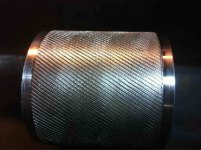
Ok, I think I got it this time. I left the knurling tool loose on the tool post holder and ran it up against the work to get it centered on the work, then locked it in and set the height. Then I backed it off, and dropped the height .002-.003" and re-tightened the locknut. A quick double check of my math and I was off and running. I probably should have drilled for a center and supported this one, because I was getting a little chatter on the end, but it's just a brass punch...

For those taking notes, 1/number of teeth on wheel = pitch. As long as your diameter is a multiple of the pitch, your knurls will line up properly, and being .001-.002" off isn't a big deal. For this punch, the knurler had 36 teeth giving a pitch of .0277" and the diameter of the work was .725". Closest multiple of the pitch was .07202", so I turned the work down to .721" and we're close enough that things line up well enough.

ImageUploadedByTapatalk1362505286.241536.jpg
 

NASTYZEN

Well-known member
Joined
Jun 11, 2010
Messages
2,823
Location
St-Colomban,Que. Canada
I knurl tens of thousands of bushings in a year on my cnc lathe with a Dorian Tools Floating head Knurl.
I find giving a few deg. angles neg off of 90 or towards the chuck, works best for me.
Still though, I always get a few that are not knurled properly as in your picture. say 1 or 2 out of a 100.

http://www.doriantool.com/
 

Kevin54

MEMBER EMERITUS
Joined
Jan 12, 2005
Messages
29,341
Location
Urbana, Ohio
Ok, I think I got it this time. I left the knurling tool loose on the tool post holder and ran it up against the work to get it centered on the work, then locked it in and set the height. Then I backed it off, and dropped the height .002-.003" and re-tightened the locknut. A quick double check of my math and I was off and running. I probably should have drilled for a center and supported this one, because I was getting a little chatter on the end, but it's just a brass punch...

For those taking notes, 1/number of teeth on wheel = pitch. As long as your diameter is a multiple of the pitch, your knurls will line up properly, and being .001-.002" off isn't a big deal. For this punch, the knurler had 36 teeth giving a pitch of .0277" and the diameter of the work was .725". Closest multiple of the pitch was .07202", so I turned the work down to .721" and we're close enough that things line up well enough.

ImageUploadedByTapatalk1362505286.241536.jpg

That knurl looks pretty good. If you have a brass wheel or a fine steel wheel for your bench grinder, ran that across and around your knurls and it will clean them up some more and make the knurls a little bit more uniform in looks.

A lot of times, if I can't get a knurl to quite come out, I'll run right to left and back to right without lifting the knurling tool off of the piece and trying to pick it back up.
 

Regnar

Well-known member
Joined
Oct 9, 2010
Messages
461
I knurl tens of thousands of bushings in a year on my cnc lathe with a Dorian Tools Floating head Knurl.
I find giving a few deg. angles neg off of 90 or towards the chuck, works best for me.
Still though, I always get a few that are not knurled properly as in your picture. say 1 or 2 out of a 100.

http://www.doriantool.com/

I always though about getting one of these. Do these cut the knurls rather than form?
 

NASTYZEN

Well-known member
Joined
Jun 11, 2010
Messages
2,823
Location
St-Colomban,Que. Canada
I always though about getting one of these. Do these cut the knurls rather than form?

The ones I have are push or form type. Dorian has all kinds available. But $$$
I havn't worn it out yet. Really tuff tool.:thumbup:
I don't know what the advantages of cutting vs pushing are?? Lots of machinists on here. Could someone maybe enlighten us?
I say push is harder on the machine and cut prob less but wears the wheels out faster.
You could prob knurl harder metals with cut also?
 

Kevin54

MEMBER EMERITUS
Joined
Jan 12, 2005
Messages
29,341
Location
Urbana, Ohio
I always though about getting one of these. Do these cut the knurls rather than form?

The one that Nasty shows will displace the metal. I've never saw a knurling tool that cuts. On a blueprint most knurls are called out by the Diametrical Pitch. You will see something like DP96 for and example, meaning that there would be 96 teeth in a certain space on a certain diameter piece of stock. I can't remember the formula right off without looking it up in the handbook. Also, a blueprint should show what the max. diameter of the stock should be after knurling. If using a piece of 1/2" dia. barstock, it may call out DP96 with a maximum dimension of .515 over the knurls.
 

thaxboyd

Well-known member
Joined
Apr 14, 2010
Messages
3,867
Location
Utah
There are cutting knurl tools, they make a very nice looking knurl. Sorry if I am repeating something already said as I didn't read this whole thread, but, a nice finishing touch to a good deep knurl is to make a skim cut off the top.
 

Kevin54

MEMBER EMERITUS
Joined
Jan 12, 2005
Messages
29,341
Location
Urbana, Ohio
There are cutting knurl tools, they make a very nice looking knurl. Sorry if I am repeating something already said as I didn't read this whole thread, but, a nice finishing touch to a good deep knurl is to make a skim cut off the top.


In all my years of tooling, I've never heard of a "cut knurl" until you mentioned it, so I looked it up. You are absolutely correct :bowdown: I states that a cut knurl is used on thin wall material and there is minimum loss of wall thickness, plus it is a lot easier on the machine.

I know when form knurling or the conventional way I have always done it, on some materials it takes quite a bit of force on the compound to make the knurl. And if things aren't tighten down real tight, the knurl will walk on you.

This is from Knurltec.com

What is cut knurling?

Cut knurling with sharp edged knurls, actually cuts the material like a milling tool. Cut knurl holders of the types K10 and K11 in the Knurltec range hold the knurls at an angle to the work piece, producing a very high quality knurl that closely retains the pre machined diameter. This method is particularly good and recommended for the knurling of nonferrous material such as brass and aluminum, as well as harder metals. Pressure knurling of brass and aluminum can cause the crests to become over worked and brittle which may cause them to break, cut knurling eliminates that possibility, and is highly recommended for a quality look and feel.

Cut knurling uses much less force than conventional pressure knurling putting less strain on the machine tool and making it more suitable for machining tubular parts.

Not suitable for knurling up to a shoulder due to the angular arrangement of the knurls.

Cut knurling is essential for machining plastics and cast iron, where pressure would impede material flow.


Looking at some tools, a cut knurling tool looks like a typical knurling tool, but the the knurls are mounted on an angle. We may have done that at work and I just never realized it. I know when I went to the lathe department to borrow a knurl, I always went to a buddy that ran a larger lathe, but he always gave me a single knurl. Now I'm wondering what the Swiss style machines used. :headscrat
 
Last edited:
To avoid these ads, REGISTER NOW!
Top Bottom