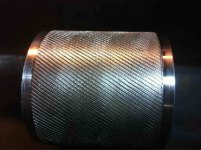
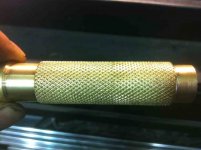
Yep, it sounds like a height issue.
With the lathe off, release the tool in the BXA and loosen the height adjustment nut to lower the knurler until it is below center. Hold the knurler up with your fingers and move the cross slide in until it makes firm contact with the workpiece on both rollers. Then turn the lever and lock it in place. Now you can adjust the nut so it is returned to that height the next time.
As others have suggested, tool height is the issue. Unlike them however, I simply advance the crossfeed in a few thou at a time paying attention to when the wheels begin spinning as they touch the work...they should begin at EXACTLY the same time. Adjust the height accordingly.
I like the floating head style also and they work fine in an Aloris style tool post.
The knurling tool was not square to the work piece. What you achieved by accident is called a spiral knurl and is done by stetting the knurl at an angle to the work, so only a corner of a wheel makes contact. Beautiful results, had you been shooting for the results you got...LOL
I too suspect the tool was not at the proper height, putting only one wheel into play.


Ok, I think I got it this time. I left the knurling tool loose on the tool post holder and ran it up against the work to get it centered on the work, then locked it in and set the height. Then I backed it off, and dropped the height .002-.003" and re-tightened the locknut. A quick double check of my math and I was off and running. I probably should have drilled for a center and supported this one, because I was getting a little chatter on the end, but it's just a brass punch...
For those taking notes, 1/number of teeth on wheel = pitch. As long as your diameter is a multiple of the pitch, your knurls will line up properly, and being .001-.002" off isn't a big deal. For this punch, the knurler had 36 teeth giving a pitch of .0277" and the diameter of the work was .725". Closest multiple of the pitch was .07202", so I turned the work down to .721" and we're close enough that things line up well enough.
![]()
I knurl tens of thousands of bushings in a year on my cnc lathe with a Dorian Tools Floating head Knurl.
I find giving a few deg. angles neg off of 90 or towards the chuck, works best for me.
Still though, I always get a few that are not knurled properly as in your picture. say 1 or 2 out of a 100.
http://www.doriantool.com/
I always though about getting one of these. Do these cut the knurls rather than form?
There are cutting knurl tools, they make a very nice looking knurl. Sorry if I am repeating something already said as I didn't read this whole thread, but, a nice finishing touch to a good deep knurl is to make a skim cut off the top.
I states that a cut knurl is used on thin wall material and there is minimum loss of wall thickness, plus it is a lot easier on the machine.What is cut knurling?
Cut knurling with sharp edged knurls, actually cuts the material like a milling tool. Cut knurl holders of the types K10 and K11 in the Knurltec range hold the knurls at an angle to the work piece, producing a very high quality knurl that closely retains the pre machined diameter. This method is particularly good and recommended for the knurling of nonferrous material such as brass and aluminum, as well as harder metals. Pressure knurling of brass and aluminum can cause the crests to become over worked and brittle which may cause them to break, cut knurling eliminates that possibility, and is highly recommended for a quality look and feel.
Cut knurling uses much less force than conventional pressure knurling putting less strain on the machine tool and making it more suitable for machining tubular parts.
Not suitable for knurling up to a shoulder due to the angular arrangement of the knurls.
Cut knurling is essential for machining plastics and cast iron, where pressure would impede material flow.