To avoid these ads, REGISTER NOW!

Help needed: Electric heater tripping branch and main breakers

R_einan

Well-known member
Joined
Aug 29, 2016
Messages
461
Location
Eastern WA
Posted this in the hearing section and not getting any notice, guess it's more of an electrical issue anyway.

Decided for my uses Electric heat was the best solution to keep my shop about freezing this winter, so I purchased a King Electric GH-2407 heater. Specs are 7.5kw/3.7kw, single phase 220v rated at 31.2a. Pulled 8/2 NM-B for the >50' run from the shop subpanel to the heater, and wired it into a 50a two pole breaker that was used by the previous owner for a TIG welder. I set up an Aube rc840t-240 switching relay/transformer so I can control the unit with a 24v thermostat.

After making all the connections, on first turning on the breaker with the relay set up, I couldn't get anything. Checked to verify power, which read 125v on each leg of the heater terminals: power isn't the issue. So I disconnected the relay and reattached the internal thermostat, to make sure the relay wasn't faulty. Turned up the thermostat and within a second of the elements turning on, the branch circuit went down, as did the main subpanel breaker (60a), along with the 60a breaker in the main panel feeding the shop. Did the same thing in the lower voltage mode as well.

Need a little direction on where to start looking next, clearly I am drawing more that the 60a of the main breaker, but why?
 
To avoid these ads, REGISTER NOW!

wyliesdiesels

Well-known member
Joined
Aug 14, 2012
Messages
20,067
Location
Modesto, CA
Posted this in the heating section and not getting any notice, guess it's more of an electrical issue anyway.


Yes, electrical section is proper place.

Decided for my uses Electric heat was the best solution to keep my shop about freezing this winter, so I purchased a King Electric GH-2407 heater. Specs are 7.5kw/3.7kw, single phase 220v rated at 31.2a. Pulled 8/2 NM-B for the >50' run from the shop subpanel to the heater, and wired it into a 50a two pole breaker that was used by the previous owner for a TIG welder. I set up an Aube rc840t-240 switching relay/transformer so I can control the unit with a 24v thermostat.

You need to change the breaker to 40a as #8/2 NM-b is limited to 40a.

After making all the connections, on first turning on the breaker with the relay set up, I couldn't get anything. Checked to verify power, which read 125v on each leg of the heater terminals: power isn't the issue.

Which terminals did you measure that at?

So I disconnected the relay and reattached the internal thermostat, to make sure the relay wasn't faulty. Turned up the thermostat and within a second of the elements turning on, the branch circuit went down, as did the main subpanel breaker (60a), along with the 60a breaker in the main panel feeding the shop. Did the same thing in the lower voltage mode as well.

Need a little direction on where to start looking next, clearly I am drawing more that the 60a of the main breaker, but why?

What do you mean by lower voltage mode? I quickly looked through the white paper and didnt see anything mentioned about a dual voltage option. According to the specs, this heater is rated for 240v.

Since you had main breakers tripping, you may be having a short circuit condition as said above, NOT an overcurrent condition.

Can you take some pics of all your connections and post them here...

What brand of breakers and panel do you have?

https://www.king-electric.com/pdfs/GH.pdf
 
Last edited:

ard

Well-known member
Joined
Feb 16, 2015
Messages
4,391
Location
Sierra Foothills... California
"Within a second" or "instantly"??

So all 3 breakers tripped? Branch, 60A sub and 60A breaker in main panel??

Can you measure the resistance across the heater(s)?
 
OP
R

R_einan

Well-known member
Joined
Aug 29, 2016
Messages
461
Location
Eastern WA
Ard: I could hear the heater starting up (so not quite instant, but close) then everything went down, all three breakers.

Wylies: it has a high/low switch on the front panel. I measured at the main terminals on the heater itself, where each leg of the 8/2 is attached to the heater terminals. Th panel is a Murray unit with Siemens breakers. I'll take pictures when I get home from work today and post them.
 

Aceman

Well-known member
Joined
Jan 28, 2007
Messages
2,513
Location
Eastern Oregon
After making all the connections, on first turning on the breaker with the relay set up, I couldn't get anything. Checked to verify power, which read 125v on each leg of the heater terminals: power isn't the issue.

When you're troubleshooting something rated 240v, it doesn't care that you have 125v on each "leg" to ground. It only cares that it gets 240v. When testing, test between the "hot" wires, not hot to ground.

Same with 120v, always try and test hot to neutral if possible. Equipment connects to the hot and neutral wires, so it makes sense to test the same way it connects.
 
Last edited:

wyliesdiesels

Well-known member
Joined
Aug 14, 2012
Messages
20,067
Location
Modesto, CA
Ard: I could hear the heater starting up (so not quite instant, but close) then everything went down, all three breakers.

Wylies: it has a high/low switch on the front panel. I measured at the main terminals on the heater itself, where each leg of the 8/2 is attached to the heater terminals. Th panel is a Murray unit with Siemens breakers. I'll take pictures when I get home from work today and post them.

EDIT:

Ok so the high/low switch just reduces the wattage probably by changing elements from series to parallel wired but actual voltage to unit terminals remains the same. This of course reduces the current draw.

Since youre tripping 60a breakers, either the coils are rated higher or you have a short. If one of the elements is bad, it could create a dead short once it heats up.... As said above, check the resistance on each element.
 
Last edited:
To avoid these ads, REGISTER NOW!

Milton Shaw

Well-known member
Joined
Feb 11, 2011
Messages
4,845
I would think the high/low switch would not use a resistor bank since that is what a heater itself is. I would think the high low switches the elements from being in series to being in parallel. Parallel being the high setting. I agree that probably be a short between one of he heaters and ground. You need to look at the heaters in detail and find where it is out of its insulators and touching round when it gets hot.
 

manwithtools

ALLIANCE MEMBER
Joined
Aug 24, 2015
Messages
14,050
Location
Lebanon, TN
I would think the high/low switch would not use a resistor bank since that is what a heater itself is. I would think the high low switches the elements from being in series to being in parallel. Parallel being the high setting. I agree that probably be a short between one of he heaters and ground. You need to look at the heaters in detail and find where it is out of its insulators and touching round when it gets hot.

:thumbup::thumbup::thumbup:
 
OP
R

R_einan

Well-known member
Joined
Aug 29, 2016
Messages
461
Location
Eastern WA
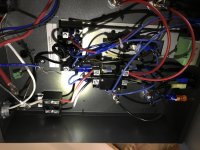
Here are the pictures of the inside of the heater, currently, the red, black, and blue wires that are disconnected are for the relay/transformer. I pulled them to test with the internal thermostat.
 

Attachments

  • IMG_2378.jpg
    IMG_2378.jpg
    141.8 KB · Views: 23
  • IMG_2379.jpg
    IMG_2379.jpg
    143.6 KB · Views: 20
OP
R

R_einan

Well-known member
Joined
Aug 29, 2016
Messages
461
Location
Eastern WA
So, after some testing:

1. I have 240v at the heater
2. I have good resistance on the heating elements
3. I have no shorts in the heating elements, resistance test so open between elements and ground

Had a thought about my initial tests as I pondered it today. I forgot that mechanical 24v thermostats have a delay built in. So... I'm an idiot and didn't wait long enough on my first test. After hooking the relay/transformer back up and disconnecting the internal thermostat I was able to turn the breaker on and then turn on the heater from the remote thermostat. Everything works correctly as well as the cool down fan delay.

I'll call the manufacturer in the morning and ask for a new thermostat so everything works correctly. But, long story short, heater works and problem solved. Thank you everyone for your thoughts and posts. Helped me sort this one out.
 

wyliesdiesels

Well-known member
Joined
Aug 14, 2012
Messages
20,067
Location
Modesto, CA
I would think the high/low switch would not use a resistor bank since that is what a heater itself is. I would think the high low switches the elements from being in series to being in parallel. Parallel being the high setting. I agree that probably be a short between one of he heaters and ground. You need to look at the heaters in detail and find where it is out of its insulators and touching round when it gets hot.

DOH!

Youre right. :eek:wned:

I was thinking of series parallel earlier but for some reason had a brain fart and said resistor bank instead. :lol_hitti

Its the same concept with motor windings, etc.

So, after some testing:

1. I have 240v at the heater
2. I have good resistance on the heating elements
3. I have no shorts in the heating elements, resistance test so open between elements and ground

Had a thought about my initial tests as I pondered it today. I forgot that mechanical 24v thermostats have a delay built in. So... I'm an idiot and didn't wait long enough on my first test. After hooking the relay/transformer back up and disconnecting the internal thermostat I was able to turn the breaker on and then turn on the heater from the remote thermostat. Everything works correctly as well as the cool down fan delay.

I'll call the manufacturer in the morning and ask for a new thermostat so everything works correctly. But, long story short, heater works and problem solved. Thank you everyone for your thoughts and posts. Helped me sort this one out.

ok so internal thermostat has short then... glad you figured it out...
 
Last edited:
To avoid these ads, REGISTER NOW!
Top Bottom