To avoid these ads, REGISTER NOW!

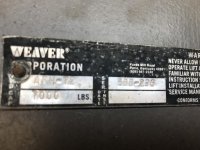
Help! Old 2 post lift WEAVER AHF-72

edboyles

Well-known member
Joined
Jul 30, 2005
Messages
176
Location
DFW, TX
Thanks for looking and I need some help.

This post is for an older 2 post Weaver lift, not the newer Derek Weaver lifts.

I have had this lift for years and has worked flawlessly. I went to use it again and noticed that the Safety Latch on the drivers side is not engaging.

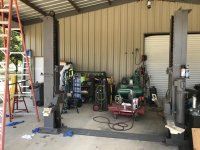
The photo I will post is where I made it engage for photo purposes only.

This lift has one cylinder on the drivers side and a large chain goes across the floor to raise the arms on the drivers side.

If you have a similar lift, can you please take a short video of your drivers side Safety Latch so I can try to figure this out.

The cylinder side Safety Latch engages each step unless you pull the arm to keep it from engaging. The driver side, the slave side is not engaging when you raise it or lower it.

Hopefully there is a fellow Weaver owner willing to help me diagnose this.
 

Attachments

  • Weaver.jpg
    Weaver.jpg
    71.8 KB · Views: 48
  • Weaver2.jpg
    Weaver2.jpg
    132.1 KB · Views: 38
To avoid these ads, REGISTER NOW!
OP
E

edboyles

Well-known member
Joined
Jul 30, 2005
Messages
176
Location
DFW, TX
I removed the internal slide and inspected the compression springs/mechanism but everything looked fine.

Something clearly changed, but I cant identify what and I used this think only a couple of times a year so I can remember the exact sequence of how the slave side Safety Latch.
 

Attachments

  • Weaver 3.jpg
    Weaver 3.jpg
    155 KB · Views: 42

JSK

Well-known member
Joined
Nov 16, 2007
Messages
432
Location
Southern CA
Too many "drivers side" in the original post - no reference to passenger side, so a bit confusing.
 
To avoid these ads, REGISTER NOW!
OP
E

edboyles

Well-known member
Joined
Jul 30, 2005
Messages
176
Location
DFW, TX
Thanks JSK for catching my mistake. To clarify;

The pump and lift cylinder is on the passenger side, and the safety latch system engages fine on the passenger side.

A chain on the floor under the cover connects and operates the slave lift on the drivers side of the lift. On that side, the safety latch pawls are not engaging. I was hoping to see a video of of the drivers side working correctly to help me diagnose the issue.
 
Last edited:
OP
E

edboyles

Well-known member
Joined
Jul 30, 2005
Messages
176
Location
DFW, TX
The lift was designed so that both of the safety release was controlled in one location on the passenger side by pump. In the absence of how to correct, I am going to modify the drivers side to a manual release instead of automatic by adding a torsion spring to keep it engaged going up, and a release lever to disengage like on the passenger control side.

I will have to walk around the car to release but that is better than not being able to use the lift. I'm just updating the post to maybe help someone in the future.

I ordered the spring today from Panzitta, and will fabricate/modify the other parts.
 

JSK

Well-known member
Joined
Nov 16, 2007
Messages
432
Location
Southern CA
It’s good to see that you take safety seriously. Be very cautious with that lift.

Around 1984’ish, while newly employed at BendPak, I was working on a new two post floorplate lift similar in concept as your old Weaver. One cylinder, with a forklift/leaf-type chain routed over a cylinder roller. The leaf chain then attached to the power side carriage. Attached to that same lift carriage was a pull chain (roller type) that was routed downward and along the floor, up then down the offside column (over an upper chain roller) and eventually connecting to the top of the trailing offside carriage on the other side. The power side carriage when lifted by the heavy leaf chain, pulled the roller chain that raised the offside carriage simultaneously – two birds, one stone. It was newly welded and void of paint. It was a proof of concept. Aesthetics were not in play.

I had been testing the lift for three days – crawling all around and under that thing watching the operation and safeties - also checking for any deformation or wear. I had a six-thousand pound load stacked on top of the arms.

The machine shop area I was a working in was tight – not a lot of egress routes in case something got wonky. One day, I just happened to get up from underneath the elevated lift. I stood up creakily as my knees were shot from crawling around the floor all day. As I stood up, I squeezed my body between the power side lift column and an old screw machine to access the lift controls. It was tight. At the very instant my hands reached the controls to start lowering the lift, the power side column slammed to the floor – the anchors let go. The six-thousand pound slab of steel, (iron plate approximately 4 x 80 x 40), hit the ground in less than a second. I would have been splattered. It made a helluva bang.

I remember a friend of mines brother used to work at the GM factory in Van Nuys, CA. His brother came home one day all shook up. I don’t think he returned to work until weeks after. That day, a fully assembled 350 small-block fell from the overhead assembly line landing within inches of him. It took a long time for him to gather his composure. He was a stud too. Worked out every day and stayed in shape - muscles on top of muscles. Even lumberjacks can get shaken.

After the huge bang in the shop, everyone came running out expecting to see me pushing red, guts-infused daisies. I remember the looks on their faces when they saw me standing there white as a ghost. They were just as ashen. After shaking it off and making like it was just a funny nothing that happened, I got the forklift and started cleaning up the mess. That’s how I was raised - by a tough South Dakota farmer woman who treated cuts with duct tape, and a dad in the service. Probably best to ignore it and move on. I could have made it a thing, but I didn’t let it get to me.

Later, after doing some engineering calculations and long math, it became apparent that two-post lifts (especially floorplates) that use a single cylinder with a pull chain to lift the other side, have huge forces on all components, especially the power side. An elevated overturning moment on the power side column is also introduced. If you think about it and ponder the design, you’ll begin to realize the complexity of the math. In those days, we threw a lot of steel at the problem – Solidworks, Ansys and FEA (Finite Element Analysis) were not introduced until years later. A single cylinder with pull chain can work, but only if you use a lot of steel and solid anchors to support the forces. Turns out, there is no cost savings when using a single cylinder.

Lastly, chains rarely if ever give telltale signs that a failure is eminent - they just let go. Cables on the other hand give you clues that they are being fatigued or worn to the point that replacement is necessary.

Be careful and always inspect.
 
OP
E

edboyles

Well-known member
Joined
Jul 30, 2005
Messages
176
Location
DFW, TX
JSK, thanks so much for your post.

You describe the lift method that I have perfectly on this Weaver.

Ironically I have always enjoyed the fact that this Weaver lift is built like a tank and when I looked at newer 2 post baseplate lifts, they just seemed wimpy. I'll have to rethink that based on your post where to sides lifting is better than one. The column footprint is huge and know I know why.

I had my Suburban on the lift when it did not want to automatically engage the safety lock on the offside carriage and immediately recognised something was not right and got it back on the ground. I have toyed with the idea of a new lift, but love how beefy this lift is.

Weaver changed from the safety latch style after this model, and I had previously wondered why. Now I think I understand why because this is not the first post I found asking how to correct the offside carriage latch.

I feel comfortable with my plan of correction, hopefully I can post an update next weekend.
 
To avoid these ads, REGISTER NOW!
Top Bottom