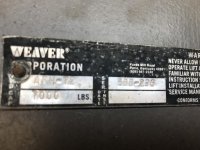
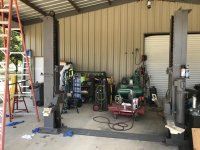
It’s good to see that you take safety seriously. Be very cautious with that lift.
Around 1984’ish, while newly employed at BendPak, I was working on a new two post floorplate lift similar in concept as your old Weaver. One cylinder, with a forklift/leaf-type chain routed over a cylinder roller. The leaf chain then attached to the power side carriage. Attached to that same lift carriage was a pull chain (roller type) that was routed downward and along the floor, up then down the offside column (over an upper chain roller) and eventually connecting to the top of the trailing offside carriage on the other side. The power side carriage when lifted by the heavy leaf chain, pulled the roller chain that raised the offside carriage simultaneously – two birds, one stone. It was newly welded and void of paint. It was a proof of concept. Aesthetics were not in play.
I had been testing the lift for three days – crawling all around and under that thing watching the operation and safeties - also checking for any deformation or wear. I had a six-thousand pound load stacked on top of the arms.
The machine shop area I was a working in was tight – not a lot of egress routes in case something got wonky. One day, I just happened to get up from underneath the elevated lift. I stood up creakily as my knees were shot from crawling around the floor all day. As I stood up, I squeezed my body between the power side lift column and an old screw machine to access the lift controls. It was tight. At the very instant my hands reached the controls to start lowering the lift, the power side column slammed to the floor – the anchors let go. The six-thousand pound slab of steel, (iron plate approximately 4 x 80 x 40), hit the ground in less than a second. I would have been splattered. It made a helluva bang.
I remember a friend of mines brother used to work at the GM factory in Van Nuys, CA. His brother came home one day all shook up. I don’t think he returned to work until weeks after. That day, a fully assembled 350 small-block fell from the overhead assembly line landing within inches of him. It took a long time for him to gather his composure. He was a stud too. Worked out every day and stayed in shape - muscles on top of muscles. Even lumberjacks can get shaken.
After the huge bang in the shop, everyone came running out expecting to see me pushing red, guts-infused daisies. I remember the looks on their faces when they saw me standing there white as a ghost. They were just as ashen. After shaking it off and making like it was just a funny nothing that happened, I got the forklift and started cleaning up the mess. That’s how I was raised - by a tough South Dakota farmer woman who treated cuts with duct tape, and a dad in the service. Probably best to ignore it and move on. I could have made it a thing, but I didn’t let it get to me.
Later, after doing some engineering calculations and long math, it became apparent that two-post lifts (especially floorplates) that use a single cylinder with a pull chain to lift the other side, have huge forces on all components, especially the power side. An elevated overturning moment on the power side column is also introduced. If you think about it and ponder the design, you’ll begin to realize the complexity of the math. In those days, we threw a lot of steel at the problem – Solidworks, Ansys and FEA (Finite Element Analysis) were not introduced until years later. A single cylinder with pull chain can work, but only if you use a lot of steel and solid anchors to support the forces. Turns out, there is no cost savings when using a single cylinder.
Lastly, chains rarely if ever give telltale signs that a failure is eminent - they just let go. Cables on the other hand give you clues that they are being fatigued or worn to the point that replacement is necessary.
Be careful and always inspect.