To avoid these ads, REGISTER NOW!

Help Wiring TWO 200amp panels to Generator Input Box??

ket-tek

Well-known member
Joined
Jan 28, 2009
Messages
1,289
Hey guys, I still haven't setup a generator input to my house as I keep waiting for the time when I'm gonna buy a LP 20-30kw for permanent installation.

I have a 400amp service feed that feed two 200amp panels directly behind the meterbase.

I do not want a separate generator panel with specific circuits, I want to have the flexibility to pick and choose any of the breakers in either panel as the situation may need.

Ultimately I want to get an a/b type transfer switch that swaps the panels incoming feed between the powerco meter or the generator input. I can find 200 amp ones all day long for a few hundred but 400 amp ones are thousands.

I do not care about automatic switching or starting, I just want a box with a big *** lever that selects powerco - off - generator..

If anyone can point me to affordable options for such a switch I'm all ears, but until then I just want to go ahead and wire a basic generator input box to my two panels. So I can easily use a basic portable gen for now.

I have two Murray panels and I also have two proper Murray interlock kits that have the sliding lever to only allow either the main or the top-left breaker pair to ever be on at the same time. This will pass code in my county.

I do have an open building permit on my property still for an addition I've been building and this generator input will be inspected.

I've talked to a few electricians and they give different answers as to how to do this with two panels. I am uploading two basic drawings, I sure hope you guys can give me some insight.
 
Last edited:
To avoid these ads, REGISTER NOW!
OP
K

ket-tek

Well-known member
Joined
Jan 28, 2009
Messages
1,289
Re: Help Wiring TWO 200amp panels to Genereator Input Outlet??

This is the input box I'm using:

$(KGrHqJHJCIE9Ep1Utj3BPYmY4EtHg~~60_35.JPG


In this first pic the generator input box has the feed split and going to each panel.

IMAG1479.jpg


In this next pic the generator input box feeds one panel, then another breaker in the same panels feeds over to the second panel.

IMAG1478.jpg


30amp Input box, 10-3 romex, two 30amp 240v breakers. The wire length is only about 24" to each panel, as the inlet box will be on the wall behind the panels, beside the meter base.

Any thoughts??
 

pattenp

Well-known member
Joined
Jun 4, 2008
Messages
10,175
Location
Virginia - USA
Re: Help Wiring TWO 200amp panels to Generator Input Outlet??

What size generator are you going to be using until you buy the 20-30kw one?

Okay you just posted the pics as I was asking the question.

You could use an interlock kit on the main breakers and put a 30A back fed breaker in each panel. Need to check with your local inspector because interlocks are not allowed everywhere.

I think you can use the panel as a junction box and pass through to the other panel and not need to use that additional breaker.

Also I like the inlet box that plugs in from the bottom instead of the front. Cord hangs better.
219475390.jpg
 
Last edited:
OP
K

ket-tek

Well-known member
Joined
Jan 28, 2009
Messages
1,289
Re: Help Wiring TWO 200amp panels to Generator Input Outlet??

What size generator are you going to be using until you buy the 20-30kw one?

Okay you just posted the pics as I was asking the question.

You could use an interlock kit on the main breakers and put a 30A back fed breaker in each panel. Need to check with your local inspector because interlocks are not allowed everywhere.

Also I like the inlet box that plugs in from the bottom instead of the front. Cord hangs better.

Prob looking at a 5000-6500w generator. I do already have the proper interlock kits for my panels, and my local code does allow interlocking kits for generator installs.

So it is ok to just run the feed from each backfeed breaker into the input box and make them up together essentially just splitting the input? Any considerations to the ground/neutrals? Just combine all four wire to the lugs in the input box, then each 10-3 to the respective panel and hooked up like any normal circuit?

One electrician I talked to on a job was saying that was not the way to do it and to jump one panel to feed the other. He mentioned something about bonded neutrals, but he didn't really explain. It seems to me that the first diagram, and like you mention is the same way the meterbase is feeding the panels, just splitting the power. The two panels already have the grounds and neutrals jumped together on the side bars between each panel.

Got a link to where those input boxes can be purchased?
 
Last edited:

pattenp

Well-known member
Joined
Jun 4, 2008
Messages
10,175
Location
Virginia - USA
I'm sure there a lot of places you can get this box but here's one.
http://www.buy.com/th/generator-inlet-box.html

I added another comment in my first post about possibly being able to do the splices in the main breaker box and then feeding over to the other box just as you pictured (2nd pic) but eliminating that additional breaker.

I have that same inlet box and it may be impossible to bring in two feeds and wirenut with pigtails to the inlet. The box is not that big.
 
Last edited:
OP
K

ket-tek

Well-known member
Joined
Jan 28, 2009
Messages
1,289
So are you saying the basically either diagram is ok to do? It seems to me that it is essentially the same thing either way. I didn't know if there was anything in the NEC pointing out dual panel feeds from a single backfeed input.
 

lakee911

Well-known member
Joined
Sep 8, 2012
Messages
53
Location
Columbus, OH
My first concern was that you're using a 30A receptacle, but (comparatively speaking) I see that's a mighty small generator so that's not a big deal.

Do you have any idea of what your typical max amp draw is? When the load is grossly oversized compared to what the generator can handle and you’re stuck transferring the entire panel, I think most folks are disappointed in the (their?) ability to manually manage the loads.

I know you said you didn’t want it, but I’d really recommend a small critical load panel. I have small six switch panel at home with over current protection on the gen side for each circuit. I can pick 6 circuits and transfer them between utility and generator. Things like lighting, fridge, furnace, TV/computer/internet, microwave, etc are wired in.
With your setup, if you transfer the whole panel, do you have any indication when the utility power returns? You’ll also be relying on your generator’s circuit breaker when you have an overload unless you take total amp draw and divide by two but then you’re giving up flexibility. So, what that means is any inability to manage loads will require a trip outside.

I’m also wondering if you’ll have any grounding/bonding issues here, but I don’t think that I know enough about your setup.

I'm pretty sure you can't back feed one panel to the other because that would essentially make your second main panel a subpanel to the other panel and that does, or should change the grounding/bonding. It's interesting though....

Jason
 
Last edited:

pattenp

Well-known member
Joined
Jun 4, 2008
Messages
10,175
Location
Virginia - USA
So are you saying the basically either diagram is ok to do? It seems to me that it is essentially the same thing either way. I didn't know if there was anything in the NEC pointing out dual panel feeds from a single backfeed input.

Lakee911 brings up some good points and NEC can be tricky when it comes to stuff like this. Whether it's right or wrong I'm not sure, but I would do #2 pic with the exception of doing a splice and split off to the other panel without using that additional breaker to feed the other panel. Basically you end up like #1 pic but the splicing and splitting is done in the first panel.
 
Last edited:
OP
K

ket-tek

Well-known member
Joined
Jan 28, 2009
Messages
1,289
Lakee911 brings up some good points and NEC can be tricky when it comes to stuff like this. Whether it's right or wrong I'm not sure, but I would do #2 pic with the exception of doing a splice and split off to the other panel without using that additional breaker to feed the other panel. Basically you end up like #1 pic but the splicing and splitting is done in the first panel.

Wouldn't doing #2 without the breaker just be pic #1 ?? Am I missing something with that?
 

pattenp

Well-known member
Joined
Jun 4, 2008
Messages
10,175
Location
Virginia - USA
Wouldn't doing #2 without the breaker just be pic #1 ?? Am I missing something with that?

Yes it would. I just don't think the inlet box is large enough to do the splicing and splitting in. There are no lugs in the inlet box just the plug and you can't land two sets of wires on the plug. You'll need to use pigtails. You can try.
 
OP
K

ket-tek

Well-known member
Joined
Jan 28, 2009
Messages
1,289
My first concern was that you're using a 30A receptacle, but (comparatively speaking) I see that's a mighty small generator so that's not a big deal.

Do you have any idea of what your typical max amp draw is? When the load is grossly oversized compared to what the generator can handle and you’re stuck transferring the entire panel, I think most folks are disappointed in the (their?) ability to manually manage the loads.

I know you said you didn’t want it, but I’d really recommend a small critical load panel. I have small six switch panel at home with over current protection on the gen side for each circuit. I can pick 6 circuits and transfer them between utility and generator. Things like lighting, fridge, furnace, TV/computer/internet, microwave, etc are wired in.
With your setup, if you transfer the whole panel, do you have any indication when the utility power returns? You’ll also be relying on your generator’s circuit breaker when you have an overload unless you take total amp draw and divide by two but then you’re giving up flexibility. So, what that means is any inability to manage loads will require a trip outside.

I’m also wondering if you’ll have any grounding/bonding issues here, but I don’t think that I know enough about your setup.

I'm pretty sure you can't back feed one panel to the other because that would essentially make your second main panel a subpanel to the other panel and that does, or should change the grounding/bonding. It's interesting though....

Jason

Having flexability is my biggest concern, when the power is out and there is nothing to do I have no issues with going outside to reset a breaker on the generator. Nor do I have issues with manually starting, plugging, refilling, etc.. This is emergency temporary power. I will be getting a large NG unit once I can find a 400amp switch over panel to do what I want. But it's been 5 years now I've been building on this house and have yet to get anything, so I want to get something now, as it may be a few more years before I spend the money to do the large permanent LP generator. And I will keep this small input wired as is once the permanent one goes in to have as a backup still if there is ever a problem with the new one.

There will be 3 fridges and a deepfreeze, but I only care about the deep freeze and one fridge, and a few lights. Otherwise I'm not interested in anything else at this point. But the house is around 5000sqft (some currently unfinished), and depending on what time of year or temperature it is we may setup camp in a different area of the house. and in the future room uses may be switched around, so I want to never have to rewire my critical circuit choices.

I can use a 50amp input box, with 50amp input breakers and 8-3 wire if it would be better?? This would allow a larger portable generator, but is it a concern to have too large of a input breaker with a smaller generator of 20-30amp max output?

I do not have a portable generator yet, so the size is not set in stone, just looking at ~$1000 give or take a little. and it seems 6500w are pretty common just under that price range.

What is the bonding issues I may have?

More details on my set is follows:

Single 400amp service feed into meterbase on the outside garage wall, this has two feeds coming out of it and each goes into one of the dual 200amp panels directly behind the meter base.

Both panels are grounded to the same ground rod, and the neutral has a jumper from the one neutral bar to the other.

Is there anything else I need to look at or info I provide by looking in the panels?

Thanks for any help with this :)
 
Last edited:
OP
K

ket-tek

Well-known member
Joined
Jan 28, 2009
Messages
1,289
Yes it would. I just don't think the inlet box is large enough to do the splicing and splitting in. There are no lugs in the inlet box just the plug and you can't land two sets of wires on the plug. You'll need to use pigtails. You can try.

I see what you mean, it is a fairly small box to make up x2 10-3's plus a third pigtail going to the rear of the plug and then shoved back in to mount the faceplate.

Thanks for the clarification.
 

pattenp

Well-known member
Joined
Jun 4, 2008
Messages
10,175
Location
Virginia - USA
I have a set up like what you are looking at except with one 200A panel. I used the interlock and a 30A inlet and have a 7500 Generac generator. The output on the gen is 30A. I just use it to run a couple circuits for a frig and freezer and also a few circuits for lights and the TV outlet. You just have to manage the use so not to overload the gen.

And I don't believe there are any bonding issues with this type of setup with a portable gen.
 
Last edited:

lakee911

Well-known member
Joined
Sep 8, 2012
Messages
53
Location
Columbus, OH
I can use a 50amp input box if that better, with 50amp input breakers and 8-3 wire if it would be better?? This would allow a larger portable generator, but is it concern to too large of a input breaker with a smaller generator of 20-30amp max output?

In nearly every case, enough to consider it a rule, the breaker provides protection for the downstream wire/circuit. If the downstream breaker (your back fed breaker in the panel) is larger than the upstream breaker (generator breaker), then you're going to trip the upstream breaker. That's ok, but it is not what we call "coordinated." Your downstream breaker is simply serving as a disconnect. If you even think you'll need more juice later, make the power inlet as large as you would like and upsize the receptacle, the wire and the backfed breaker. The wire can be larger than the breaker or the inlet, but the inlet needs to be larger or equal to the breaker.


What is the bonding issues I may have?

More details on my set is follows:

Single 400amp service feed into meterbase on the outside garage wall, this has two feeds coming out of it and each goes into one of the dual 200amp panels directly behind the meter base.

Both panels are grounded to the same ground rod, and the nuetral has a jumper from the one neutral bar to the other.

I'm not quite sure that I'm following you here ... I don't know why "the nuetral has a jumper from the one neutral bar to the other." Aren't these in seperate panels? Typically you'll have one place where the grounded conductor (nuetral) is bonded (jumpered) to the grounding conductor (ground). Where is that done?

When you have two panels, *I* would expect that to be done in the meter enclosure, however, I have read online (and I don't know if its NEC compliant or not) that sometimes it's bonded in both locations and each panel shares the ground rods. Let's suppose that what you're doing.

If on utility, both interlocks are on utility and in parallel all is well. Panel A backup is connected to generator and Panel B is connected a breaker on A. When you put panel B in backup it becomes a subpanel to A and subpanel needs 4W connection, not 3W connection.
 

pattenp

Well-known member
Joined
Jun 4, 2008
Messages
10,175
Location
Virginia - USA
........
If on utility, both interlocks are on utility and in parallel all is well. Panel A backup is connected to generator and Panel B is connected a breaker on A. When you put panel B in backup it becomes a subpanel to A and subpanel needs 4W connection, not 3W connection.

lakee911, I think this is making things more complicated than it needs to be. If he hooks it up as in pic #1 would this not negate the issue of the second main panel becoming a sub-panel? He would have the two separate interlocks and the two back fed breakers to flip.

ket-tek, don't know where you live, but are you trying to get this done before frankenstorm hits this coming Monday?
 
Last edited:

wyliesdiesels

Well-known member
Joined
Aug 14, 2012
Messages
19,995
Location
Modesto, CA
One PITA thing I see with this setup is u would have to manually shutoff every breaker that u don't want on the generator power, otherwise the wife or kids might turn something on and trip the generator! Of course, if u don't care about flipping a bunch of breakers on and off, then nevermind!

Also, this setup leaves too much room for error cause I can just see someone forgetting to move both of the interlocks and now the generator is feeding the utility lines creating a hazardous situation for the lineman trying to restore the power. Now yes, the lineman should always assume stuff is hot but I have heard of some customers having their drops cut because they were careless with their backup generator! And yes of course, everyone says and thinks that they don't ever forget critical stuff like that but it can happen when you're in a hurry. Just make sure to put a big note where it will be seen as a reminder to shut both interlocks off!

I can use a 50amp input box, with 50amp input breakers and 8-3 wire if it would be better?? This would allow a larger portable generator, but is it a concern to have too large of a input breaker with a smaller generator of 20-30amp max output?

If u mean 8-3 NM, that's only rated to 40amps. If u wanted 50amp NM wire, u would have to use 6-3NM! Since I know I'll probably get flamed on this subject, u can check out a debate on this in another forum- www.electricalknowledge.com/forum/archives/3270.asp. Also, the 60 degree column is used for sizes #1 and smaller and the 75 degree column is used for larger sizes.
 

pattenp

Well-known member
Joined
Jun 4, 2008
Messages
10,175
Location
Virginia - USA
..........
Also, this setup leaves too much room for error cause I can just see someone forgetting to move both of the interlocks and now the generator is feeding the utility lines creating a hazardous situation for the lineman trying to restore the power. Now yes, the lineman should always assume stuff is hot but I have heard of some customers having their drops cut because they were careless with their backup generator! And yes of course, everyone says and thinks that they don't ever forget critical stuff like that but it can happen when you're in a hurry. Just make sure to put a big note where it will be seen as a reminder to shut both interlocks off!

Can't happen with the two interlocks as pictured. At least I don't see it.
 
OP
K

ket-tek

Well-known member
Joined
Jan 28, 2009
Messages
1,289
Thanks for trying to help me out fellas.

I did not wire the panels when the house was build 5 years ago, but I've wired the addition, garage, and bonus room into the panels since then, and all has passed the various inspections so far. But adding outlets and lights with the correct wire/breaker sizes is pretty basic.

As mentioned I will be getting an inspection on it in the future when I get my final on the addition. So if it's wrong I'll find out then, but I'd rather only do the work once. :)

Wiring a single inlet to a single panel is pretty basic as well, but two panels seem to be pretty open ended everytime I ask an electrician.

I had planed to wire identical as is done with one panel, but just a additional 8-3 run from the second panel to the same input box (assuming now there is enough room to make it all up inside a single input box)..

And pattenp, I would be nice to get it done in time. I have a friend with a couple generators and he said I can come borrow it tonight and keep for the week incase I need it. Worst case I will plug my fridge and freezer in through the window like last time. :)

But I have everything here already, and it's only about an hour of work so getting it done in time should be no problem, if I'm sure I'm doing it right.

I went out a looked through a box of stuff and I do already have a input, it's a 50amp though, I have 30 amp breakers and 10-3.. I did see at lowes this morning they had plenty of the 30amp version of this same reliance input box as well, so if I need to go grab a 30amp it's no problem.

Here are my two panels and the meter directly behind it. Easy install with no fishing, and there is a access panel below the panels, so drill straight out and bring the wires up into the bottom of the panels, no need to got through the side of one panel to get to the other.

IMAG1480.jpg


IMAG1481.jpg


IMAG1482.jpg
 
OP
K

ket-tek

Well-known member
Joined
Jan 28, 2009
Messages
1,289
One PITA thing I see with this setup is u would have to manually shutoff every breaker that u don't want on the generator power, otherwise the wife or kids might turn something on and trip the generator! Of course, if u don't care about flipping a bunch of breakers on and off, then nevermind!

Also, this setup leaves too much room for error cause I can just see someone forgetting to move both of the interlocks and now the generator is feeding the utility lines creating a hazardous situation for the lineman trying to restore the power. Now yes, the lineman should always assume stuff is hot but I have heard of some customers having their drops cut because they were careless with their backup generator! And yes of course, everyone says and thinks that they don't ever forget critical stuff like that but it can happen when you're in a hurry. Just make sure to put a big note where it will be seen as a reminder to shut both interlocks off!


If u mean 8-3 NM, that's only rated to 40amps. If u wanted 50amp NM wire, u would have to use 6-3NM! Since I know I'll probably get flamed on this subject, u can check out a debate on this in another forum- www.electricalknowledge.com/forum/archives/3270.asp. Also, the 60 degree column is used for sizes #1 and smaller and the 75 degree column is used for larger sizes.

No kids, no problems there. It's so rare I lose power it doesn't bother me too much, and the wife is pretty smart she can handle it.

on the 6-3 wire, I'll pass due to the cost and hassle of working with, since I will be getting a large generator down the road for permanent installation using a transfer switch, I will just go buy a 30 amp input box and keep everything at 30, and still keep this outlet in the future as a small generator backup input.

Can't happen with the two interlocks as pictured. At least I don't see it.

Yeah I don't see how it can happen, that's the point of the interlock, there's no Line feed after the main breaker connecting the two panels, so even if one panel was on main and one was on generator it's not connecting the power in any way??
 

Alchymist

Well-known member
Joined
Mar 1, 2009
Messages
4,423
Location
Central PA
I'm sure someone will be along to correct me if I'm wrong (I was once), but if you are not switching the neutral, then the genset has to have a 4 wire connection. The neutral in the genset cannot be connected to the ground conductor or frame, and a ground rod is required at the genset.
 
To avoid these ads, REGISTER NOW!
OP
K

ket-tek

Well-known member
Joined
Jan 28, 2009
Messages
1,289
I'm sure someone will be along to correct me if I'm wrong (I was once), but if you are not switching the neutral, then the genset has to have a 4 wire connection. The neutral in the genset cannot be connected to the ground conductor or frame, and a ground rod is required at the genset.

All the generators I've been looking at have 4 wire outputs. The generator would sit right near the meter and the ground rod is right there as well?

Now I've re-read a thread from fews back I posted similar questions in and mrb was responding saying the issue is that the nuetrals are still connected when the backfeeds are off and this is an issue. And back then is when I got sidetracked on ever install this due to no good solution.

I would hire an electrician to do the job, but everyone I've talked to had a different way, reason, comment, or just didn't seem real sure how to do it. So instead of paying someone to come take a stab at it not being real confident in what they were doing, I'm back to trying to figuring it out myself. Now of course I've obviously not been talking to the best electrician's out there, but I haven't had any luck find guys locally that are half as smart as some the guys on here.
 
OP
K

ket-tek

Well-known member
Joined
Jan 28, 2009
Messages
1,289
Thanks, good information on when a ground rod is required or not.

As this reads it seems that pretty much every generator I've used or any trade has used on a job needs a ground rod? (going of the mentioned assumption that generators with onboard outlets typically have neutrals bonded to the frame)

Caution-Generator Neutral Grounding
Generators will often have the neutral conductor bonded to the generator frame. This is commonly done on small portable generators supplied with receptacles. [Illustration 3]
Larger generators with a cord supplied pin and sleeve connector typically do not have the neutral grounded to the frame. There is no industry standard for when the neutral is or is not grounded, however it seems to be dependant on the generator having receptacles mounted on the frame, as then the neutral is grounded to the generator frame. The generator user needs to know if the neutral is grounded or not.

If the generator neutral is grounded then the generator can only be used with a transfer switch that transfers the neutral, or as a stand alone generator for a carnival or special even, and then ground rods are required.


These two diagrams show separate or not-separate installs, but in the not-separate diagram it shows the service neutral and generator neutral always connected to the panel, how would this be any different to the neutrals from two panels being connected in the service feed while the mains are off and the generator being on? Is this to do when the generator is not plugged in?

Fig%202.jpg


I am obviously beyond my scope of knowledge here. I can do the work if had a specific diagram that was guaranteed correct but it seems there are more variables than I am grasping.

I'm still open to going ahead and having a 400amp manual transfer switch installed and be done with it in preparation for the larger generator. But I can't seem to find exactly what I would need to buy there either. I'm ok spending $500-$1200 on one but can't seem to find what I would need.
 
OP
K

ket-tek

Well-known member
Joined
Jan 28, 2009
Messages
1,289
Here's the old thread where the same thing was discussed and mrb's replies about the neutrals.

http://www.garagejournal.com/forum/showthread.php?t=73292

Over two years later and I'm still nowhere on this.. :)

Like mentioned I could hire an electrician and get it turnkey and ***-raped at the same time, but that doesn't mean it's going to be done right. There is a major lawsuit going on in my county right now where an electrical firm has installed over 100 backup systems for like $10k a pop and they were all done wrong and not even close to code. The owner is facing some serious restitution/jail time.
 

VHF

Well-known member
Joined
Oct 27, 2008
Messages
420
Location
NW Wisconsin
What about two 200A manual transfer switches, one for each pannel?

But aren't you going to want a ATS (automatic transfer swtich) once you get a larger generator? No concerns with having automatic operation to run furnace/freezer/fridge if you aren't home?
 

Alchymist

Well-known member
Joined
Mar 1, 2009
Messages
4,423
Location
Central PA
Key here in a setup where the neutral is not switched: The neutral is to be bonded to the EGC in ONE place only. If the genset has the neutral bonded to the ground, then the neutral must be switched. At least that's my understanding.
 

VHF

Well-known member
Joined
Oct 27, 2008
Messages
420
Location
NW Wisconsin
Ronk also makes combined meter base/manual transfer switches:

http://www.ronkelectrical.com/meter_rite_socket.html

Might simplify your installation by keeping the wiring changes outside. Presumbably you would just mount the generator input below the transfer switch. Need to make sure this has double-lugs to feed both your pannels. You would also need to make sure your utility is happy with your choice for meter base. (Note they have both a conventional 320A service and a model for CT meters.)

You would have to go outside to throw the switch, but if you are using a portable generator you need to go outside anyway!
 

VHF

Well-known member
Joined
Oct 27, 2008
Messages
420
Location
NW Wisconsin
Key here in a setup where the neutral is not switched: The neutral is to be bonded to the EGC in ONE place only. If the genset has the neutral bonded to the ground, then the neutral must be switched. At least that's my understanding.

Agree. The neutral-ground bonding at the generator should generally be lifted when powering a house. A few generators have a switch for this; others have a bonding pigtail that can be disconnected.

Regarding powering two pannels from a single generator, it will be important to determine where the neutral-ground bonding currently occurs in your setup--in the meter base or inside each pannel.
 
OP
K

ket-tek

Well-known member
Joined
Jan 28, 2009
Messages
1,289
Does using this diagram make any difference in neutrals, since the generator feed is going thru the first panel to the second panel like a subpanel and not all four wires tied together at the inlet??

IMAG1478.jpg
 

theoldwizard1

Well-known member
Joined
Feb 22, 2011
Messages
43,129
Location
SE MI
Re: Help Wiring TWO 200amp panels to Genereator Input Outlet??

Ultimately I want to get an a/b type transfer switch that swaps the panels incoming feed between the powerco meter or the generator input. I can find 200 amp ones all day long for a few hundred but 400 amp ones are thousands.

I do not care about automatic switching or starting, I just want a box with a big *** lever that selects powerco - off - generator..

If that is the way you want to wire it, that is what it is going cost !

In this first pic the generator input box has the feed split and going to each panel.

IMAG1479.jpg

It is not wired as you drew it, but using a generator interlock feed on both panels is the way to go. And it is relatively cheap.

The way a generator interlock works is you add a double breaker to each panel and then wire them to the generator. Then there is a mechanical interlock placed on the breaker panel cover (not the door). The interlock physically limits into from either the meter or from the generator but not both.

Interlocks are sold by the panel manufacturer or here. Better pictures and explanation on that website also.
 

theoldwizard1

Well-known member
Joined
Feb 22, 2011
Messages
43,129
Location
SE MI
Does using this diagram make any difference in neutrals, since the generator feed is going thru the first panel to the second panel like a subpanel and not all four wires tied together at the inlet??

IMAG1478.jpg

I don't think this solution would be acceptable, because it is possible to back feed the power lines.

With 2 breaker panels and 2 interlocks it is impossible to back feed.

All neutrals will be joined and bonded to ground inside the panel box,
 

theoldwizard1

Well-known member
Joined
Feb 22, 2011
Messages
43,129
Location
SE MI
I have two Murray panels and I also have two proper Murray interlock kits that have the sliding lever to only allow either the main or the top-left breaker pair to ever be on at the same time. This will pass code in my county.
How did I miss this the first time I read it ?

Your done !


Just splice the feed from the generator in a box with feeds leading to those 2 top-left breakers. The ground from the generator should be brought into the box where neutral and ground are bond and then bond at the same point.


Many people don't like interlocks because you need to manually turn off circuits that are not mandatory.
 

wyliesdiesels

Well-known member
Joined
Aug 14, 2012
Messages
19,995
Location
Modesto, CA
I'm sure someone will be along to correct me if I'm wrong (I was once), but if you are not switching the neutral, then the genset has to have a 4 wire connection. The neutral in the genset cannot be connected to the ground conductor or frame, and a ground rod is required at the genset.

I remember reading about this requirement somewhere.....
 

theoldwizard1

Well-known member
Joined
Feb 22, 2011
Messages
43,129
Location
SE MI
Regarding grounds and neutrals, pay the inspector to make an extra trip out to the site while your electrician is there and have the two of them debate it !

In the end, it is all up to the inspector.
 

pattenp

Well-known member
Joined
Jun 4, 2008
Messages
10,175
Location
Virginia - USA
I'm sure someone will be along to correct me if I'm wrong (I was once), but if you are not switching the neutral, then the genset has to have a 4 wire connection. The neutral in the genset cannot be connected to the ground conductor or frame, and a ground rod is required at the genset.

Portable generators that have a bonded neutral will need the bond removed when the neutral is not switched at the panel. If the neutral is switched at the panel the neutral is to remain bonded in the generator plus the generator is to be grounded to earth.
 
Last edited:

theoldwizard1

Well-known member
Joined
Feb 22, 2011
Messages
43,129
Location
SE MI
Portable generators have a bonded neutral and the bond will need to be removed when the neutral is not switched at the panel.

Older generators do have neutral and ground bonded internal. They also do NOT have 4 prong receptacles.

Newer generators with 4 prong receptacles do not have neutral and ground bond inside the generator.
 

pattenp

Well-known member
Joined
Jun 4, 2008
Messages
10,175
Location
Virginia - USA
Older generators do have neutral and ground bonded internal. They also do NOT have 4 prong receptacles.

Newer generators with 4 prong receptacles do not have neutral and ground bond inside the generator.

That is not correct. Newer portable generators even with a four prong 240V recep have internal bonded neutrals. It's an OSHA requirement on portables. But not all portable gens are OSHA compliant.

My newer Generac GP7500e has an internal bonded neutral.
 
Last edited:

theoldwizard1

Well-known member
Joined
Feb 22, 2011
Messages
43,129
Location
SE MI
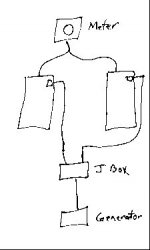
Wired this way, it does not matter what size the generator is. It is up to the operator to select which circuits are used after turning off the main breakers, moving the interlock and turning on the auxiliary feed breakers.

The wire from the junction box to the auxiliary feed on the breaker panels should be sized for the size breaker (100A) and the distance from the panel to the junction box.

The wire from the junction box to the generator should be sized to the lesser of the max load of the 2 breaker panels (200A) or the output breaker of the generator and the distance from the generator to the junction box. If the generator is hardwired, a disconnect near the junction box is likely to be required.
 

Attachments

  • Image1.jpg
    Image1.jpg
    12.1 KB · Views: 22
OP
K

ket-tek

Well-known member
Joined
Jan 28, 2009
Messages
1,289
Wired this way, it does not matter what size the generator is. It is up to the operator to select which circuits are used after turning off the main breakers, moving the interlock and turning on the auxiliary feed breakers.

The wire from the junction box to the auxiliary feed on the breaker panels should be sized for the size breaker (100A) and the distance from the panel to the junction box.

The wire from the junction box to the generator should be sized to the lesser of the max load of the 2 breaker panels (200A) or the output breaker of the generator and the distance from the generator to the junction box. If the generator is hardwired, a disconnect near the junction box is likely to be required.

Thanks for the input, but as I see it the diagram you give is the exact same thing as the first one I posted. But just making up the parralled connections in a j-box before the input box.

I read for about 6-8hours on this in various other forums last night and this morning about using dual 200 panels on a 400 service, and there is confusion and no clear answers in all of the threads.

I'm not sure what the actual issue is, but from what I'm piecing together something along the lines of the neutral on the service meter side is still tied to through both panels and to the generator. Although I do not see why it is any different than a single panel, as the neutral is still not disconnected with a gen input box.

Is the issue only arising because you can have one panel on gen and one panel on service???
 
To avoid these ads, REGISTER NOW!
Top Bottom