To avoid these ads, REGISTER NOW!

Help with floor pour issues.

grinthock

Well-known member
Joined
Aug 1, 2015
Messages
55
Location
Southern Ontario, Canada
I am new to the forum - but I should have been here awhile ago, I just finished a garage build project, the contractor did the entire structure, foundation and floor. There are footings and a 4 ft foundation.

The floor is a 6" deep 30x40ft floor, no rebar, mesh or otherwise. I was told it was not required. I told him I will be putting a 10K 2 post hoist in the shop.

I was told that they used a power trowel to finish the floor.

I have serious concerns about the quality of the job and I am looking for extremely open opinions - am I over reacting? Is this something I should be concerned about? How can this be fixed?

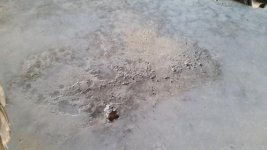
The edges look unfinished, there are void/bug holes, and the surface appears to be uneven and chipping in a few spots pretty bad.

The contractor seems to be willing to talk, but does not seem to be taking me seriously. I want to find a reasonable solution that does not involve breaking up and replacing the entire slab (which seems insane).

Thanks in advance.
 

Attachments

  • 20150801_083123.jpg
    20150801_083123.jpg
    19.5 KB · Views: 436
  • 20150801_083115.jpg
    20150801_083115.jpg
    14.9 KB · Views: 380
  • 20150801_083053.jpg
    20150801_083053.jpg
    11.4 KB · Views: 356
  • 20150801_083025.jpg
    20150801_083025.jpg
    12.7 KB · Views: 348
  • 20150801_082953.jpg
    20150801_082953.jpg
    19.6 KB · Views: 387
  • 20150627_125803.jpg
    20150627_125803.jpg
    15.9 KB · Views: 327
To avoid these ads, REGISTER NOW!

dfiler2

Well-known member
Joined
Dec 15, 2014
Messages
2,858
Location
NW Minnesota
The finish can probably be repaired to look a little better by grinding or possibly top coating. You don't have your location listed but my main concern would be no rebar or mesh, that IMO is insane but I'm in Northern MN where the ground moves a lot depending on the weather and temperature.

I think others will suggest listing your basic location in order to get some solid answers.
 

ddawg16

Well-known member
Joined
Jul 11, 2008
Messages
21,005
Location
S. California
That looks hand trowled, not power trowled.

No rebar or mesh? Oh dear.

Not even in the footings? That would go against any building code.

I'm guessing this is not a permitted structure? In the US, an inspection would have been done before the pour....

Did he put down a vapor barrier?
 
OP
G

grinthock

Well-known member
Joined
Aug 1, 2015
Messages
55
Location
Southern Ontario, Canada
Who the GC is -- isn't important really, it doesn't fix my problems.

Here's a photo took during the pour process, I don't see any mesh or re-bar. There is also none in the foundation - I am not familiar with the code in the area.
 

Attachments

  • 20150624_091311.jpg
    20150624_091311.jpg
    30.5 KB · Views: 496

pstnbly

Well-known member
Joined
Jul 20, 2010
Messages
766
Location
So. Vermont
That pour looks like it kicked faster then the finisher expected. Being as its poured directly on the stone subgrade I'm sure the concrete went off very fast and got ahead of the finisher that's why you see the rough spots and places where the aggregate was pulled out. The concrete should have had a retarder added to slow the set time especially if it was warm that day. The pour looks ok, the finish ***** but can be ground and filled to look better. No reinforcement for a lift not good.
 

PCustoms

Well-known member
Joined
Jul 23, 2011
Messages
22,408
Location
VT
Have the contractor cut out 4'x4' pads where the lift base will go. Re-pour these areas with proper reinforcement.

Probably should pin this to the rest of the slab too, but not sure.
 
OP
G

grinthock

Well-known member
Joined
Aug 1, 2015
Messages
55
Location
Southern Ontario, Canada
So the question is - as it is pour'd now is it safe. If I installed my lift on it - would it be safe to use.

The contractor has offered me a few options

1) Take some compensation (amount isn't enough in my mind)
2) Nothing

3) Recently he has offered to bring someone in and pour 2" ON TOP of the floor in some way. My concern is
a) What's that going to do
b) What stop's Layer A from breaking away from Layer B ?

I am not against this 2" pour idea - but until I get some secondary advice from someone else - I am not allowing it to happen.
 

boobag

Well-known member
Joined
Aug 15, 2010
Messages
397
dont pour 2" on top. it will fail.

if you epoxy the floor, you can easily fill those rough spots in to not show.
steel is not necessary on a floor. the big question is did he cut the floor the day after pouring? the cuts provide controlled crack lines.
 
OP
G

grinthock

Well-known member
Joined
Aug 1, 2015
Messages
55
Location
Southern Ontario, Canada
Epoxy appears to be the route being discussed now.

He did NOT perform saw cuts and it has been a month. My understanding is that they have to be done within 24 hours - I am wondering A) why they need to be done so soon and B) what is the implication if they are not done in a timely manner.
 

mitusa

Well-known member
Joined
Dec 24, 2011
Messages
1,991
Location
SW Oklahoma
A six inch slab without rebar or mesh is not good....... I don't know of a good solution. You might get by with the grind and epoxy to smooth it out.

:(
 
OP
G

grinthock

Well-known member
Joined
Aug 1, 2015
Messages
55
Location
Southern Ontario, Canada
I would agree - however I need to find documentation that proves that the slab without mesh or rebar is bad. It cannot be opinion, it has to be based on some kind of standard, or engineering. This contractor is not going to remove the slab - he is dead set against it. He seems a little more amenable to repairing the surface, but I want an engineer to sign off on the slab's design and use case.

I'm in Canada - so the rules are different CSA A23.1 applies but I need to get a copy of that standard -- our wonderful CSA wants $200+ for a PDF copy of it which is BS.
 

KDXSR5

Well-known member
Joined
May 17, 2015
Messages
281
Location
Wyoming
He seems a little more amenable to repairing the surface, but I want an engineer to sign off on the slab's design and use case.

That finish would not be acceptable to me, nevermind the lack of any reinforcement. That would not fly in my area. Of course he only wants to fix the surface; it is the cheapest thing for him to do and also appease you. This may or may not be what you really want in the end, but it is the cheapest and easiest fix for the contractor.

If you are thinking you want a new slab, then make your contractor find an engineer to prove that it is OK or tell the contractor you will be going to court. You shouldn't have to prove that his bad concrete job is safe, unless you are the one who specified the slab specs. In that case, it is mostly on you; you should have had an engineer look at it before hiring a contractor.

Was this job built off of engineer stamped drawings including the lift? If so, was the slab installed as specified? If not installed to specs, then there is a good chance you could win a judgement if it came to court.

If there were no engineer stamped drawings (which is what it sounds like), then all bets are off. I personally do not deal with this situation, because all of the jobs I am on have stamped drawings. I am not real confident that you will have a solid leg to stand on in court.

The exception to this is if they violated code. Find out exactly what the contractor installed, exactly what your local code specifies, and go from there. Check both slab and footing codes. It sounds like you are already trying to do this. When not given a set of specs to follow, many contractors will do the bare minimum that code allows, unfortunately. Minimum code, in my experience, is just not enough in many cases. If they didn't even follow code, which is the bare minimum they must do, you have a good chance of winning in court.

I would love to see you stay out of court, but IF the contractor failed to follow stamped design drawings or local code and is now refusing to correct the mistake (I would want full replacement, personally), then you will either have to live with it, pay someone to redo it, accept his surface fix proposal, or take the contractor to court. There are lawyers that specialize in construction litigation due to the very sue happy nature of the construction industry. I hope that you have kept your retention payment until this issue is resolved. Good luck, and keep us updated.
 
Last edited:

Slowgsr

Well-known member
Joined
Nov 14, 2014
Messages
610
Location
Southern ontario
It's sounds like a lowest bid awarded contract, I too work of engineered drawings, and I follow them to a tee, then if something's wrong IT isn't my problem. I don't move from the drawings despite the owners or GCs request unless it's in writing and I get an extra.

Anyways, you usually get what you paid for.
 

DTE

Well-known member
Joined
Jul 13, 2013
Messages
996
Location
North Carolina
Here in NC for a garage floor you are not required to have any metal in the floor. In the County I'm in you have to have 4 inches of stone and a vapor barrier. I am getting my ground ready to pour my floor in a week or so and I am not putting any re-bar or wire in it and don't see it being a problem.
 

Shelby_sho

Member
Joined
Jun 8, 2012
Messages
14
Check the lift install documentation for the concrete requirement . Last I looked it was 4" without reinforcement.
 

coldh2o

Well-known member
Joined
May 21, 2013
Messages
1,422
Location
Ontario, Canada
If there were no engineer stamped drawings (which is what it sounds like), then all bets are off. I personally do not deal with this situation, because all of the jobs I am on have stamped drawings. I am not real confident that you will have a solid leg to stand on in court.

The exception to this is if they violated code...

Was a building permit applied for and issued? If so, there had to be drawings. This is the big question - were they engineered drawings, or done by the contractor, owner, someone else? and were they followed? If he built what was spec'd on the drawings, you're SOL.

In Ontario there is no code requirement for a reinforced floor, or engineered design of the slab unless its for a floating slab greater than about 600 square feet, but you have a full foundation so that doesn't apply.

There are millions of slabs out there without reinforcement, it's not an absolute necessity. It's based on the strength and integrity of the underlying material, but more so the proposed loading. Was the base properly prepared and compacted? With respect to loading for general use I would think 6" of concrete is probably ok, but cutting out and providing reinforced pads for the lift is a wise idea.
 
To avoid these ads, REGISTER NOW!

SALIV8

Well-known member
Joined
Dec 11, 2008
Messages
2,114
Location
chicago and s/w michigan
What was the psi of the concrete?

The finish looks questionable to me, and I would like to know if he plate compacted the gravel before the pour also...

I am not a concrete guy nor expert, but I would like to see it plate compacted at the very least. 6" without cuts, reinforcement steel, and a vapor barrier might compel me to call some local licensed concrete contractors and ask their opinion and recommended fix if needed.
 

beetlespin

Active member
Joined
Aug 13, 2013
Messages
37
Get him.

I had a similar situation with a pad for my hot tub. All I needed was a LEVEL 10x10 pad. I got a mess. Wish I can find the pictures of the abortion.

He wrote me a check and then called to say he put a stop on it. I ran to the bank it was from and got my money. I was laughing all the way home.

I used the money to pour 2" on top of the mess that was originally done.
 
OP
G

grinthock

Well-known member
Joined
Aug 1, 2015
Messages
55
Location
Southern Ontario, Canada
Just some additional photos for comments..

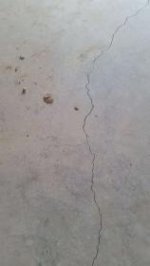
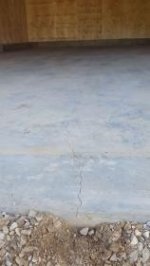
I'm being told these are "normal" contraction cracks. Where the cracks seems to form in multiple directions, and start and stop -- chunks are even coming out.
 

Attachments

  • crack1.jpg
    crack1.jpg
    4.7 KB · Views: 142
  • crack2.jpg
    crack2.jpg
    6.2 KB · Views: 142
  • crack3.jpg
    crack3.jpg
    6.8 KB · Views: 169
  • c4ack4.jpg
    c4ack4.jpg
    5 KB · Views: 148

Gcrop

Well-known member
Joined
Mar 29, 2015
Messages
70
Location
Memphis, TN
Just some additional photos for comments..


I'm being told these are "normal" contraction cracks. Where the cracks seems to form in multiple directions, and start and stop -- chunks are even coming out.


Like others in here, I am no expert but I'm pretty sure that is the purpose of expansion joints. Which I think you said you don't have. Controlling the cracks.

My 22x30 slab was poured 1.5 months ago and the only cracks are in the expansion joints (now filled with Rust Bullet). Pretty sure every expansion joint in my garage has a crack already.


Sent from my iPhone using Tapatalk
 

Bruce4310TX

Well-known member
Joined
Nov 4, 2009
Messages
507
Location
Forth-Worth, TX
Your slab is going to fail plain and simple if the ground moves All crete cracks but only re-bar or wire mesh can help hold it together No re-bar or even wire mesh nothing is going to keep it together, at least you didnt waste money on fiber-mesh it doesnt give any structural strength to the slab. Do not put a lift on it with out putting in a proper footing for the Lift.
 

rburke65

Well-known member
Joined
Nov 10, 2007
Messages
12,349
Location
Canfield, Ohio
Well I don't know that the floor is going to fail, I don't know how anyone can say that. And, as stated, most 2 post requirement is a 4" floor. Just my opinion.
 
OP
G

grinthock

Well-known member
Joined
Aug 1, 2015
Messages
55
Location
Southern Ontario, Canada
Well I don't know that the floor is going to fail, I don't know how anyone can say that. And, as stated, most 2 post requirement is a 4" floor. Just my opinion.

I would tend to agree. I take all opinions on the matter with a grain of salt and while I appreciate the opinion and candor, in my situation I must rely on those who are accredited engineers and concrete professionals to provide the opinions that stand up to legal challenge if necessary.

I am carefully weighing my options to repair my new shop.

Here is a less technical and more "What If" question that I would appreciate knowing everyones opinion on.

So you see the issues I have had, if given the following solutions, which would you choose.

1) Accept a $4000 bill deduction from the project in compensation for the poor workmanship

2) Have the contractor pay for an epoxy coat installation (Which would require grinding down my high spots, and grinding down the floor and filling in stuff) --- (He wants me to pay for part of this on the basis i'm ending up with something better than the original project, not sure I agree with that)

3) Replace the floor (break up, remove and repour)

I could install my lift with the epoxy job, my contraction cracks are luckily not totally in the way, but I don't feel I should have to pay to fix any of this.

Thoughts?
 

SALIV8

Well-known member
Joined
Dec 11, 2008
Messages
2,114
Location
chicago and s/w michigan
I would tend to agree. I take all opinions on the matter with a grain of salt and while I appreciate the opinion and candor, in my situation I must rely on those who are accredited engineers and concrete professionals to provide the opinions that stand up to legal challenge if necessary.

I am carefully weighing my options to repair my new shop.

Here is a less technical and more "What If" question that I would appreciate knowing everyones opinion on.

So you see the issues I have had, if given the following solutions, which would you choose.

1) Accept a $4000 bill deduction from the project in compensation for the poor workmanship

2) Have the contractor pay for an epoxy coat installation (Which would require grinding down my high spots, and grinding down the floor and filling in stuff) --- (He wants me to pay for part of this on the basis i'm ending up with something better than the original project, not sure I agree with that)

3) Replace the floor (break up, remove and repour)

I could install my lift with the epoxy job, my contraction cracks are luckily not totally in the way, but I don't feel I should have to pay to fix any of this.

Thoughts?

After you have spoken with a pe or two, and a few licensed concrete companies about their opinions on this pour, only then I could make a decision.

My main concern is if it was properly compacted before the pour and that it lacks some steel , vapor barrier, and cuts.

I wouldn't think getting some expert opinions would cost much.

With that said a 4g refund is attractive to me, or the redo option based on what the experts say.
 
Last edited:

yaidunno

Well-known member
Joined
Feb 10, 2011
Messages
1,336
Location
WI
The "contractor" first states that no reinforcement of any kind is needed, then utters the suggestion that an additional 2 inches can be poured on top?! I'm at a loss for words. It's really a shame that a topic like this surfaces every few weeks. Having only helped pour 30-40 yards of crete, I'm far from an expert, but I've got a pretty good handle on procedures and practices that work and withstand the test of time. Your "contractor" clearly does not.

BTW, cracks like that are not normal, and likely wouldn't have formed had he cut relief cuts. I don't see any from the photos shown. Yes, concrete will always crack, but with the cuts, the cracks have a path to follow and are well hidden.

What is the base material? How thick is it? To what degree was it compacted?
 

boobag

Well-known member
Joined
Aug 15, 2010
Messages
397
Just some additional photos for comments..

I'm being told these are "normal" contraction cracks. Where the cracks seems to form in multiple directions, and start and stop -- chunks are even coming out.

this is exactly why you need expansion joints, or need to cut the floor. concrete actually shrinks a little when it dries. plus the movement of the earth.....you need to give the concrete somewhere to flex or move. now without joints or cuts, the concrete cracks at random and looks bad. it wont fail, it will just always look bad.
 

nehog

Well-known member
Joined
Jan 2, 2010
Messages
7,935
Location
Jaffrey, NH
Just some additional photos for comments..

I'm being told these are "normal" contraction cracks. Where the cracks seems to form in multiple directions, and start and stop -- chunks are even coming out.

Not normal at all. My 30x60 has no cracks except for a few in the 'expansion' cuts that were made.
 

BoostedOne

Well-known member
Joined
Mar 4, 2010
Messages
117
Location
Osteen, Fl
Yes, it is normal for concrete to crack they say.. However, this has been what, 2 weeks??? Id venture to say that is far from normal.


If the guy is willing to give you 4K back, i hate to know what the job cost.

I wouldnt be too worried about the lack of rebar if he did use fibermesh(fiberglass strands in the concrete). With the poor worksmanship it would likely be obvious if he did, there will be "hairs" sticking out of the concrete.

From what i understand though, since it doesn't look like there was a vapor barrier put down, then I don't think Epoxy is going to be a long lasting option for you. When the concrete sweats(bringing moisture out of the ground) it will hit the bottom of the epoxy and have nowhere to go, and it will disbond.


I feel for you.. you have a real mess there.

Regarding the min thickness for the lift, yes many lift makers spec a minimum 4".. For my comfort even on top notch work thats not enough to make me warm and fuzzy. On that slab, I dunno if I would have the confidence to put anything heavier than a old VW Beetle or MG on the lift. Id probably consider going 4 post if stuck with the slab.

Tip for the next guy or next time:
I dont understand why folks who are pouring a new slab and planning on a 2 post lift dont just go overkill in the lift area.. When I converted my pole barn into a shop(roughly 1500 sq ft), I did the slab 6" thick, 4500psi, no metal, with fibermesh. But where I have the lift, there is a 12'x4' section that was dug out 6" deeper, and filled #5 rebar, and then an additional layer of #5 that extends into the surrounding slab area a few feet. It cost maybe 40 dollars in rebar, and the overkill deep hole under the lift which may sound like alot is about 24 cubic feet, less than a yard.. A yard of concrete is about 110-140$, barely anything considering the total cost of a slab.

I am happy to say my slab is holding up awesome. 5 years, still not a single crack(not even sure if I have any in the control joints).. and it gets 1 ton diesel trucks, tractors, etc on it all the time.
 

Cairo94507

Well-known member
Joined
May 9, 2015
Messages
343
Location
Auburn, CA
If code in your area is no rebar or mesh, then I think the $4000 deduction is good. If code calls for rebar and he is a licensed contractor, I would lodge a complaint against his license and file a claim against his bond. Here in CA (at least a few years ago) a contractor had to have at least a $15K bond posted. I would not be happy or satisfied with that pour. I would never consider a 2" pour on top of concrete. This guy (contractor?) is a complete scam artist.
 

pauls340

Well-known member
Joined
Jan 27, 2009
Messages
321
Location
North of Motown
Those cracks are caused by the dry shrinkage that naturally happens with unenhancedconcrete. Here in the States, ACI, American Concrete Inst says concrete begins to crack 2-6 hrs after placement. That concrete should have been sawcut before the Contractor left. Period. 99% of the time when your type of cracks are directly across from each other at the control joint, that control joint was cut after the concrete cracked. If you can get that removed and replaced for $4000, do it, but invest in Vapor Lock Enhanced Concrete, VLEC , Mfg in Smithville Ontario. You will have zero moisture issues, ever. Your concrete will be waterproof and vapor proof. VLEC stops radon and methane gas going through concrete. We are actually putting a 2" cap of VLEC over existing concrete next month. A premium bonding agent must be used. Good Luck.
 

jeopardy98

Well-known member
Joined
May 11, 2015
Messages
587
Location
Prince George, VA
I just posted a thread because I was curious if I was being too picky about my pour and my tiny cracks on my expansion joints a few days after my pour. I hate to say it but after seeing your pour I feel 1000x better about mine. There is no way, no how that I would let that mess you have fly. I hope you get it all fixed up.
 
OP
G

grinthock

Well-known member
Joined
Aug 1, 2015
Messages
55
Location
Southern Ontario, Canada
Just to close the door on this one - as I know a few were following.

It has been a few weeks or arguments. I have had a myriad of contractors, and engineers involved including the Concrete Floor Association.

Ultimately there are some lessons learned here, that if/when you contract for a building like I am constructing -- ensure that specific details about your slab are called out. The problem there is - I'm not a builder, so I didn't know what to ask, and when things started to go sideways, I didn't have ton of leg to stand on (didn't ask for contraction cuts, or mesh) as these things are not CODE but more of a better practice would still give me a reasonable legal argument for workmanship --- but you have to ask yourself if you want to roll that dice.

So really my issues with the floor came down to.

1) No contraction cuts
2) No reinforcement mesh or rebar
3) Improper Finishing
4) Waves / High spots


Points 1/2 I do not have a smoking gun on, however 3/4 there is a clear workmanship issue.

After discussion with the Concrete Flooring Association here, to request their options for repair they recommended
1) Rip out and replace
2) Epoxy coat the floor with a quality product.

My contractor was advised to use a quality product by either Sika or Euclid to repair it. The contractor called Sika who recommended a local expert.

The sub that came in does industrial floors, he does not do residential but happened to have a gap in his schedule, he has been doing this for many many years. I was provided a 5 year warranty against the epoxy coming up.

The product used was SikaFloor 261CA (100% Base epoxy) in 2 coats, with most of the time spent on prep.

1) Shot Blast the floor, which pulled up all of the delmaination and exposed all sorts of bug holes and issues
2) Grind down with a diamond grinder all the high spots
3) Fill all voids, holes and contraction cracks
4) Coat the floor with a first coat that is squeegeed into the surface and then allow to flash
5) Final coat which is squeegeed on and then backrolled.

The floor needs to cure for 2 days before I can go in there - but from my perspective it looks amazing right now. They were here for close to 16 hours and I monitored the entire process and the owner of the installer answered all my questions, he has been doing this for 30 years.

Projects never go perfect - and it was a judgement call by me as to how to fix this. The contractor was responsible to repair the floor, this was his chosen method that I approved, in the end I end up with a superior finish as a result of his screw up.

attachment.php


attachment.php
 

Attachments

  • 11885159_10155952922840291_2890863314317623037_n.jpg
    11885159_10155952922840291_2890863314317623037_n.jpg
    39.6 KB · Views: 254
  • 11899911_10155954172545291_727621407895937889_n.jpg
    11899911_10155954172545291_727621407895937889_n.jpg
    24.8 KB · Views: 258
To avoid these ads, REGISTER NOW!
Top Bottom