To avoid these ads, REGISTER NOW!

Help with initial startup issues, radiant floor heat

boostedranger

Active member
Joined
Apr 7, 2007
Messages
44
I am going to start by listing what I have and then will get to the issue at hand.

40X60X16 pole building
2 inch formular 250 around perimeter
2 inch crete-heat panels under slab
1/2 inch pex, 12 inch on center
2 zones
6 loops 295 ft long zone 1
3 loops 220 ft long zone 2
2 grundfos UPS15-58FC pumps, speed 2 for zone 1, speed 1 for zone 2
Nortitz NRC661 tankless water heater natural gas
bluefin stainless manifolds, 3 and 6 loop
Axel SP-82 2 zone pump controller
2 air and floor thermostats, currently set to control slab temp
Air eliminator
Expansion tank 2 gallon
fill and drain valve

All plumbing is 3/4 copper with the exception of the pex loops

I have a static system pressure of 15psi and as far as i can tell i have purged all air

Zone 1 is approx 1700 sqft
Zone 2 is approx 700 sqft, 20x35

Both zones are currently in the same air space, and not thermally separated in the slab. I did this for the future if I decide to drop a wall. I am aware i will have to cut out a strip of concrete and add insulation to thermally isolate the 2 zones, but for the time being, the thermostats will be set the same and they should still work.

I currently have no insulation, but the plan is to have R19 walls and R30 ceiling minimums, once I am done wiring and plumbing everything else I can have the insulation done.

My calculations are based on coldest outside temp of 10*, inside temp of 65*, 2400 sqft, puts me between 39600 and 79200 BTU. I have found 2 methods to calculated GPM requirement and head loss, these are the numbers from the worst case of the 2. Zone 1 requires 5.6 GPM with head loss around 10.4 and 2.3 GPM with a head loss of 6.2 on zone 2. With these numbers the pump curve chart shows this pump to be a fit.

My issue seems to be that the water heater doesn't see flow even though both pumps are running, I can watch the heater fire up, create heat, and after 5 or so min the burner shuts off and eventually the heater shuts off as its in standby mode. I have a transfer pump that I have connected to the fill and drain valves and a bucket that I used to bleed the air and if I run that pump and open the valves the heater will kick on as I am creating flow.

My thermostats control the pump motors only, the heater senses flow and turns itself on, or rather it is supposed to.

I am trying to get this up and running to keep the concrete at a minimum temp to just keep things from freezing until I can get the insulation done.

Anyone have any suggestions?

Thank you
Jon
 
To avoid these ads, REGISTER NOW!
OP
B

boostedranger

Active member
Joined
Apr 7, 2007
Messages
44
I am going to add that I have the balance valves and flow meters wide open and don't see any flow on the flow meters. If I close all but 1 of the loops on each manifold I see flow, but only .5 or .6 GPM.
 

TurnipTruck

Well-known member
Joined
Aug 28, 2005
Messages
1,552
Location
Southcentral Alaska
Assuming a tankless is treated the same as a low-mass boiler, you need a pump just for the heater and pumps for each zone, with some sort of hydraulic separation like primary/secondary, large headers, or an actual hydraulic separator.

Post some pics of the near-boiler piping.
 
OP
B

boostedranger

Active member
Joined
Apr 7, 2007
Messages
44
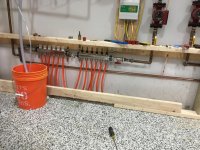
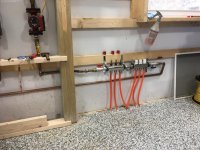
Here are pics, as far as a pump for the heater itself, I have not seen anything like this, but I guess its a possibility.
 

Attachments

  • 49B0BB97-2ADD-46C4-A258-8B43BD7C86D6.jpg
    49B0BB97-2ADD-46C4-A258-8B43BD7C86D6.jpg
    155.6 KB · Views: 152
  • D9A01B04-17E7-4D47-972E-8A011E7E51F3.jpg
    D9A01B04-17E7-4D47-972E-8A011E7E51F3.jpg
    160.3 KB · Views: 139
  • 0BEE8A3B-8419-4514-9C00-643CE3889686.jpg
    0BEE8A3B-8419-4514-9C00-643CE3889686.jpg
    156.9 KB · Views: 135

yeldogt

Well-known member
Joined
Jan 2, 2012
Messages
18,184
How does the tankless want to be piped -- do they list it as an application. It may want to see pressure -- and that going to need the pump pumping into the unit.

Water is a strange thing and a circulator -- does just that -- circulates. It's not pumping = pressure.

I would have set that up primary / secondary. Alpha three speed on the primary. You could also run both manifolds off one smart alpha pump -- if you know that one zone will always be on you have constant circulation on that zone and a zone valve on the second. There are ways to do both Delta T pumps and Delta P pumps and make it work.

You need to investigate the piping for the heater -- remember water heaters are seeing high pressure
 
OP
B

boostedranger

Active member
Joined
Apr 7, 2007
Messages
44
How does the tankless want to be piped -- do they list it as an application. It may want to see pressure -- and that going to need the pump pumping into the unit.

Water is a strange thing and a circulator -- does just that -- circulates. It's not pumping = pressure.

I would have set that up primary / secondary. Alpha three speed on the primary. You could also run both manifolds off one smart alpha pump -- if you know that one zone will always be on you have constant circulation on that zone and a zone valve on the second. There are ways to do both Delta T pumps and Delta P pumps and make it work.

You need to investigate the piping for the heater -- remember water heaters are seeing high pressure

The heater is listed for a combination setup where it does both DHW and space heating, it is not listed as warranted if used for space heating only, I was recommended this unit by a company that uses them for radiant heat only and has success. I did not use that company for my parts because once I got pricing they were not competitive.

I talked to a plumber buddy today and he says they have no pressure transducer and they have a simple paddle wheel to tell them when they have flow. also when I hook up my transfer pump and can make the heater activate, my pressures are 4-5 psi, when my system pressure when closed and bled cold is 15 psi. The heater is rated to work at flow ranges from .5-6.6 GPM.

I will have to take the system apart 1 section at a time and make sure I have no issues, I will also check the check valves in the pumps for debris and proper install.
 

fitter30

Well-known member
Joined
Jun 23, 2019
Messages
2,966
Location
Peace Valley,mo
Yeldogt is correct you need a primary/ secondary loops. Primary just pumps through the boiler to keep a constant flow. Can't make in your first pic the piping from pumps to the boiler including the expansion tank. You have to have flow through the boiler at are else you won't have a boiler just junk and water running out of it. Return lines from both manifolds to tee together before entering boiler. The problem with that is pumps fight each other before existing the tee ( called the bull) The fix is two tees piped in series with both circuits plumbed into the bulls and one side is capped other side to boiler.
 
Last edited:
OP
B

boostedranger

Active member
Joined
Apr 7, 2007
Messages
44
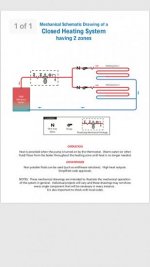
I don't really get the primary and secondary loops, I will have to research that. I am using an instant on demand hot water heater that is designed to heat water from room temp to final temp before it exits the unit, not a boiler. Attached is the schematic that I followed, I didn't buy from this company as they were absurd on pricing.image1.jpg
 
OP
B

boostedranger

Active member
Joined
Apr 7, 2007
Messages
44
Ok, I did some looking into the primary/secondary loop setup and it appears to be more beneficial in larger systems, they say 3000+ feet of 7/8 pex. I have just under 2500 ft of 1/2 inch. Not sold yet, although the more I look the more I see the only company doing what I have is the one I copied.

Is the reason for needing primary/secondary loops due to the multiple zones? What if I was to shut all the valves on the smaller zone and run it as a single system for the time being? Would that work?
 

86turbodsl

Well-known member
Joined
Jul 1, 2005
Messages
6,554
Location
Michigan
Ok, I did some looking into the primary/secondary loop setup and it appears to be more beneficial in larger systems, they say 3000+ feet of 7/8 pex. I have just under 2500 ft of 1/2 inch. Not sold yet, although the more I look the more I see the only company doing what I have is the one I copied.

Is the reason for needing primary/secondary loops due to the multiple zones? What if I was to shut all the valves on the smaller zone and run it as a single system for the time being? Would that work?

bullpucky. Where you getting that? I have primary / secondary on 2500ft of 1/2 pex in a 40x64x14. Primary / secondary decouples your generation from your radiation. I'd be using a large diameter for your boiler loop and use closely spaced tees on your secondary coming off the primary.

As for your water heater, i have no experience using such a heat source in your application. I do not believe they are generally recommended though. I have a buffer tank on my system, fed by a cast iron boiler. Keeps the cycling down to a minimum.
 
OP
B

boostedranger

Active member
Joined
Apr 7, 2007
Messages
44
bullpucky. Where you getting that? I have primary / secondary on 2500ft of 1/2 pex in a 40x64x14. Primary / secondary decouples your generation from your radiation. I'd be using a large diameter for your boiler loop and use closely spaced tees on your secondary coming off the primary.

As for your water heater, i have no experience using such a heat source in your application. I do not believe they are generally recommended though. I have a buffer tank on my system, fed by a cast iron boiler. Keeps the cycling down to a minimum.


https://www.radiantcompany.com/heatsources/ondemand/primarysecondary-plumbing/

4th paragraph down, I also saw it elsewhere but don't have that page open anymore. I am not saying it can't be used, just saying someone else said it. At this point I'm just trying to get some heat in the floor with what I have so I don't have freezing concerns, I can redo or change things in a week or 2 when I have time.

I will take all suggestions,

As for larger pipe for the boiler loop, does that make sense if the fittings on the heater are 3/4?
 

Jackfre

Well-known member
Joined
Dec 26, 2010
Messages
4,406
Location
N CA
Here you go! You are well into this. You may as well understand how it will work. Dan writes very well being able to take a complicated topic and explain so the layman can get it.
 

Attachments

  • F5E22069-679E-4C92-8304-B7F3CD9400D3.jpg
    F5E22069-679E-4C92-8304-B7F3CD9400D3.jpg
    149.7 KB · Views: 65

Jackfre

Well-known member
Joined
Dec 26, 2010
Messages
4,406
Location
N CA
Tankless WATER HEATERS are designed to provide a large temp rise (deltaT) from ground water temp to about 120*. so n your area about a 60* rise and to do so at a variable flow. When you put them in a closed loop heating system you end up with fixed flow and a small delta T, about 20*, so precisely the opposite of what they are designed for. GPMxDelta Tx500=BTU. Push those numbers around a bit based upon say a supply temp of 110* and return of 90*. Understand also that they have a minimum input. I think it is 15 or 19kbtu and a minimum flow of .6 gpm to be able to fire. Keep in mind that all the time your pump is running and that reliable little turbine is spinning it thinks that Mrs Magillicuddy is in the shower and will work very hard to supply hot water. In your case you are going to get bound up on minimum flow and fire and that unit will short cycle until the cows come home and it kills them. The "it kills them" comment is based upon 20 yrs in the field supporting mis-applications of tankless water heaters in space heating applications. Takagi is the only tankless i have seen that works in this application. I base that not on my experience but on that of members here who say they work. Wherever you got he comment about P/S not being necessary below 3000' is ridiculous. P/S removes the pressure drop of the water heater from the system, making it easier to get flow to the slab. You still have the same problems of min flow and delta T but P/S is a benefit in almost all hydronic space heating applications. Most of the wall hung boilers require it. If they didn't and you had a problem and called tech service they would tell you to P/S it. Read Dan's book. I still think you are cooked, but you will better understand how.
Noritz make excellent water heaters. They also offer a combi boiler. That is a Korean boiler they and many others in the US market private label. They brought it out to go after Navien's combi boiler market.
 
OP
B

boostedranger

Active member
Joined
Apr 7, 2007
Messages
44
Tankless WATER HEATERS are designed to provide a large temp rise (deltaT) from ground water temp to about 120*. so n your area about a 60* rise and to do so at a variable flow. When you put them in a closed loop heating system you end up with fixed flow and a small delta T, about 20*, so precisely the opposite of what they are designed for. GPMxDelta Tx500=BTU. Push those numbers around a bit based upon say a supply temp of 110* and return of 90*. Understand also that they have a minimum input. I think it is 15 or 19kbtu and a minimum flow of .6 gpm to be able to fire. Keep in mind that all the time your pump is running and that reliable little turbine is spinning it thinks that Mrs Magillicuddy is in the shower and will work very hard to supply hot water. In your case you are going to get bound up on minimum flow and fire and that unit will short cycle until the cows come home and it kills them. The "it kills them" comment is based upon 20 yrs in the field supporting mis-applications of tankless water heaters in space heating applications. Takagi is the only tankless i have seen that works in this application. I base that not on my experience but on that of members here who say they work. Wherever you got he comment about P/S not being necessary below 3000' is ridiculous. P/S removes the pressure drop of the water heater from the system, making it easier to get flow to the slab. You still have the same problems of min flow and delta T but P/S is a benefit in almost all hydronic space heating applications. Most of the wall hung boilers require it. If they didn't and you had a problem and called tech service they would tell you to P/S it. Read Dan's book. I still think you are cooked, but you will better understand how.
Noritz make excellent water heaters. They also offer a combi boiler. That is a Korean boiler they and many others in the US market private label. They brought it out to go after Navien's combi boiler market.

Well, Here I am, What can I do to make what I have work for the winter?

I apparently was led down a bad path and I should have realized that when I decided the manifolds they sent were overpriced and I ended up replacing them before I tried them.

I just spent an hour D***ing with it and after more flushing i was able to get it to run for 15 minutes straight, thought great, maybe it was air bound, then it shut down again. It didn't run long enough to even get a return temp above 45*.

Can i get another pump, plumb in a P/S loop and get heat for the winter?

I will order the books and learn, and I have learned a ton so far, but if I have to spend another $3-5K to replaced all the **** I already have the old lady is going to loose her ****.
 

brewchief

Well-known member
Joined
Sep 20, 2008
Messages
2,370
Location
Michigan
Have you tried it with both circulators set to high speed?

Sent from my SM-G965U using Tapatalk
 

PWC Repair

Well-known member
Joined
Dec 27, 2012
Messages
3,170
Location
Arkansas
Try running the larger (left) side pump with the right side one off AND the return valve shut OFF on the right side system. That should keep the tee from causing backflow pressure and causing a no flow issue.
 
OP
B

boostedranger

Active member
Joined
Apr 7, 2007
Messages
44

Jackfre

Well-known member
Joined
Dec 26, 2010
Messages
4,406
Location
N CA
Understand your situation concerning her. I think we all do. Don’t add anything until you can make what you have work as well as it can. Can you see supply and return temps? You can read gpm flow through the Noritz off the display. Not sure how much data the Noritz displays, but get into the manual and get good with that display. It might be worth a call to Noritz tech service just for that. With the S/R temps and flow...and patience, you can learn a lot about what is going on. Do read the books. Then when you have all that together we will help you spend your money
 
To avoid these ads, REGISTER NOW!

86turbodsl

Well-known member
Joined
Jul 1, 2005
Messages
6,554
Location
Michigan
You are not screwed but you do need to do some replumbing. Make the floor your primary loop and put two closely spaced tees in the loop. That's your feed and return to the water heater. Like has been said they don't work great in this application but you can probably get by for the winter.

Sent from my LG-TP450 using Tapatalk
 
OP
B

boostedranger

Active member
Joined
Apr 7, 2007
Messages
44
Try running the larger (left) side pump with the right side one off AND the return valve shut OFF on the right side system. That should keep the tee from causing backflow pressure and causing a no flow issue.

Tried that and same issue
 
OP
B

boostedranger

Active member
Joined
Apr 7, 2007
Messages
44
Understand your situation concerning her. I think we all do. Don’t add anything until you can make what you have work as well as it can. Can you see supply and return temps? You can read gpm flow through the Noritz off the display. Not sure how much data the Noritz displays, but get into the manual and get good with that display. It might be worth a call to Noritz tech service just for that. With the S/R temps and flow...and patience, you can learn a lot about what is going on. Do read the books. Then when you have all that together we will help you spend your money

I have a pressure/temp gauge right after the air separator/expansion tank, I have temp gauges at the inlet of each supply manifold and exit of each return manifold, so I can get those readings. I do know that for the short times I have had the heater running, I have had full discharge temp minus 5* at the inlet of the supply manifolds, the return temps never seemed to move, but since the slab temp is currently 42* I would assume it would take 12-24 hours to get some heat in the slab before seeing those return temps start to rise.

I will do some digging on the north and see if I can get any useful data out of the display.

I have no problem adding another pump and creating a P/S loop setup, won't cost a ton and won't have to redo everything, just need to figure size on pump and decide if I stick with the 3/4 for the primary or up it to the 1 inch, but since the heater is 3/4 inlet and outlet I'm leaning towards sticking with the 3/4.

Ordering the books now, patience and willingness to learn I defiantly have.

Thank you
Jon
 

fitter30

Well-known member
Joined
Jun 23, 2019
Messages
2,966
Location
Peace Valley,mo
Is that a spirothem air bleed? They work great just let the pump run for hour or two with boiler off turn pump on high speed you sound like your air bound and not moving any water. Feel the pump after ten minutes and it shouldn't be hot. Check boiler panel for flow read out.
 
OP
B

boostedranger

Active member
Joined
Apr 7, 2007
Messages
44
Is that a spirothem air bleed? They work great just let the pump run for hour or two with boiler off turn pump on high speed you sound like your air bound and not moving any water. Feel the pump after ten minutes and it shouldn't be hot. Check boiler panel for flow read out.

yup have one of those, the expansion tank is hanging from it
 

brewchief

Well-known member
Joined
Sep 20, 2008
Messages
2,370
Location
Michigan
The inlet of the water heater looks to have a screen according to the instructions, make sure it's clear, even the flux from soldering can plug it up to some degree.

Running the circulators and letting the spiral vent pull the air out is good advice.

If there is a mode on the display to show flow that would be really helpful.

If I was piping it from scratch I would probably use 1" for the loop to the manifolds and 3/4" for the short bit from the heater but I don't think that I would redo it completely at this point. I would change the way it tees together on the return.

I'm no fan of using a water heater like this but it should work if you can get a reasonable amount of flow through it and get proper flow through the rest of the system, primary/secondary piping will be a step in the right direction for sure.

Sent from my SM-G965U using Tapatalk
 

yeldogt

Well-known member
Joined
Jan 2, 2012
Messages
18,184
How did you purge the system --

The nice thing about Dan's layout in "pumping away" is that it allows "foolproof" purging of the system. The fill through the spirovent at the pressure tank with the system valve closed and the vent open allows each part to be flushed .. it's so simple.

Also -- while pumps work to zone and control -- they can use a fair amount of energy. Radiant likes constant circulation -- this allows for low temps and comfort.


Take a look at a diagram for a low loss header (LLH) -- it's easier to see how the primary and secondary is doing "it's thing" . You can see the water in a loop -- giving the boiler what it wants ... flow. Once you have that loop of hot water -- you can take from that -- pull it into the distribution system. Within limits this same principle can be done with a pair of close spaced T's.

The 3 speed alpha pump is about twice the cost of a plain 14/42 pump -- but they can use about 18w when running vs 85w -- that adds up.

Again -- you don't need two pumps for the zones. Also -- there is no need to cut the concrete when you do the separate rooms .. the difference is not going to matter in an insulated space
 

86turbodsl

Well-known member
Joined
Jul 1, 2005
Messages
6,554
Location
Michigan
Unless he's got flow controls on the loops, i disagree, two pumps is best. A single pump flowing into two different lengths of loops presents different "resistances" and more flow will follow the path of least resistance, which in this case, speeds up the flow in the shorter loops and slows it down in the longer loops, leading to higher delta T in the long ones and smaller delta T in the short ones. Uneven heat. It's why i made all my loops exactly the same length and flipped the manifolds. A Taco 007 pulls about 70watts. I use a single 007 for my entire shop. He can likely get away with pretty small pumps but it should be calculated out and the proper pump be selected.
I would think that replumbing the floor loop as the primary, with close tees for the boiler, would solve most of the issues, allowing the "boiler" to be low flow/high deltaT, and the floor loop to keep high flow/low deltaT and the floor temps will be much more even and the pumps much happier.

I also recommend reading books / articles by John Siegenthaler, who is an awesome resource on hydronics, much like Holohan, although probably more prolific with information. I have a couple of his books and he has a monthly article about hydronics in PM magazine that is good to read. Also Caleffi has a lot of free information out there that can be very informative if you study it. Much of this information can be absorbed and used by non-professionals, but it's not easy for the non-technical minded.
 
Last edited:

yeldogt

Well-known member
Joined
Jan 2, 2012
Messages
18,184
88 -- Actually, In my experience -- he should be fine. The exact same thing is going to occur with two pumps.

What really happens is the flow is great enough to take care of the longest run. Actually -- he has adjusters. Without using constant circulation -- it really does not matter as getting even heat is hard.

You can also plan a short loop -- I have done this twice on masonry steps --- works.

Also -- 70 x 2 can add up ... for me 24/7. + $20 month
 
OP
B

boostedranger

Active member
Joined
Apr 7, 2007
Messages
44
YELDOGT, I purged the system with a garden hose hooked up to a slop sink faucet. I have one of the webstone purge and fill valves, ran pumps while purging

86TURBODSL, I have the Bluefin manifolds with built in flow meter

I cleaned the inlet screen this morning before the baby woke up and it had a lot of debris. System ran for about an hour after that, but I wasn't able to purge with the garden hose as before because it was frozen. I used a transfer pump in a 55 gallon drum, if I can get my MIL to watch the baby today I may be able to get back out there
 

Jackfre

Well-known member
Joined
Dec 26, 2010
Messages
4,406
Location
N CA
I am sorry to pile on here. I know you are in a fix, but a couple more things. the problem you run into with a low delta T, which you have with radiant as it comes up to temp, is getting the flow to the unit. Again, the formula. The only time I was able to get one of these things to work decently, while still consuming vast qty's of gas, was to put a 10 gallon water heater as the low loss header. That gave volume to the water heater side and I controlled the circ off an aqua stat with as large a make/break temp set as I could. You then had to regulate the supply temp to the slab off of that tank. The idea was to get some run time on the water heater. it was a classic "hit and hope" solution and the gas consumption was high.
When the Rinnai and Noritz tankless first came out all of my New England customers threw tham at hydronic heating. Rinnai said it was ok, I said it wasn't. Guys put them in and there were nothing but problems. A couple years later Rinnai pulled the listing for closed loop applications. The only systems that worked without problems was hydro air on an open loop and I did several thousand of those without problems. Gas consumption was very high on hydronic closed loop systems. The units would cycle and cycle and never really get up to efficient steady state conditions. Now, those were Rinnai's and not Noritz but they operate very similarly.
I'll go off on a tangent here and ask, how is you water heater in the house? Perhaps, rather than trying to drive a square peg into a round hole you could get the best out of the Noritz, preserving the investment, and put a tank water heater on the slab. I don't like tanks on these systems either but think it is your best option for the life of one tank. You won't need to throw more money at the slab, other than the tank and you will save yourself some dough and save for a real wall hung boiler that will make that system give you the comfort you deserve.
I've been thinking about this a lot for the last couple days and backing up a couple steps is the most sensible, imo. This especially so to kinda/sorta preserve an even temperature in the household, if you get my drift.
Guys, what do you think?
 

86turbodsl

Well-known member
Joined
Jul 1, 2005
Messages
6,554
Location
Michigan
88 -- Actually, In my experience -- he should be fine. The exact same thing is going to occur with two pumps.

What really happens is the flow is great enough to take care of the longest run. Actually -- he has adjusters. Without using constant circulation -- it really does not matter as getting even heat is hard.

You can also plan a short loop -- I have done this twice on masonry steps --- works.

Also -- 70 x 2 can add up ... for me 24/7. + $20 month

I would hope your circulators aren't running 24/7 unless you're at design temp all the time! :)

We can agree to disagree on pumps. It's ok. The great thing about hydronics is there's so many ways to accomplish your goals. Yeldogt, i know you have many systems under your belt.

Jackfre, i am not a fan of water heaters on hydronics either, although i know some people get away with it. They tend not to last long. A real boiler would do wonders here. Is there any chance you can find a used boiler somewhere? My first hydro system in my barn, i had a used oil boiler. Cost me like 500. 15 years later, i scrapped it and put in a different, free one. They're out there if you look.
 
OP
B

boostedranger

Active member
Joined
Apr 7, 2007
Messages
44
https://www.noritz.com/wp-content/uploads/2018/05/Spec-Sheet-NRC661-v3.pdf

2nd page gives a pressure loss graph that seems to show that at 6 gpm the heater itself has right around 60 ft of head, I never realized how much restriction these things have. I calculated around 11 ft of head for the longest run and that was adding 2 ft for buffer, would this explain why I have no flow? My pumps max out at like 20ft of head.
 

yeldogt

Well-known member
Joined
Jan 2, 2012
Messages
18,184
I would hope your circulators aren't running 24/7 unless you're at design temp all the time! :)

We can agree to disagree on pumps. It's ok. The great thing about hydronics is there's so many ways to accomplish your goals. Yeldogt, i know you have many systems under your belt.

Jackfre, i am not a fan of water heaters on hydronics either, although i know some people get away with it. They tend not to last long. A real boiler would do wonders here. Is there any chance you can find a used boiler somewhere? My first hydro system in my barn, i had a used oil boiler. Cost me like 500. 15 years later, i scrapped it and put in a different, free one. They're out there if you look.

I'm not really disagreeing with you -- what you say can ... maybe is occurring. It just in my experience the small difference with a slab will not be noticeable -- especially with a control.

And yes -- I do set mine up with constant circulation. The systems use outdoor reset and are always matching the load. That's why having low power consuming pumps add up.
 

yeldogt

Well-known member
Joined
Jan 2, 2012
Messages
18,184
https://www.noritz.com/wp-content/uploads/2018/05/Spec-Sheet-NRC661-v3.pdf

2nd page gives a pressure loss graph that seems to show that at 6 gpm the heater itself has right around 60 ft of head, I never realized how much restriction these things have. I calculated around 11 ft of head for the longest run and that was adding 2 ft for buffer, would this explain why I have no flow? My pumps max out at like 20ft of head.

YES -- that why you need the pump to pump into the devise. Understanding the point of no pressure change is so important.

The key is to find out what's the minimum it needs to work in your application ...

Small mass boilers all have high restrictions -- as a water heater it has lots of pressure and flow.
 
OP
B

boostedranger

Active member
Joined
Apr 7, 2007
Messages
44
YES -- that why you need the pump to pump into the devise. Understanding the point of no pressure change is so important.

The key is to find out what's the minimum it needs to work in your application ...

Small mass boilers all have high restrictions -- as a water heater it has lots of pressure and flow.

Ok, now it all makes sense. With my 2 current circulators I must be right at the .5 minimum GPM for the heater to operate due to the unknown to me high internal resistance in the heater. which is why it works for a short time and then shuts off
 

yeldogt

Well-known member
Joined
Jan 2, 2012
Messages
18,184
Google -- point of no pressure change. Watch

In a closed system -- think about it .... you can't add to the system. All you can do is pressurize the bladder .... but that's fixed.

It's a strange thing to visualize --
 
Last edited:
OP
B

boostedranger

Active member
Joined
Apr 7, 2007
Messages
44
Google -- point of no pressure change. Watch

In a closed system -- think about it .... you can't add to the system. All you can to is pressures the bladder .... but that's fixed.

It's a strange thing to visualize --

I totally get it... I am an auto technician and work on and diagnose A/C systems, although they have positive displacement pumps I see similarities in them. Engine cooling systems are even more similar, so I am grasping more and more as I find more info.

Thank you for all the help
 

PWC Repair

Well-known member
Joined
Dec 27, 2012
Messages
3,170
Location
Arkansas
I don't know if this will help any. Today I filled my system for the first time and purged. Seems like within just a few minutes of runtime all my air was out??? I started with water hose on a manifold fill valve and the actual plumbing to the rest of it valved off. I opened one floor loop at a time untill it pumped back out of the return manifold as a solid stream. Each loop took about 3 gallons into a bucket before a solid stream. I have a tank water heater which I also filled up through the drain valve. Then I opened the vents, opened the manifold valves, and slowly filled until hissing stopped and my pressure gauge started reading up to about 5psi. Then I bled a bit of air out of the pump itself. Then turned on the pump and of course the pressure dropped a bit and I heard a few bubbles passing through, and the auto vent said psss ps ps PSsss. And I cracked open the inlet to allow a bit more water pressure in and brought the gauge up to 10psi. Then I just let it sit there and run and literally just a few minutes I heard no more air bubbles and pump was running quietly. I have about 1200ft of 1/2" tubing in the floor and a fan coil unit with it's own small pump.

Does any of that help at all?
 

86turbodsl

Well-known member
Joined
Jul 1, 2005
Messages
6,554
Location
Michigan
And yes -- I do set mine up with constant circulation. The systems use outdoor reset and are always matching the load. That's why having low power consuming pumps add up.

Why do you do that? The circulators job is just to deliver the btus to the radiation. Once you've done that, the circs are just wasting watts. Whats the rationale? Curious, not criticizing. All my systems use outdoor reset too. Eventually your temps hit your reset temp and it should shut off. Mine do. Circs only run when delivering btus.
 
Last edited:
To avoid these ads, REGISTER NOW!
Top Bottom