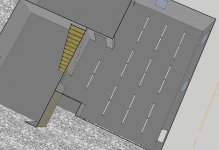
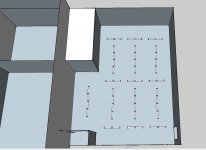
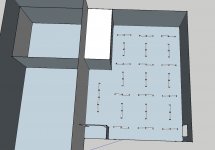
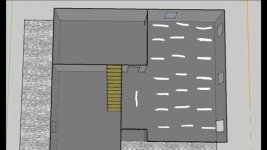
Trying to figure out lighting so i can finish my wiring and move on to insulation. I tried to figure out the lighting calculators but am lost. I will be doing body and paint plus suspension fab mostly. Any help i can get i would appreciate. Right now walls and ceiling are bare but i will be finishing them out in either osb or drywall and painting them white.
Thanks
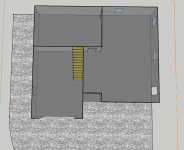
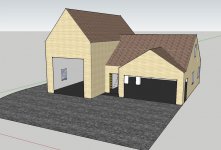
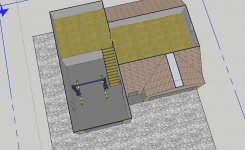
the 14x25 room will be the paint booth, the side with the lift will be used rarely most for oil changes, light mechanical or remove body's from frames and storage. the 26x33ish area will be what i use mostly for welding, body work and buffing.
Clearly, those are three separate areas, which will require three separate (and very different) solutions.
The paint booth is perhaps the most critical area, at least from a lighting perspective, because you REALLY need to see what you're doing, and even relatively minor shadows can be a big problem. To accomplish that goal, you want the ENTIRE vehicle covered as evenly as possible, and especially from as many different angles as possible. As such, you can forget "lighting calculators" for this part of the job; and you should accept going in that you WILL wind up with what would otherwise constitute "gross overkill" in terms of raw brightness. There are MANY possible approaches to this. But just to get you started...
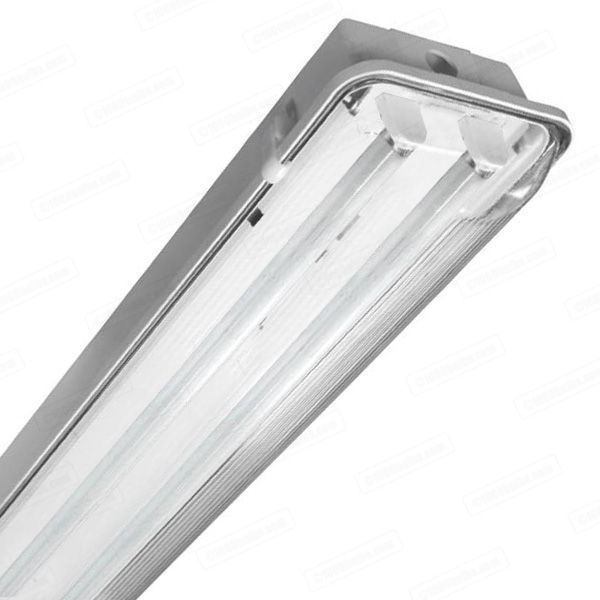
I'd probably start with pairs of twin-tube (or a single tandem 4-tube; i.e., 8-foot) fixtures placed VERTICALLY in each of the corners. Then put two more-or-less continuous runs of similar fixtures around the entire perimeter (or as much of it as you have solid wall surfaces to mount to, anyway -- and yes, you should make at least some effort to put solid doors on the main entrance, and attach lights there too); one of these would be at about knee height, the other at about shoulder height. Finally, fill in the overhead illumination with a few twin-tube fixtures, probably oriented crossways but in a somewhat staggered pattern. With the possible exception of the ceiling-mounted ones, all the fixtures should offer good impact protection, since they will be mounted in "vulnerable" locations. The simple "wrap" type fixtures with polycarbonate lenses that I've pointed to on many occasions (cf.
http://www.garagejournal.com/forum/showpost.php?p=3615373&postcount=9) could work in a pinch; but I'd probably lean toward something more substantial, such as:
http://www.1000bulbs.com/product/59133/TCP-WL4WA254USPQS.html
or:
http://www.homedepot.com/p/Lithonia...Fluorescent-Fixture-XWL-2-32-120-RE/202034431
either of which would offer the added advantage of better sealing off the innards from the volatile solvents and such which will be floating around in that space.
Moving on to the lift area...
Your biggest challenge here will be getting sufficient light UNDER the car when it is elevated. I've seen a number of different approaches to this, but I've not exactly "fallen in love" with any of them. Among the possibilities are:
-- Do something similar to the paint booth, with wall-mounted lighting around the perimeter, placing the fixtures JUST low enough to throw light up onto the underside of the car when the lift is all the way up.
-- Mount some fluoresent strips to the lift posts themselves, probably two sets on each post, "front" and "back". This of course presumes that the lift-related controls (and other "stuff") are not in the way. And again, impact-protected fixtures are de rigueur.
-- Use mostly "portable" lighting, which can be easily moved to under the car once it is in place and elevated. This could be as simple as a cord-reel mounted drop light or two, to as ambitious as some home-brew "creeper lights" (basically, high-power LED or fluorescent fixtures mounted in a sturdy box, which in turn is mounted on casters, with a long and as-flexible-as-possible cord to a nearby wall outlet).
-- Some combination of the above.
The one thing you CAN count on is, any lighting mounted directly overhead will be a near-complete waste. When the car is on the lift, it will be making a huge shadow, and you will be working IN that shadow. Not fun.
Finally, for the body/fab shop area...
The first question is, will it be used more-or-less as you showed in your second set of images, with multiple cars parked "cheek to jowl"? Or will it be more of a "bring in one car at time to work on it" proposition? Your lighting needs (at least in terms of the ideal layout) WILL change, depending on the answer to that question.
Either way, I would probably split the space into two areas, at least for planning purposes, as this should help make things somewhat simpler (in terms of visualization, if nothing else)...
The smallish offset area where you're showing a workbench, cabinets, and various service doors is "Area 1", so to speak. Most of what you'll need here falls into the category of "task lighting", and can probably be fulfilled by LED or fluorescent fixtures mounted under those wall cabinets. That should light of the workbench itself quite nicely. But it won't throw much light into the surrounding area; so figure on adding one run of twin-tube fixtures just inside the (imaginary) "border" between this space and the main shop area. How many fixtures you'll need for this run will depend on several things, including the exact dimensions of that offset area and what you're doing for lighting in the rest of the space; but I'm guessing two or so will do the trick -- in effect, it's mostly a "hallway" anyway.
If I've figured out your diagrams correctly, this effectively leaves a simple rectangle measuring about 19 feet by 33 feet for the main shop area. That's ~627 ft.^2. You're going to want
at least 100 lumens/ft.^2 for the sort of work your planning to do in there (and still more certainly won't hurt, but I won't insist on it). So figuring again on standard F32T8 tubes (due mostly to the ceiling height you're saddled with here), you want at least 24 of them, probably more like 28-32 by the time we account for "working height" vs. "source" lumens, and tube aging. In this case, they WILL be mounted out of harms way on the ceiling; so those simple "wrap" fixtures mentioned above should be just fine. The exact placement/layout will depend, as noted above, on exactly how you plan to use the space.
Most cabinets will be upstairs. My toolboxes, tool cart, welders etc will be stored on the lift side and moved over as needed.
For your sake, I'm hoping to be wrong; but I'd wager heavily that schlepping that stuff back and forth on a daily basis is going to get old in a hurry.
I will have cabinets and a workbench by the paint booth and thats it downstairs.
You didn't mention the loft area; but based on your comments above, it should not be ignored. I don't know what you're planning to use this space for besides storage; but even if only that, you'll need SOME decent lighting just to see what you're retrieving/replacing. You WON'T need the sort of intensity that would be required in a real work area, tho'; figure maybe 50 lumens/ft.^2 or so as a reasonable target.