Thanks for everyone's input. A lot of good idea, and some very good points here.
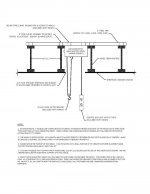
I re-design it as follow:
https://sphotos-a-ord.**.fbcdn.net/hphotos-prn1/537181_540887612632891_776612124_n.jpg
The drawing is not quite proportional. I probably have to cut a hole at the ceiling for the tongue to go up.
The wall are interior wall. However, It separate my garage and my neighbor's garage.
Yes, 2000lb is the capacity. The trailer itself probably weight less than 500 lbs. I am 160lbs and I can push it up against the wall myself… so its not really heavy.
The thing I hate about the new design is more parts (which means more $), and there are two locations (the pulley and the hoist) I have to reinforce.
Anything I am missing?
Thanks again for all the input.
Did you catch 54FordPanel's comments about the "safety cage"?
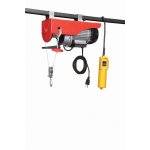
That rectangular loop that the cable passes through activates a kill switch. When the red disc hits the cage, it stops the motor from pulling any more.
If the cable is pulled at a sufficient angle, the drag of the cable on the cage will also activate the switch.
Running the cable through a pulley like you pictured above gets you past this problem, but so does mounting the hoist on an angle to keep the cable centered in the cage.
The first method however completely loses the safety feature gained by that kill switch. When pulling through a pulley, if something jams up, this hoist will continue to pull until something breaks. That will happen IN AN INSTANT, with no warning. It may rip the block from the wall, it may rip the hoist from its mounting. But if either of those fail, there is a good chance that the trailer will end up dropped on you.
Food for thought when you plan this out.
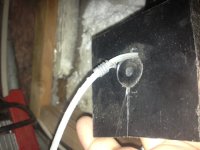
I did something similar to use one of these hoists in a weird position. My answer to keep the safety cage working was to pass the line through a block of wood that was about the size of the red disc (so it would hit the cage), but that the line could freely slip through (ok, it was more complicated than just a drilled block of wood, because of course, I couldn't put that on the cable without cutting the spliced hook end off).
I carefully pulled the cable in until the point where it should not be safely reeled in any more, and slid the wooden block up to the cage. I then marked in marker the point where the cable entered that wood.
I then reeled the cable out, and used two hands to untwist the cable while my wife stuck a foot long piece of 14 gauge galvanized wire through the twists. When I let go, the wire was nicely stuck through the cable. I then twisted the wire around the cable to make a wrap that would not move. This wrap passes perfectly smoothly through pulleys, but catches on that block of wood (which is drilled to pass the cable, but not this thicker part). So when I hoist too far up, the wrapped cable catches on that wood, and drags it into the cage. No more safetly problem.