To avoid these ads, REGISTER NOW!

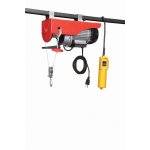
HF 440lb electrical hoist

yorkee

Member
Joined
Oct 11, 2011
Messages
19
I am sick of pushing up the trailer up against the wall physically. Its doable, but as I am getting older I am getting weaker. So I am This idea:

9451873015_fcac442bef_o.png


My goal is to minimize $ spent while maximize utilities. So far, I spent $70 and bought the 440lb electrical hoist from HF. The tailor is a 2000lb trailer... Something like this

Can I just mount the hoist to the wall or ceiling with bolts and expect it to work? Or I have to beef up the 2x4 on my garage ceiling to support it?

I am thinking of just couple long 3/8 bolt through the 2x4 with some big fat washer. Will my garage collapse?

If I want to put it on a rail so I can use it for something else, what other stuff I need other than the I beam and mounting?

Thanks in advance.
 
To avoid these ads, REGISTER NOW!

Orange65

Well-known member
Joined
May 3, 2010
Messages
200
Location
Clanton, AL
Your wall was built to support the roof and to withstand some wind loads if this is an exterior wall. I assume that since you are talking about running long bolts thru the wall, it is an interior wall. Interior walls are not build for any sideways loading, just vertical loading for the most part. I would be really careful trying this. A better idea would be to support the hoist from the ceiling if you can get in the attic and add a crossmember that would tie to several roof trusses. Maybe a couple of 2 x 8's put together in the form of a Tee as seen from the end with bolts thru this to the hoist below- that might work. It would be better to use something from below and put the load in the floor.

Be careful trying this. I would also look at straps to hold the trailer once it is in place- I would not trust the brake on the hoist.
 

Stinger

Well-known member
Joined
Jul 20, 2009
Messages
839
Location
Basehor, KS
My assumption would be if you can do this job by hand, it won't put enough force on the wall to cause any issues (assuming the trailer will always be touching the ground so the wall is never supporting the full weight of the trailer). I don't know the full details of your wall/garage construction though so it's just a generalization.
 

Steevo

Well-known member
Joined
Aug 18, 2009
Messages
8,738
Location
43.49600, -112.04300
You need to put the winch up the wall at a height equal to the distance from the back of the trailer to the point where you will grab the tongue with your cable hook.

Let's say that is 10' off the floor. If you have a horizontal rim joist or floor jist at that height as part of a second floor, you are pulling sideways on that, but it is probably more horizontally braced than a wall stud due to the subfloor, joists, etc.
I wouldn't have an issue with lagging the winch mount plate into that with four 5/16 or 3/8" lag bolts.

If it will hit the side of wall studs at that height, I think I would run a piece of 1/4" x 4" steel angle or 1" x 3" steel channel across four of the studs, lag it into each of them and mount the winch to the angle/channel to spread the side-load on the studs. You'd hate like hell to be happily pulling your trailer up and yank a single stud out through the sheet rock.

Like Orange said, add a chain to the mount plate to hook around the vertical tongue for a safety.

I'd also put a couple of vertical 2x4 "bumpers" on the wall at the bottom, for the back of the trailer to hit/rub against as you lift the front.
 
Last edited:

BD1

Well-known member
Joined
Mar 18, 2007
Messages
4,602
Location
north side
If you want to utilize the winch for other projects , mount winch about where the tongue end of trailer is at ceiling and mount a ****** block where you have winch shown.
 

jhelrey

Well-known member
Joined
Sep 15, 2010
Messages
7,249
Location
MN
After the first 45degrees the weight is negligible. Part of trailer is always on the ground so lift needed, negating any silly angle or compounding is less than half of trailer weight. Lag a 2/4 across three studs as overkill and mount the winch to that 2/4.
Waaaay overkill, but indisputable.

Agreed
 

54FordPanel

Well-known member
Joined
Aug 7, 2009
Messages
5,711
Location
Fort 54, Littleton, Co
The only thing you need to be concerned about (other than what others have mentioned about reinforcing the wall) is that those things are very particular about pulling at an angle. It will not pull at the angle you show in your drawing.

Your problem will be what I will call the "safety cage switch". (I don't know the proper term: it's the hoop thing hanging down around the cable )

Your cable will only swing about 15-20 degrees out before it hits the cage. Then it will stop. They are made to only pull straight up, not at an angle.

I hard mounted mine on my beam in my garage. Among other things, I use it to pull cars in/out of the garage, but I use a pulley thru a hoop in the floor.

You would have to mount the hoist pointing up, on the floor, then to a pulley on your wall. Or you can mount it anywhere, but it would have to point directly at a pulley, and the pulley can angle to the trailer.

Edit: Or, you could remove the safety cage I guess. I think mine is a good thing.

Edit again: Or maybe mount it at an angle pointing towards the trailer hitch. Mine will not pull an angle.
 
Last edited:

Angelfire

Well-known member
Joined
Mar 22, 2012
Messages
1,367
Location
New Mexico and Ireland
I don't know if you weld, but I'd probably look to fab up something to mount the hoist near the floor at just below the tongue level (ie. as parallel to the tongue as possible) then run the cable under the trailer. If you have concrete floors, I'd mount this contraption to the floor vs the wall.
 

LEVE

Well-known member
Joined
Jun 23, 2008
Messages
1,727
Location
On the Willapa
When I did my "elevator" project, I lag bolted a section of a 2X6 to the top sill plates of the garage wall. Then the same winch you've bought, was affixed to piece of 2" ABS Conduit, which was lag bolted to the 2X6. This has easily pulled 300lbs with no problems.

IMHO, you're plans will work without a hitch.
 

plow

Well-known member
Joined
Feb 12, 2013
Messages
1,024
Location
Louisiana
I have one of these winches and use it to unload heavyISH stuff out of the truck. I have a feeling that the advertised capacity on these things are over rated. I THINK I have the 880#er.
 

jmarkwolf

Well-known member
Joined
Jan 15, 2013
Messages
1,813
Location
Southeast Michigan
You're manually pushing a 2000lb trailer up against wall? Yikes!

As long as you're not hoisting the trailer off the ground, you're never lifting more than half the weight of the trailer ( the other half is supported by the ground ). Then if you "double up" the cable from the hoist, you "halve" the weight the hoist is actually pulling.

When the trailer is fully upright the trailer is fully supported by the ground. The only side load on the wall would be to keep the trailer from "tipping".

With a 2000lb trailer you're still exceeding the capacity of a 440lb hoist. I wouldn't count on much safety margin on an HF hoist.
 
Last edited:

LXCam

ALLIANCE MEMBER
Joined
Apr 23, 2013
Messages
19,113
Location
AZ
When I did my "elevator" project, I lag bolted a section of a 2X6 to the top sill plates of the garage wall. Then the same winch you've bought, was affixed to piece of 2" ABS Conduit, which was lag bolted to the 2X6. This has easily pulled 300lbs with no problems.

IMHO, you're plans will work without a hitch.


Absolutely attach to the top plate. Gotta remember the only thing holding the stud is place against a lateral load are a couple 16 penny nails. Attaching the the top plate and a couple studs will distribute the load across a majority of the wall and not a few nails. If possible a backing plate and a through bolt connection would be ideal like has been pointed out. Obviously this is one of those fly weight trailers or your one extra strong sumamumbitch, so doing this ain't rocket science.
 

Jere

Well-known member
Joined
Oct 26, 2011
Messages
708
I don't know if you weld, but I'd probably look to fab up something to mount the hoist near the floor at just below the tongue level (ie. as parallel to the tongue as possible) then run the cable under the trailer. If you have concrete floors, I'd mount this contraption to the floor vs the wall.

I am with Angelfire on this, mount it to the concrete floor, put a tow strap or tow on the back of the trailer and add a 3rd wheel where the tongue is if there isnt one there already
 

Hephaestus29

Well-known member
Joined
Mar 13, 2011
Messages
2,979
Location
Indianapolis
I have the 440 lb winch & with the dual line have used it to lift my 750lb Johnson bandsaw several times into the back of my truck & moved it around my garage. There was a connection problem inside the winch with one of the wires but we fixed that & I havn't had a problem with it since.

I don't see a problem using the winch for that, as long as you spread the load out over about 3 studs maybe 4. A lot of the weight of the trailer is still going to be on the floor anyway.
 

CGarcia

Well-known member
Joined
Mar 18, 2010
Messages
109
Location
Houston, Tx
You're manually pushing a 2000lb trailer up against wall? Yikes!

As long as you're not hoisting the trailer off the ground, you're never lifting more than half the weight of the trailer ( the other half is supported by the ground ). Then if you "double up" the cable from the hoist, you "halve" the weight the hoist is actually pulling.

When the trailer is fully upright the trailer is fully supported by the ground. The only side load on the wall would be to keep the trailer from "tipping".

With a 2000lb trailer you're still exceeding the capacity of a 440lb hoist. I wouldn't count on much safety margin on an HF hoist.

Im pretty sure 2000lbs is the capacity of the trailer, not its weight.
 

Silver Heels

Well-known member
Joined
Oct 19, 2011
Messages
126
You're manually pushing a 2000lb trailer up against wall? Yikes!

As long as you're not hoisting the trailer off the ground, you're never lifting more than half the weight of the trailer ( the other half is supported by the ground ). Then if you "double up" the cable from the hoist, you "halve" the weight the hoist is actually pulling.

When the trailer is fully upright the trailer is fully supported by the ground. The only side load on the wall would be to keep the trailer from "tipping".

With a 2000lb trailer you're still exceeding the capacity of a 440lb hoist. I wouldn't count on much safety margin on an HF hoist.

I think the OP is referring to the carrying capacity, not actual weight of the trailer
 
OP
Y

yorkee

Member
Joined
Oct 11, 2011
Messages
19
Thanks for everyone's input. A lot of good idea, and some very good points here.

I re-design it as follow:

https://sphotos-a-ord.**.fbcdn.net/hphotos-prn1/537181_540887612632891_776612124_n.jpg


The drawing is not quite proportional. I probably have to cut a hole at the ceiling for the tongue to go up.

The wall are interior wall. However, It separate my garage and my neighbor's garage.

Yes, 2000lb is the capacity. The trailer itself probably weight less than 500 lbs. I am 160lbs and I can push it up against the wall myself… so its not really heavy.

The thing I hate about the new design is more parts (which means more $), and there are two locations (the pulley and the hoist) I have to reinforce.

Anything I am missing?

Thanks again for all the input.
 
To avoid these ads, REGISTER NOW!

Harix

Well-known member
Joined
Feb 21, 2010
Messages
106
Put the winch on the trailer. It will have dual function. It can pull itself into the wall, and it can pull your vehicle to the trailer.
 

nolimits76

Well-known member
Joined
Jul 11, 2013
Messages
959
Location
Oklahoma
I used this hoist to lift the top of my Jeep a few years back. Hard top weighed a few hundred pounds, but the killer was the size of it. Really it's a 2 person job. Until I had a harness made for it and then attached the D ring in the harness to the hook on the hoist. :)

Keep in mind, if you don't double back like the HF picture shows, I believe you cut your lift capacity in HALF to 220lb.

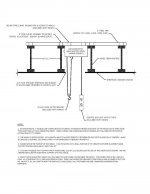
Here are my plans from the Jeep top. Be sure to blow up to 100% so you can read the notes. It has some dimensional data that might be helpful to you.
 

Attachments

  • image_20602.jpg
    image_20602.jpg
    78.5 KB · Views: 24
  • WINCH.jpg
    WINCH.jpg
    69.2 KB · Views: 54
Last edited:

akdiesel

Well-known member
Joined
Aug 8, 2008
Messages
2,617
Location
Wasilla, AK
The total amount of force is still being applied to the anchor.
The anchor being the hoist. Using a mechanical advantage to hoist things helps reduce the load on the motor or the person pulling on the load.
The wall in this case will still see the full amount being pulled, the only advantage is less force on the hoist.
I would not use lag bolts. Through bolts to the other side of the wall with a backing plate across two studs for support. You are probably only lifting approx a third or slightly more at that angle.
But once the trailer is upright, there is still a lot of weight pulling it down (axle, tires, etc...) so to secure it in that position over time safely and then to unlock it safely seems to more of a concern in my eyes.
 
OP
Y

yorkee

Member
Joined
Oct 11, 2011
Messages
19
After the feedback, I start thinking about the wall mount. Its actually an external wall. So I assume its strong enough...

Here are some design using a 24ga steel plate instead of 2x6.

9460129754_89870eb22a_o.png


9460129770_24cc2d8881_o.png


I can double deck the 24Ga plate. You think its strong enough to pull 400lbs?

Thanks.
 

rlitman

Well-known member
Joined
Oct 18, 2010
Messages
24,596
Location
Long Island
Thanks for everyone's input. A lot of good idea, and some very good points here.

I re-design it as follow:

https://sphotos-a-ord.**.fbcdn.net/hphotos-prn1/537181_540887612632891_776612124_n.jpg


The drawing is not quite proportional. I probably have to cut a hole at the ceiling for the tongue to go up.

The wall are interior wall. However, It separate my garage and my neighbor's garage.

Yes, 2000lb is the capacity. The trailer itself probably weight less than 500 lbs. I am 160lbs and I can push it up against the wall myself… so its not really heavy.

The thing I hate about the new design is more parts (which means more $), and there are two locations (the pulley and the hoist) I have to reinforce.

Anything I am missing?

Thanks again for all the input.

Did you catch 54FordPanel's comments about the "safety cage"?
That rectangular loop that the cable passes through activates a kill switch. When the red disc hits the cage, it stops the motor from pulling any more.
If the cable is pulled at a sufficient angle, the drag of the cable on the cage will also activate the switch.

Running the cable through a pulley like you pictured above gets you past this problem, but so does mounting the hoist on an angle to keep the cable centered in the cage.

The first method however completely loses the safety feature gained by that kill switch. When pulling through a pulley, if something jams up, this hoist will continue to pull until something breaks. That will happen IN AN INSTANT, with no warning. It may rip the block from the wall, it may rip the hoist from its mounting. But if either of those fail, there is a good chance that the trailer will end up dropped on you.

Food for thought when you plan this out.

I did something similar to use one of these hoists in a weird position. My answer to keep the safety cage working was to pass the line through a block of wood that was about the size of the red disc (so it would hit the cage), but that the line could freely slip through (ok, it was more complicated than just a drilled block of wood, because of course, I couldn't put that on the cable without cutting the spliced hook end off).
I carefully pulled the cable in until the point where it should not be safely reeled in any more, and slid the wooden block up to the cage. I then marked in marker the point where the cable entered that wood.

I then reeled the cable out, and used two hands to untwist the cable while my wife stuck a foot long piece of 14 gauge galvanized wire through the twists. When I let go, the wire was nicely stuck through the cable. I then twisted the wire around the cable to make a wrap that would not move. This wrap passes perfectly smoothly through pulleys, but catches on that block of wood (which is drilled to pass the cable, but not this thicker part). So when I hoist too far up, the wrapped cable catches on that wood, and drags it into the cage. No more safetly problem.
 
Last edited:

54FordPanel

Well-known member
Joined
Aug 7, 2009
Messages
5,711
Location
Fort 54, Littleton, Co
Did you catch 54FordPanel's comments about the "safety cage"?
That rectangular loop that the cable passes through activates a kill switch. When the red disc hits the cage, it stops the motor from pulling any more.
If the cable is pulled at a sufficient angle, the drag of the cable on the cage will also activate the switch.

Running the cable through a pulley like you pictured above gets you past this problem, but so does mounting the hoist on an angle to keep the cable centered in the cage.

The first method however completely loses the safety feature gained by that kill switch. When pulling through a pulley, if something jams up, this hoist will continue to pull until something breaks. That will happen IN AN INSTANT, with no warning. It may rip the block from the wall, it may rip the hoist from its mounting. But if either of those fail, there is a good chance that the trailer will end up dropped on you.

Food for thought when you plan this out.

I did something similar to use one of these hoists in a weird position. My answer to keep the safety cage working was to pass the line through a block of wood that was about the size of the red disc (so it would hit the cage), but that the line could freely slip through.
I carefully pulled the cable in until the point where it should not be safely reeled in any more, and slid the wooden block up to the cage. I then marked in marker the point where the cable entered that wood.

I then reeled the cable out, and used two hands to untwist the cable while my wife stuck a foot long piece of 14 gauge galvanized wire through the twists. When I let go, the wire was nicely stuck through the cable. I then twisted the wire around the cable to make a wrap that would not move. This wrap passes perfectly smoothly through pulleys, but catches on that block of wood (which is drilled to pass the cable, but not this thicker part). So when I hoist too far up, the wrapped cable catches on that wood, and drags it into the cage. No more safetly problem.

Good point and good solution. Does it consistently work like it should?

Maybe the best thing is to mount it at an angle on the wall, or on a bracket where it can be swiveled and then fixed at an angle.
 
OP
Y

yorkee

Member
Joined
Oct 11, 2011
Messages
19
Good catch! I caught the angle part (thats why I have one pulley to make it straight) but I forgot about the safe stop...

I guess I will run the hinch on the floor. That way I can put stopper with moveable range of the height of my garage...
 

kbs2244

Well-known member
Joined
Nov 11, 2006
Messages
14,065
Also remember that the more to the front of the trailer you attach the end of the cable the longer you make the lever and lessen the force needed to tilt it.

I would put it in the ceiling, spaced from the wall the distance that the tongue would be when it is standing on end. So you end up with the cable vertical.

I am assuming you have some kind of stops that keep the trailer from backing up and rubbing on the wall while tilting.
 

COBRA5LADDICT

Active member
Joined
Feb 20, 2008
Messages
36
been there. I made a mount plate that that tied into the floor joists above and the wall studs. it worked great.. only problem I had was getting the back end of the trailer to not skid on the floor when lifting. I ended up using some rubber backed carpet tiles.
 
OP
Y

yorkee

Member
Joined
Oct 11, 2011
Messages
19
been there. I made a mount plate that that tied into the floor joists above and the wall studs. it worked great.. only problem I had was getting the back end of the trailer to not skid on the floor when lifting. I ended up using some rubber backed carpet tiles.


Awesome idea! I may steal that.

Did you flab the metal plate yourself? How thick and what stud you use to secure it?
 

rlitman

Well-known member
Joined
Oct 18, 2010
Messages
24,596
Location
Long Island
Good point and good solution. Does it consistently work like it should?

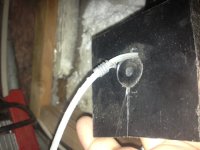
I think the picture should clear up how I did it.

I cut a slot in a piece of 1/2" thick UHMW plastic that leads to a hole sized for the cable. To lock the cable in, I cut a larger hole in the slot using one sized hole saw, and use the plug from the next larger sized hole saw to plug the circle.

The first time I tried, the hole for the cable was too close fitting, and the cable dragged the plastic and would shut the hoist down. It needs to be kinda loose, but still tight enough to reliably never let that twisted wire through. This was especially important in my use, because the plastic piece wants to fall down into the cage when mounted upside down as I have it.

Right now it works great. I have the hoist mounted pretty much upside down, on a pipe secured to my attic floor. The cable has a pulley which hooks onto a ring above my attic stairway so I can easily lift an air conditioner into the attic. This mechanism prevents the hoist hook from jamming in the pulley.

I know the wire looks like it just wraps around the cable. But it needs to pass through at least once to lock it into position. If it can slide, it is pointless. But as you can see, the plastic will just slide up to the next pulley and stop there while the cable glides through it. The wire wrap will easily pass through any pulley that the cable works in.
 

Attachments

  • photo.JPG
    photo.JPG
    101.9 KB · Views: 23

COBRA5LADDICT

Active member
Joined
Feb 20, 2008
Messages
36
I made the mount from some 14ga scrap I had around. I marked the studs on the wall and the joists in the ceiling then drilled the mount and mounted it all with some 3" 5/16 lag bolts. I ended up getting into a total of 7 or 8 studs or joists. No cracks in the drywall so I don't think anything is moving around.
 
OP
Y

yorkee

Member
Joined
Oct 11, 2011
Messages
19
Finally have the hoist up!

https://scontent-b.**.fbcdn.net/hphotos-ash4/1185262_557351564319829_40630545_n.jpg

https://scontent-a.**.fbcdn.net/hphotos-ash3/1235048_557351627653156_110673117_n.jpg

1238039_557351594319826_1434807091_n.jpg


This is the raw basic functionality. Still have some work to do... the safety cage, secure hook, make more space on the roof for the tongue...
 
To avoid these ads, REGISTER NOW!
Top Bottom