To avoid these ads, REGISTER NOW!

Home Foundation must do’s

Iowadriver

Member
Joined
Feb 20, 2018
Messages
21
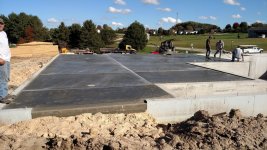
There’s a few things I’ve learned while having the foundation for my new home poured. If you have some things that you have done or have heard of pre/post foundation please post. Im interested to here the ideas. My foundation hasn’t been back filled so I’m personally looking for ideas. The few that I’ve done/consider are:

9’ basement walls, really adds to the size.

Drains from window wells to sump pump.

Spray on waterproof on outside of foundation.

Dedicated utility room.


Sent from my iPhone using Tapatalk
 
To avoid these ads, REGISTER NOW!

jkeyser14

Well-known member
Joined
Dec 19, 2008
Messages
1,818
Location
(rural) Maryland
3 prong approach to waterproofing:
#1: Spray on liner or stick on membrane.
#2: Drainage mat to prevent hydrostatic pressure.
#3: French drain run to daylight (or sump pit only if daylight not possible).

Also, add exterior foam insulation to the foundation walls. This can go on either side of the drainage mat. I ptefer the outside of the mat since it helps protect it during backfilling.
 
OP
I

Iowadriver

Member
Joined
Feb 20, 2018
Messages
21
3 prong approach to waterproofing:
#1: Spray on liner or stick on membrane.
#2: Drainage mat to prevent hydrostatic pressure.
#3: French drain run to daylight (or sump pit only if daylight not possible).

Also, add exterior foam insulation to the foundation walls. This can go on either side of the drainage mat. I ptefer the outside of the mat since it helps protect it during backfilling.


Where does the drainage mat go?


Sent from my iPhone using Tapatalk
 

ConCretin

Well-known member
Joined
Jan 20, 2011
Messages
3,378
Location
Central Maine
I second the comments regarding water management. Depending on soil conditions and your water table, the requirements could be as simple as damp proofing or as complicated as water proofing, drainage mat and drain piping. This is one of those cases where overkill is just enough. You'll never regret having a dry basement and going back later to fix a wet basement adds tremendously to the cost.

Drainage mat usually consists of a dimpled plastic sheet bonded to filter fabric. It goes right over the waterproofing and creates a void for water to drop down to a footing drain.
 
Last edited:

wrenchguy

Well-known member
Joined
Sep 22, 2011
Messages
4,697
Location
NW Indiana
Inside, create multiple positive drainways in the SOIL under the basement floor to ur sump pits. Then after that fill area with clean stone to ur pour grade. Lastly cover area with quality vapor barrier. This will prevent permanent ponds under floor area when the pump quits.
Outside, backfill with clean stone as much as u can. I schemed a plan around the overdig and brought the stone 2' short of final grade. Getting water to the drain tile as fast as possible is key.
 

Innovate1

Well-known member
Joined
Jul 28, 2014
Messages
4,288
Location
Illinois near St. Louis, Missouri
That vault/safe room under the front porch thing.

Great plan - did that on the current home. Although some areas have rules that make that difficult - ventilation, insulation, etc. Was planning to build in one area and we gave up on the safe room - think part of the issue may have been the plans guy not knowing how to label and draw things that met the AHJ requiremetns. Ended up scrapping that location completely for several reasons but one was all the red tape.

If you have a precast hollow core plant near you that is reasonable for small jobs that is ideal. That's what we did but they have stopped making the thinner slabs and the costs have gone way up.
 

yeldogt

Well-known member
Joined
Jan 2, 2012
Messages
18,184
Deep basements are great where needed for utilities .. but they can throw off design/ space feeling if not done correctly for a living area.

I have never lived in an area where I needed a safe room .. but water and radon are issues.

I always do a spray on foundation coating w/ thin layer of insulation. I like the green stuff currently. Inside and outside drain in stone ... heavy VB under the slab w/ plenty of stone. I usually do install a sump pit with an overflow from the internal loop of drains --- just in case. It's lower in the ground vs the exterior at the footing level ... Sealed lid for radon on the pit.

With new block or solid foundation I have never had any water issues --- on old foundations or stone ... I trench and fill the whole thing with stone.

With widow wells -- even on old houses -- I have never had any issues. I use the grid covers -- not much water gets in?

Having a utility plan for basement mechanicals is important -- it can solve a lot of issues later.

EDIT: I agree with a later poster that the soil/stone pipe is often not done correctly. You can't just place a layer of landscape fabric and call it done. It takes much more stone vs what most want to use and you have to get the pipe correct and wrap the layers .. not just cover.

Shallow trenches can actually heave the pipe because the pipe is too high in the trench
 
Last edited:

BD1

Well-known member
Joined
Mar 18, 2007
Messages
4,602
Location
north side
I went with larger I beams 12x58 , to minimize posts / columns.
Floor drain for furnace and water heater.
My laundry room on main floor of my hillside ranch.
A sump pump and or ejector pump for bath, floor drains, and drain tile


Sent from my iPhone using Tapatalk
 

stokefire7

Well-known member
Joined
Oct 5, 2011
Messages
616
Great plan - did that on the current home. Although some areas have rules that make that difficult - ventilation, insulation, etc. Was planning to build in one area and we gave up on the safe room - think part of the issue may have been the plans guy not knowing how to label and draw things that met the AHJ requiremetns. Ended up scrapping that location completely for several reasons but one was all the red tape.

If you have a precast hollow core plant near you that is reasonable for small jobs that is ideal. That's what we did but they have stopped making the thinner slabs and the costs have gone way up.

Never thought about pre-cast. Good idea.
Illinois native myself . :hellobye: Still have family and tools there.
 

jkuro

Well-known member
Joined
Apr 28, 2009
Messages
552
Footer drains ,backfilled with rock to within 12" of grade. Cover rock with landscape fabric and finish with dirt. If its not to late place some plastic sheeting over your waterproofing and under the footer drains. If that's not enough place footer drains on the inside of the basement with about 6" of gravel on the entire floor before you pour
 
Last edited:

3onthetree

Well-known member
Joined
Nov 14, 2018
Messages
191
Keeping these points to the exterior of the poured foundation wall, here's the best current technology can offer:

- Mortar cant strip at the footing/wall connection
- Footing drain tile, solid perforated pipe, socked, at or a couple inches above the bottom of the footing. Connected to sump pump (daylight is for walk-outs). Vertical cleanouts to above grade at every corner.
- Window wells graveled, then piped into footing drain tile.
- Asphaltic emulsion damproofing. This will prevent standing moisture penetration through concrete, but does not span across cracks that WILL develop (you might call this "tar").
- Self-adhered sheet waterproofing (you might call this "sticky membrane"). This will expand a bit and still cover those cracks that WILL occur (but surely will get brittle over time).
- Exterior rigid insulation. This is the best location for basement insulation, as any condensation occuring will be outside.
- Dimpled membrane, another product that is similar to what the gravel does for redundancy. There are two ways to install this, one with the dimples toward the concrete. This provides a drainage plane down to the drain tile. The other way is toward the soil, which requires a fabric on the dimples. This way alleviates more hydrostatic pressure.
- Fabric wrapped (like a burrito) gravel from the drain tile all the way to within 6" of grade (Most contractors will not do this because of the labor involved - backfill soil, leave room for 12" plane of gravel, then compact. Repeat in lifts of 6"-12").
- Grade sloped away from foundation, 8" below sill.

There are specific details in installing each, like making sure the damproofing is compatible with the rigid insulation, covering the exposed insulation and capping it and the membrane, the direction to point the pipe holes, etc.
 
Last edited:
To avoid these ads, REGISTER NOW!

gml1998

Well-known member
Joined
Mar 1, 2014
Messages
201
Definitely use drainage mat. Hydrostatic pressure bowed my poured walls 4 inches.
 

larry4406

Well-known member
Joined
Jan 27, 2006
Messages
19,157
Location
Northern Virginia
Footer weep holes 2” diameter every 8’ entire perimeter. Draintile inside and out at weep elevation encapsulated in #57 stone. Walls sprayed with hot spray bitumen water proof (not the “damp proof” nonsense) after snap ties broken off and covered with pitch. Drain board installed over the tar to prevent scarring during backfill. GeoTech fabric over exterior gravel bed to prevent contamination from soil fines. Internal draintile in 4” stone bed under slab also separated via vapor barrier. Internal draintile connected to sump crock.

It all goes to **** here. Don’t skimp. +1 on daylite if grade is favorable.
 
Last edited:

MushCreek

Well-known member
Joined
Jan 14, 2015
Messages
9,763
Location
Upstate South Carolina
I did the drains, waterproofing membrane, dimple board, and gravel backfill. The basement has always been bone dry. I also graded away from the foundation, and the house has large overhangs and gutters to further control water near the house. Overall topography plays a key role as well. If you build at the bottom of a bowl, you're gonna have trouble.

One thing I wish I had done was use floor trusses. I used I-Joists, and they're great, but a PITA to run plumbing and wiring through. The drains were a particular hassle.
 

Milton Shaw

Well-known member
Joined
Feb 11, 2011
Messages
4,836
Take pictures of everything that is going to be buried or concreted over. It will save you some time 15 or 20 years from now if something breaks of you need to add something. Go on and print the pictures and keep them in safe with homeowner papers. Spend as much as needed now to keep it dry, sump pump, drainage, covering. Now its at least 20 times cheaper than digging it back up.
 

Ing3018

Well-known member
Joined
Sep 3, 2009
Messages
185
Location
Michigan, USA
As others have mentioned:
Control surface water - All areas need to drain away from your building- Roofs, sidewalks, driveways, adjacent ground.
Control soil moisture - Sealing and vapor barriers under floor and on walls. Waterproofing if needed.
Control soil gas - check your soil for radon and design for that if present. Floor penetrations for sumps or condensate drains in radon soils should be designed to vent.
Insulate the basement walls on the exterior and the slab underneath.
Consider radiant tube heating for the floor.
Treat adjacent soil for termites if that's an issue in your area.

You didn't say what kind of soil you are building in or what climate you are in. Check out the site Buildingscience.org. They discuss different approaches for basement design for different climates.
 

joes169

Well-known member
Joined
Sep 19, 2011
Messages
663
Location
WI
Lot's of folks mentioned draintile at the footing, but I would HIGHLY recommend looking at "Form-a-Drain" vs. typical 3-4" curraged tubing that isknown to clog with soil fines eventually. "Form-a-Drain" carries more water at a faster rate to the crock (or daylight) and also carries water at a lower elevation. Much easier to keep at a level elevation also, which helps reduce sediment build up.

https://buildblock.com/products/accessories/form-a-drain/
 

GTO

Well-known member
Joined
May 8, 2009
Messages
3,927
Location
NJ,FL
Read online reviews before recommending them...

ok buddy...YMMV,but I can take you by dozens of homes in my area that have Superior Walls,and talk too many Contractors as well that use them for every home they build.(NJ) btw
 
OP
I

Iowadriver

Member
Joined
Feb 20, 2018
Messages
21
Agree. Spray on waterproofing is not adequate, IMO


How much gravel are you guys putting in? 2’? My contractor has a small pile on top of tile and footing that’s all


Sent from my iPhone using Tapatalk
 

Coyote556

Well-known member
Joined
May 6, 2013
Messages
108
Location
The Show-Me State
Back fill gravel to 18” from the surface if you are in an expansive clay area. Expensive, but you will be glad you did in 15years when the other basements are cracking and getting pushed in
 

slimcake

Well-known member
Joined
Sep 27, 2016
Messages
929
Heres mine. Love my safe room there in the first picture. They wanted to fill it with sand ffs....
 

Attachments

  • IMG_20160901_115338166.jpg
    IMG_20160901_115338166.jpg
    138.4 KB · Views: 40
  • IMG_20161005_153003849.jpg
    IMG_20161005_153003849.jpg
    152.7 KB · Views: 37

matt_i

Well-known member
Joined
Mar 14, 2008
Messages
10,725
Location
SE Michigan
I think the biggest advance outside of waterproodfing the walls is the advance of geo fabrics to protect the drainbed at the bottom of the wall.

Im going to go out on a limb and represent most of the ones built in the mid 90s and earlier are filling up with clay slit fines to the point where they are non-functional where that soil type is present because there really wasn't geo fabric at that time.
 

jetnow1

Well-known member
Joined
Jun 27, 2016
Messages
511
Location
CT.
Don't know about Radon in your area but the time to address it is when doing the foundation if possible. Your local health dept can probably tell you how common it is in your area, but remember two houses next to each other can have very different levels.
 

Parrothead

Well-known member
Joined
Apr 27, 2014
Messages
5,346
Location
Earth
There’s a few things I’ve learned while having the foundation for my new home poured. If you have some things that you have done or have heard of pre/post foundation please post. Im interested to here the ideas. My foundation hasn’t been back filled so I’m personally looking for ideas. The few that I’ve done/consider are:

9’ basement walls, really adds to the size.

Drains from window wells to sump pump.

Spray on waterproof on outside of foundation.

Dedicated utility room.


Sent from my iPhone using Tapatalk

Or 10’ walls if available in your area. People line up to buy those in my market.
 
To avoid these ads, REGISTER NOW!
Top Bottom