To avoid these ads, REGISTER NOW!

Hot Dawg install: electrical and thermostat

Mainiac Mat

Well-known member
Joined
Sep 2, 2020
Messages
409
Location
Maine
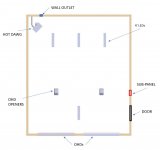
I pulled the trigger on a 60K BTU Hot Dawg and am planning out the install. I have some decisions to make regarding the electrical. I have lots of options as I have yet to close in the walls (open stud bays), so I want to make a decision based on my intended use, which is to only heat the garage when I'm working out there.

attachment.php


Option 1:
The easiest way to get power to it would be to tap into a 20 amp outlet box right below the unit, wire it up to a box with a light switch (for use as a disconnect) and then from their box in the ceiling, and from there to the heater with MC. This also puts the disconnect near the heater (code?). I'm not really worried about the power draw, as it is only ~4 amps. The down side of this option is that the switch is remote from the side entry, so I'd have to walk across the garage to flip the heater on.

Option 2:
The next option would be to wire a dedicated circuit and have the switch by the breaker door. This way I could easily flip the heater on, then come back out in 15 min. to start working. But this leaves me without a disconnect close to the heater. Perhaps I could terminate the circuit at an outlet box in the ceiling near the heater and connect the heater with an appliance cord with a plug.

The next decision is where to put the thermostat. Because it's a low voltage (24 v) system, I don't think I have any concerns about the wiring run being too long. And if that's correct, I think the best location is again, by the door.

So what say yee.... option one or two for wiring? Thermos by unit or by the door.
Hot Dawg wiring.JPG
 
To avoid these ads, REGISTER NOW!

penright

ALLIANCE MEMBER
Joined
Dec 27, 2016
Messages
618
Location
SW of Mustang, OK
This is what I am looking at on mine, so if my thoughts are off, I hope someone jumps in and corrects me.
The first thing that helped me was learning what the letters on the terminals mean and that help me infer how they work.
This video is what it takes to hook up a Big Maxx to wifi thermostat.
The big thing watching it was showed me what the letters mean. I bet if you searched this forum and youtube there are a ton of them.

The big thing is R and W. R is power (24V AC) and W energized whatever is needed for the Heater to come on. So mechanical heater only thermostats need only those two wires. I assume whatever relay mechanism the heater has, the other side of the 24V, which they call common, already connected. So all you are doing is switching the R to the W.

So if you put a 120V outlet for the heater to the plugin, then you have a disconnect for the heater. Then if you put a switch in between the thermostat W and the heater W, you can turn the heater off no matter what the temperature is. So you don't have to switch power to keep it off when you are not in there. Here is a thread here that is discussing the issues of why some thermostats will not go low enough to "shut them off". The issue as I understand it has to do with condensation and running it long enough to evaporate any off. I think that is only an issue if you are running low temps in a 24/7 scenario. I think we would be ok, since most of the time when we run it, it will be enough to evaporate any moisture.

Now when you get into smart thermostats, you need the C brought to the thermostat. That way you have 24V AC for the thermostat electronics. Also, there is a G That controls the fan. The rest of the letters has to do with AC.

I think a lot of this is standard, but I am giving the normal disclaimers to try at your own risk. I am not heat and air guy, just a DYI'r :)
 

naturalgas

Well-known member
Joined
Dec 6, 2014
Messages
497
Location
Metrowest Ma.
It should have its own 15 amp circuit . A shut off switch either mounted on unit or close by. You can put thermostat anywhere you want.


Sent from my iPad using Tapatalk
 

spudley

Well-known member
Joined
Dec 27, 2016
Messages
702
Location
Northeast Wisconsin
I have a 15 amp dedicated circuit. I turn the heater on at the thermostat when needed. If I need to service the unit, I flip the breaker.
 

Showkey

"MEMBER EMERITUS"
Joined
Aug 9, 2014
Messages
8,638
Location
Wausau WI
T stat next to the power supply.
Near the door it’s in the warm draft area and will shut down heat too early.
Near the power supply the cold air circulation path will keep the T stat honest.
 
To avoid these ads, REGISTER NOW!
OP
M

Mainiac Mat

Well-known member
Joined
Sep 2, 2020
Messages
409
Location
Maine
O.K. guys... dedicated circuit with switch on back wall behind the unit... next to the T-stat.

Not the convenience I was hoping for, but the reasoning makes sense.

The unit came from the distributor with a freebie generic heat only thermostat. I'll have to check whether or not it has an on-off switch.

I'm gathering that it's better to shut the unit off at the T-stat to ensure it goes through the cool down cycle.
 

Showkey

"MEMBER EMERITUS"
Joined
Aug 9, 2014
Messages
8,638
Location
Wausau WI
You might consider heating to some level ( like 50*)* all the time.
Convenience, comfort, minimal condensation, never freezes, no wait are high on the list.
If your on Nat Gas depending on your gas rate and insulation...........many of us find it’s less than a $1.00 per day during the coldest months.

* some set at lower temps like 32-40*. The heater manufacturers specifications say minimum intake air temp is 50*.
 

banjopete

Well-known member
Joined
Oct 5, 2014
Messages
302
Location
Edmonton, Alberta, Canada
I like the on off by the unit however you do it and the tstat out of the direct line of the fan like you are planning.

I'm quite a ways north and in deep cold for a good 4 months a year and pay around $20/mo to keep my 24x26x8 heated to 6 deg Celsius year round with fairly regular garage work time thrown in where I'll really warm it up. That's just for the cold months not avg out through the year. Quite economical for me.

Sent from my SM-G960W using The Garage Journal mobile app
 
OP
M

Mainiac Mat

Well-known member
Joined
Sep 2, 2020
Messages
409
Location
Maine
Heating year round would be nice, but we burn LPG and pay ~$2.40/gal

I did run a heat loss calc. and came up with min heater size of 32K BTU and an estimated fuel cost of $175/mo. in the dead of winter. But that's more than I want to pay to heat space that is largely unoccupied.

Now getting a warehouse thermometer and heating to 40 deg. F and bumping it up when I work out there might be doable...... I think I'll do some research on that as the manufacturer's recommendations may be less applicable for condensation might be less of a concern when venting horizontally our of a short (40") Cat. III stainless steel pipe with a downward slope on it.
 
OP
M

Mainiac Mat

Well-known member
Joined
Sep 2, 2020
Messages
409
Location
Maine
Alright... I decided to stop being lazy and to dig deeper into the Installation and Service Manual..... Pg. 2 Special precautions.....

#6. Low profile heaters are designed for use in heating applications with ambient startup temperatures between -40°F and 90°F, and ambient operating temperatures between 40°F and 90°F.

I'm going to assume that using a warehouse T-stat and running it set to 40 deg. will be OK.
 
OP
M

Mainiac Mat

Well-known member
Joined
Sep 2, 2020
Messages
409
Location
Maine
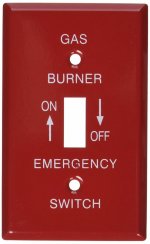
So do you guys think I should use a red switch plate cover for my disconnect switch? Code? Good idea? Bad idea?

1.jpg
 
To avoid these ads, REGISTER NOW!
Top Bottom