To avoid these ads, REGISTER NOW!

Hot tools

bluedog225

Well-known member
Joined
Jan 31, 2012
Messages
3,241
Location
Texas
Do you guys think it’s better to let a tool cool off on its own or run it unloaded to cool it off?

Specifically, my big Milwaukee cordless drill. I’m running 2 1/2 inch Simpson SDS screws into LVL.

The bracket takes 26 screws. By the time I finish, the exhaust is too hot to handle. I could run it longer, but I don’t want to melt the solder joints as I’ve done in the past with one of these.

I know it’s a quality tool, but it seems like it should be able to stand up to some longer use. I can switch to a corded tool. Maybe that’s the answer for something like this?

I vaguely recall my Milwaukee corded metal cutting saw specifically said to run it unloaded to cool it down

Anyway, it’s slowing the job down. I have to switch to some other task for half an hour to an hour and then go back to it.

I could lube these screws with toilet ring wax. But I don’t think the Simpson engineers would approve.

What do you think?
 
To avoid these ads, REGISTER NOW!

Milton Shaw

Well-known member
Joined
Feb 11, 2011
Messages
4,835
If overheating is the problem the only drill that won't have problem is what is used in industrial service an air powered (pneumatic) tool. That is why air powered tool still win hands down in commercial and industrial use. There cooling is what makes it operate so it cannot overheat ever and is also safe in wet locations and never will shock you. Other wise get a couple of more drills and swap them out to let them cool. Maybe 3D print a holder to cover half the air vents on the drill and incorporate a small fan to speed the cooling up or attach a vacuum hose and **** more air through it than it flows by internal fan alone. Even a air nozzle boosting the cooling air through the drill vents. Cheapest and longest lasting would be a pneumatic air drill like used in aircraft and automotive construction.
 

nadogail

Well-known member
Joined
Jan 23, 2009
Messages
31,907
Location
Coronado, CA
I have found that if I poke my screws into a cake of wax they screw into the wood faster and easier. I get my wax from New Unused Toilet Rings and melt them into a reusable refrigerator container.

A 100 Watt light bulb makes a nice heat source.
 
OP
B

bluedog225

Well-known member
Joined
Jan 31, 2012
Messages
3,241
Location
Texas
I like the wax idea. But I’ve been reading up on epoxy setting threaded rods into concrete holes the last couple of days and the things I think would make a difference or would make an improvement, are all wrong.

The general theme of those discussions is, don’t mess with Simpson products. My clever ideas will not help.🍻

It hasn’t occurred to me to use an air tool. What a great chance to buy a new tool. Probably easier to handle as well. Thanks.
 

PCustoms

Well-known member
Joined
Jul 23, 2011
Messages
22,326
Location
VT
You talking the normal screws used on the hangers?

No reason that should be heating your drill
 
OP
B

bluedog225

Well-known member
Joined
Jan 31, 2012
Messages
3,241
Location
Texas
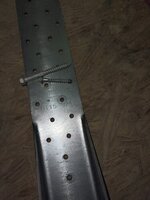
it’s the quarter inch Simpson SDS screws. Go into an HTT5 hanger. The drill has to grunt a little bit to get through those hanger holes.

It’s a relatively late model Milwaukee M28 hammer drill. Less than five years old from memory. Its predecessor heated up pretty good as well.
 
OP
B

bluedog225

Well-known member
Joined
Jan 31, 2012
Messages
3,241
Location
Texas
That’s a surprise. Just looking at the size of the holes, I misjudged them for 1/4. Also surprising given the beefiness of this hanger. And the three-quarter inch bolt it attaches to.

Using the small smaller screws will make this job a lot easier. Thanks.
 

MOS3522

Well-known member
Joined
Nov 6, 2022
Messages
1,768
Location
Colorado
Right. It’s got hammer drill function. But also it’s a regular drill.

Thought so, as I said switch off hammer mode and it's fine. But as several have said an impact gun is going to be a lot better.

Project Farm came out pretty strongly on Dewalt being > Milwaukee, but sounds like you are a red battery guy in which case you should get Milwaukee.


RoninB4

Well-known member
Joined
Jul 22, 2020
Messages
3,484
Location
Under My House
Just looking at the size of the holes, I misjudged them for 1/4.
-Not to pile-on but your non calibrated eyeball is the root of this problem. Using the wrong fastener (Simpson spec) means you've likely been requiring the too-large-for-the-hole 1/4" fasteners to act as a forming tap, creating internal threads in the metal hangers. It's little wonder that overheating and excessive time are the result. After decades of machine shop work I still use a caliper for hole size when a fastener has to go through the hole. You never know when the production run gets the hole size wrong. Get in the habit of taking a couple of extra seconds to measure things. Just a suggestion.
Using the small smaller screws will make this job a lot easier.
-I'll bet it would serve you well to remember why this occurred.
 

CV428

Well-known member
Joined
Dec 12, 2019
Messages
156
I usually set up a small work fan for myself (I overheat extremely easily thanks to Lyme disease). If a tool gets warm to the touch, I rest it on the fan. Never have an issue, really, as long as I take a moment to put the tool down for 10-15 seconds.

The one exception was when I melted my M18 Milwaukee drill... I ignored the fact it was burning my hand and kept drilling concrete (I have a 15 amp hammer drill, but the smallest bit snapped when I was drilling brick the same day). The drill caught fire, so I tossed it in the grass. It still works but sounds awful.

As for the question about running them at no-load, that's a fun thermodynamics question. That only works if the fan can dissipate more heat than the motor and all internal friction is generating. Lower load = less heat generated = it has a chance... Some tools are better than others. You really need RPM to move air. Some power tools don't even have a cooling fan. Your mileage may vary.
 

Old tool guy

Well-known member
Joined
Apr 13, 2023
Messages
3,166
“After decades of machine shop work I still use a caliper for hole size when a fastener has to go through the hole. “

I can’t use a caliper, but i can read the spec sheet.
 
To avoid these ads, REGISTER NOW!

PCustoms

Well-known member
Joined
Jul 23, 2011
Messages
22,326
Location
VT
“After decades of machine shop work I still use a caliper for hole size when a fastener has to go through the hole. “

I can’t use a caliper, but i can read the spec sheet.

Even better, if the screw doesn't go through the plate I just grab a smaller screw. Can't say I've seen many calipers come out during framing...
 

RoninB4

Well-known member
Joined
Jul 22, 2020
Messages
3,484
Location
Under My House
Even better, if the screw doesn't go through the plate I just grab a smaller screw.
-If you measure before buying it avoids a trip to return the useless 26 fasteners per hanger for what does fit. Too many details?
Can't say I've seen many calipers come out during framing...
-Perhaps so, hope your framing is better than your HVAC ducting work ;) (just kidding)
 
OP
B

bluedog225

Well-known member
Joined
Jan 31, 2012
Messages
3,241
Location
Texas
It’s a little unfortunate. I got probably 60 or 70 pounds of these SDS screws for just about nothing.

As far as I can tell, Simpson doesn’t appear to support drilling out the HTT5 hangers to accept them.

With a quarter inch hole, the SDS screws would be a tight fit. I don’t think I would run into the elongation derating. Those number 10 screws seem like thin soup.


IMG_6195.jpegIMG_6148.jpeg
 

Old tool guy

Well-known member
Joined
Apr 13, 2023
Messages
3,166
As far as I can tell, Simpson doesn’t appear to support drilling out the HTT5 hangers to accept them.
I can’t believe you would even consider that idea. You’re making a non-engineered and non-tested field modification to their product, for which they have liability.
 
OP
B

bluedog225

Well-known member
Joined
Jan 31, 2012
Messages
3,241
Location
Texas
It’s ok to think about things.

I’d do a pull out test with the No 10 and the 0.25’s if I had some spare material laying around.
 

Wolley

Well-known member
Joined
Jun 24, 2022
Messages
420
Location
Maine
Waxing screws??? What is it 1980. Got use one of these and ditch that Milwaukee.
 

Attachments

  • FCRTUKNISCBEXIW.jpg
    FCRTUKNISCBEXIW.jpg
    323.8 KB · Views: 14

Old tool guy

Well-known member
Joined
Apr 13, 2023
Messages
3,166
When i used brass screws for woodworking projects i would wipe them on a bar of soap. Lightly.
 

RoninB4

Well-known member
Joined
Jul 22, 2020
Messages
3,484
Location
Under My House
With a quarter inch hole, the SDS screws would be a tight fit.
-Apparently they're currently enough of a tight fit to have caused the problem that gave you reason to post this. Numbers will tell you just how tight a fit they are. Just because you can force them in doesn't mean an interference fit is the right option to do here. Drilling the holes larger so you can use wrong fasteners? Doubling down on bad decisions seems like a lot more work than just exchanging for the correct fastener.
I don’t think I would run into the elongation derating.
-If the fastener OD is larger than the hole then metal is being displaced somewhere, either off the fastener or the hanger. Displaced metal means distortion. For one or two holes it's probably no big deal, but for 26 holes the cumulative distortion may add up to something objectionable. I'd sooner trust the engineering and FEA from the maker and use the spec'd #10 fasteners than a gut feeling or some half-assed "pull test" if the application was critical/important. Did I miss what this was for?
Those number 10 screws seem like thin soup.
-They may seem too small to you but consider how many are used (26?) that reduces the load per fastener. Do what you want but I'd sooner trust the engineered spec from a long standing company like Simpson than some dead reckoning estimation from your less experienced background. Not knocking you either.
 
Last edited:
OP
B

bluedog225

Well-known member
Joined
Jan 31, 2012
Messages
3,241
Location
Texas
Agreed. Simpson knows what they are doing. And it’s a nice safe harbor. The No. 10s are spec’s and will work fine. I’ll have to find another use for all the SDS. Though drilling a using the SDS isn’t necessarily wrong, it’s not specified or approved by Simpson. And would require review and testing. There’s a difference.

I’m adding hold-down to the LVL rafters through top plate to the stud. In addition to the Simpson “hurricane“ ties. I want more hold-down capacity. I pulled a few of the H2.5A’s and they used short joist hanger nails. I’ll post a pic next time I’m out there.

I know it’s not the intended use of the HTT5. But it’s a tension load and seems in the spirit of the design. Two HTT5-3/4 in opposition.

Thanks all.
 

PCustoms

Well-known member
Joined
Jul 23, 2011
Messages
22,326
Location
VT
Though drilling a using the SDS isn’t necessarily wrong, it’s not specified or approved by Simpson.

That makes it wrong.

Doing what you think is "stronger" may actually have negative effects, especially in lumber.
 
OP
B

bluedog225

Well-known member
Joined
Jan 31, 2012
Messages
3,241
Location
Texas
That makes it wrong.

Doing what you think is "stronger" may actually have negative effects, especially in lumber.

It’s not wrong. It might be weaker. I suspect it will be stronger. We are talking about a sheet of metal and wood screws. Not the space shuttle.

Simpson designs are approved and tested. That’s great; and convenient. They specs do not preclude independent judgment and analysis.

Me cranking SDS screws into a hole that was too small is problematic for a lot of reasons. Putting the SDS screws through a properly sized hole has some fairly predictable results.
 

dscheidt

Well-known member
Joined
Apr 26, 2017
Messages
2,882
Simpson designs are approved and tested. That’s great; and convenient. They specs do not preclude independent judgment and analysis.

You've only provided evidence that neither judgement nor analysis have been used in your plans.
 
OP
B

bluedog225

Well-known member
Joined
Jan 31, 2012
Messages
3,241
Location
Texas
My favorite job in my entire career was working with engineers. I love the way they think. I appreciate all the good input here.
 

KnurledNut

Well-known member
Joined
Jan 28, 2011
Messages
8,096
Location
n/a
Lead framer emeritus here...
Since these are not being used for their intended purpose, it really doesn’t matter.
They are now glorified rafter ties and overkill as is.
If this was a customer request, I would nix the whole idea and get a stronger hurricane tie that is rated for the application or do a combination of them for liability reasons.
Simpson offers several different versions. They also have long rafter screws, but I wouldn’t recommend those due to the weak substrate side grain.

If these tension ties were the only option, I would have no issue drilling the holes 1/32nd bigger to accommodate the larger screws. Simpson does allow predrilling base material for the SDS screws, which I would do with a self-centering bit.
Two of these in opposition sandwiching a double plate is not a bad idea at all, especially if bearing plates are used. It would be stronger than any of the engineered rafter ties as it connects the stud and not just top plates. The smaller screws would be preferred on the stud side installation to prevent splitting.

I am guessing most of the commenters here have never personally built a home with an engineered lumber package? Its a whole different animal. LVL’s are dense. The larger screws will be less likely to break off or be compromised during installation.
 
To avoid these ads, REGISTER NOW!
Top Bottom