Something that I'm not understanding?


as far as I know we never did allow combined ground & neutral . our stoves & dryers were always hard wired until about 1970 ish , when plug & receptacle started to come in .We don't allow that sort of stuff any more
Thats a typical 30A twist lock generator plug.
EDIT: and it is typically used on 120V. So there would be a ground and a neutral both.
I've never seen a dual voltage 3 prong twist lock plug for a generator .I have some 30 amp generator cords with this type plug/receptacle.
You can buy lots of stuff at stores that are not code compliant.as far as I know we never did allow combined ground & neutral . our stoves & dryers were always hard wired until about 1970 ish , when plug & receptacle started to come in .
Hubbell was making plugs and receptacles long before NEMA was standardizing them. Sure, you didn't need a plug for a range or dryer when it could just as easily be hard wired with no additional expense, but the same can't be said for many other things. Commercial kitchen equipment comes to mind. Studio and stage lighting for another.as far as I know we never did allow combined ground & neutral . our stoves & dryers were always hard wired until about 1970 ish , when plug & receptacle started to come in .
This. When I was a kid my dad had an electronics shop above a stage lighting company and ran spots for them as a side gig so I got to play around in the shop. Every par can in the place used this type of plug. Can't have lights coming unplugged.Studio and stage lighting for another.
Hubbell invented and patented the first separable plug and receptacleHubbell was making plugs and receptacles long before NEMA was standardizing them.
any dryer or range that was installed pre-1996 code cycle had a bonded neutral at the connection terminals.... ive seen it many times.... this is because they used a 10-30 or 10-50. 14-30 and 14-50 was not used back then.as far as I know we never did allow combined ground & neutral . our stoves & dryers were always hard wired until about 1970 ish , when plug & receptacle started to come in .
@The Cobbler is canadianany dryer or range that was installed pre-1996 code cycle had a bonded neutral at the connection terminals.... ive seen it many times.... this is because they used a 10-30 or 10-50. 14-30 and 14-50 was not used back then.
A 30 amp 120 volt twist lock would be a L5-30R. While they look similar when not side by side, they most definitely aren't. Push as hard as you want to, but one won't plug in to the other.Thats a typical 30A twist lock generator plug.
EDIT: and it is typically used on 120V. So there would be a ground and a neutral both.
No need to be name calling...@The Cobbler is canadian
Not supposed to work, but I've seen 20A locking plugs forced into 30A receptacles, so YMMV....Push as hard as you want to, but one won't plug in to the other.


Theres no way that is UL listed. It has the wrong voltage label on it.Not supposed to work, but I've seen 20A locking plugs forced into 30A receptacles, so YMMV.
Oddly, I found a picture online of this legitimate current production L6-30, which also says 125/250V:
You are indeed correct that Cobbler's connector is an obsolete L10-30, and that shouldn't be compatible with an L6-30, but with enough force, metal prongs bend and plastic deforms too, so I wouldn't go telling people to hammer in puzzle pieces.
I suppose it is possible, but the angled end pieces are opposite each other between a 1030 and a 630.Not supposed to work, but I've seen 20A locking plugs forced into 30A receptacles, so YMMV.
Oddly, I found a picture online of this legitimate current production L6-30, which also says 125/250V:
You are indeed correct that Cobbler's connector is an obsolete L10-30, and that shouldn't be compatible with an L6-30, but with enough force, metal prongs bend and plastic deforms too, so I wouldn't go telling people to hammer in puzzle pieces.
With practice, you'll improve. Just takes timeI suppose it is possible, but the angled end pieces are opposite each other between a 1030 and a 630.
Just yesterday the supply house screwed up an order for me and gave me a L16-30P and a L16-20C, both were supposed to be 20 amps. Of course, I didn't catch it until I tried to plug them together and found it to be an exercise in futility. They sure looked the same until compared side by side.
There was a 20 ton press about eight feet away. I was thinking about it.With practice, you'll improve. Just takes time
i doubt canada always had grounding terminals on receptacles and plugs...@The Cobbler is canadian
my house is circa early 50's , some of the wire is grounded, some not.it was like whatever the electrician had with no rhyme or reason. none of the receptacles had grounds originally. the stove cable is grounded and is original . I've never seen an ungrounded stove but seen many ungrounded 15amp receptacles . pretty confident we never had bonded grounds & neutrals for stoves , at least post knob & tube anywayi doubt canada always had grounding terminals on receptacles and plugs...
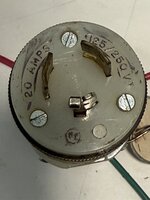


A old 7310, & a relic of the days before NEMA came up with different configurations for every voltage & ampere rating, the straight blade configuration that the Aussie's copied (20A crowfoot) was rated 20A 250V, it's now 20A, 125/250V, & considered non NEMA like the above pictured cord cap.I have a similar 20A set. It says Hubbell Twist-Lock on the back. It's old.
Not disagreeing about the nomenclature, but that receptacle is UL Listed:Theres no way that is UL listed. It has the wrong voltage label on it.
(L)6-30r is 250v only

That's not a receptacle. It's a connector body.Not disagreeing about the nomenclature, but that receptacle is UL Listed:
Picky much?That's not a receptacle. It's a connector body.
"R" means receptacle.Picky much?
In NEMA electrical connector terminology, "L" signifies a locking connector, while "R" indicates a receptacle (outlet), meaning a "NEMA L" connector is a locking plug, whereas a "NEMA R" is a standard non-locking outlet; essentially, the "L" prefix denotes a twist-locking mechanism to secure the connection, while "R" simply means it's the receiving part of the connection.
Could that be a disconnect for an electric heater that draws 20 plus amps?L10-30R. Two hots and a neutral, no ground. I have no idea what it would be used for but the straight blade 10-30R was what electric dryers plugged in to pre 1996.
It could be, but it would be wrong. A 240 volt heater would be two hots and a ground, the 10-30 configuration doesn't have a ground, the third slot is supposed to be for a neutral and wouldn't be connected to the yoke of the receptacle.Could that be a disconnect for an electric heater that draws 20 plus amps?
That's not a receptacle. It's a connector body.
Hmmm... Tell that to @alfredeneuman"R" means receptacle.