To avoid these ads, REGISTER NOW!

How do I do a DIY alignment with Toe Plates

YoshiMoshi3

Well-known member
Joined
Nov 2, 2022
Messages
489
1778896299018.png
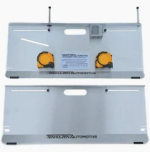
I have toe plates and am trying to understand how to DIY adjust the toe on my car. My car service information states:
Rear total toe-in: 2 +/- 2 mm (0.08 +/- 0.08 in)
Front total toe-in: 0 +/- 2 mm (0 +/- 0.08 in)

How do I get a measurement down to 1 mm increments with a measuring tape?

Let me take the rear as an example
1778896547401.png
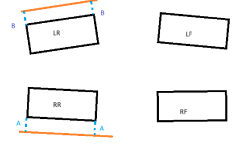
If I'm understanding correctly, using the toe plates, I can measure values A and B. I want toe in, so I want A < B.
Total Toe = A - B
Let's say when I calculate the total toe, I am not within the stated specification of 2 +/- 2 mm (0.08 +/- 0.08 in). Lets say I get 5 mm, under the assumption I could gets this type of measurement with a measuring tape. How do I know which tire(s) to bring in inwards or outwards? Tire C or Tire D?
1778896930767.png
I do not believe there's a way of knowing which one to change, because all I know is the total toe, and don't know where it is coming from? I could have one of three situations:

Tire D is perfectly parallel with the Forward direction, while Tire C is angled slightly in a toe-in state (1) or toe-out state (2)
1778897204198.png1778897309499.png

Tire C is perfectly parallel with the forward direction, while Tire D is angled toe-in state (3) or toe-out state (4) direction.

Neither Tire C nor Tire D is perfectly parallel (options 5-8):
(1) Tire C is toe-in, Tire D is parallel with Forward
(2) Tire C is toe-out, Tire D is parallel with Forward
(3) Tire C is parallel with Forward, Tire D is toe-in
(4) Tire C is parallel with Forward, Tire D is toe-out
(5) Tire C is toe-in, Tire D is toe-in
(6) Tire C is toe-in, Tire D is toe-out
(7) Tire C is toe-out, Tire D is toe-in
(8) Tire C is toe-out, Tire D is toe-out

Given my measurement of 5 mm, I can cross off Option (5). But other than that, there doesn't appear to be much I can deduce.

Now if I could create a line with a piece of string that is perfectly parallel with the forward direction, I could deduce if each tire is toe in or toe out, and by how much, but how is this possible to do? From there I could figure out which of the 8 possible situations I am in, and determine which tire(s) to bring toe in/out. Wouldn't my piece of string be off by a few degrees of being true parallel with the forward direction, impacting the accuracy?
 
To avoid these ads, REGISTER NOW!

rsanter

Well-known member
Joined
Dec 22, 2007
Messages
18,487
Location
visalia ca
No idea
we do it old school when we were at the track

jack the tire up off the ground
spin the wheel/tire with a marker held against the tire. Do this on both front tires

now you measure the front and back of the tire mark to get your toe measurement
 

5ubtle

Well-known member
Joined
Jun 15, 2016
Messages
390
Location
Spartanburg, SC
With a lot of care (and double checking) I believe that I am able to make each measurement to within ±1mm. That leaves me with a "toe measurement" accuracy of ±2mm. YMMV.

Let's say when I calculate the total toe, I am not within the stated specification of 2 +/- 2 mm (0.08 +/- 0.08 in). Lets say I get 5 mm, under the assumption I could gets this type of measurement with a measuring tape. How do I know which tire(s) to bring in inwards or outwards? Tire C or Tire D?
1778896930767.png
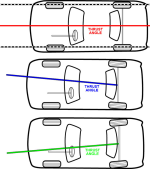
You are probably worrying about details that don't need this much attention. If the rear tires don't have the same amount of toe, you get something called a "thrust angle". A non-zero thrust angle points the rear of the car in a direction other than straight ahead. The result is that the car will "dog track". If your car dog tracks by 5°, you will notice it. If your car dog tracks by 0.1°, you will not notice it.

If your vehicle is not "dog tracking" now, and you want to change the rear toe, then adjust both equally.
 

TobeyA

Well-known member
Joined
Apr 7, 2021
Messages
251
Location
TX
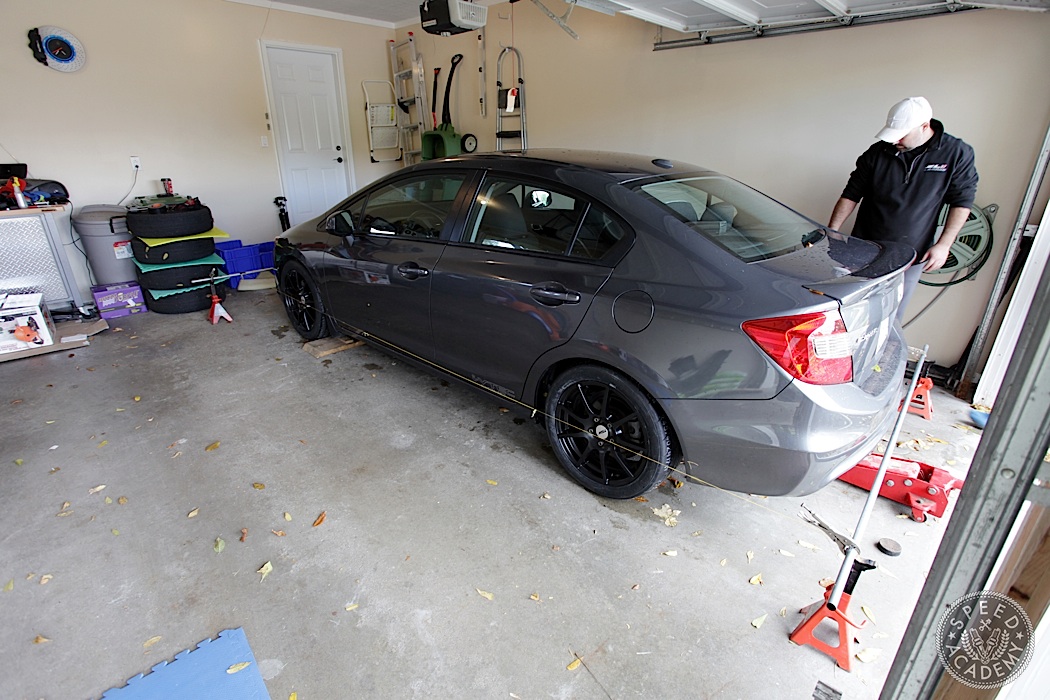
The easiest way to do what you are describing is to use strings. Here's a description:

I do this on my race cars. It's a bit fiddly to get set up. But gets quicker each time you do it.
 

OX1

Well-known member
Joined
Aug 6, 2012
Messages
157
Location
Jackson, NJ
The easiest way to do what you are describing is to use strings. Here's a description:

I do this on my race cars. It's a bit fiddly to get set up. But gets quicker each time you do it.

Problem with strings on the ground with some cars, especially rear camber.
If the adjustment is a slot, as soon as you loosen bolt, weight of vehicle forces
camber negative (usually) and you need long pry bar to force it back
(which you don't have space, if you are on the ground/jack stands).

You can lift up car, so weight is not on suspension, but then you can't really
adjust it "on the fly", like you can with an alignment machine on a lift.

And even with cams for rear camber, a lot of times I need really longer "power arms"
to hold both cam and cam nut, to get them tight enough I am happy they won't slip,
but not change alignment while tightening.

I do need to eventually get the "strings" to work though, as I can't bring a 4 post
and alignment system with me on track days. (actually been eyeing up stacker
trailers, so maybe I can :)).
 
OP
Y

YoshiMoshi3

Well-known member
Joined
Nov 2, 2022
Messages
489
With a lot of care (and double checking) I believe that I am able to make each measurement to within ±1mm. That leaves me with a "toe measurement" accuracy of ±2mm. YMMV.


You are probably worrying about details that don't need this much attention. If the rear tires don't have the same amount of toe, you get something called a "thrust angle". A non-zero thrust angle points the rear of the car in a direction other than straight ahead. The result is that the car will "dog track". If your car dog tracks by 5°, you will notice it. If your car dog tracks by 0.1°, you will not notice it.

If your vehicle is not "dog tracking" now, and you want to change the rear toe, then adjust both equally.
What measuring device do you use to get an accuracy within +/- 1 mm.

I think I understand now.
1778929496647.png
If I were to use toe plates, the second car (blue line) and third car (green line) would all be within alignment, as in theory they could both have the same acceptable total toe within the specified range. The ideal thrust angle is zero though (red line). What you do to one side you do to the other, and this can just be estimated? As far as loosen by a ~ a quarter turn on both sides is ok, to just estimate it and do approximately the same to both sides, and then measure total toe?
The easiest way to do what you are describing is to use strings. Here's a description:

I do this on my race cars. It's a bit fiddly to get set up. But gets quicker each time you do it.
I understand how the string method could work if your strings are true parallel with the Forward direction. This is very understandable to me. However, how do you know your strings are actually parallel with the forward direction?
1778929825139.png
Lets say my string is the orange line. It's reasonable to assume that my string is off by a few mm from true parallel or by a degree or two with the forward direction, and that I would have no way of knowing? This would throw off all my measurements. Something like below:
1778930186314.png
 
To avoid these ads, REGISTER NOW!

ctandc72

Well-known member
Joined
Sep 19, 2020
Messages
1,085
Location
VA
I'm sure someone will critique it - but the way I have done it for years is this:
- Get two jack stands
- Pick a side of the car
- Run a line tied to the jack stands so the height of the string rungs roughly right across the middle of the hub of the wheels
- At the rear wheel position the line / jack stand so the the string is the same distance from the front flange / rear flange of the rear wheel

This will make the line parallel to the plane of the rear wheel. Now if your rear end orientation is out of whack / bent etc - YMMV

You can also check the line with a laser level. If you wanted to go further, you could get another pair of jack stands / line and do the same on the other side at the same time. Once the second side line is parallel to the same spots on the rear wheel that used on the other side's measurements, get the distance from one string to another one the rear. Duplicate this on the front. You now how a square surrounding the car.

Get to trash bags, or floor tiles etc. I use a folder over contractor's trash bag under each front wheel. I spray some WD40 etc in between the folds. The contact patch of the front tires sits fully on the trash bags. Before doing this - depending on the vehicle (mine are rather low to the ground) I turn the wheels all the way out on one side, loosen the outer tie rod lock nut, then rinse repeat on the other side.

Then I make sure the steering wheel is straight and locked.

Then I simply measure the distance from the line to the rear flange of the front wheel, then I measure the distance from the same spot on the front of the wheel. The difference between the two numbers is toe in / out depending.

I take the factory recommendation or the measurement I personally want for TOTAL toe in / out (depends on chassis / car) and split it in half and adjust each front wheel to that number.

Cycle the suspension after making a toe adjustment. Then recheck. Lock the nut down and cycle check it again to make sure it didn't move.

The only time this hasn't worked for me is when I have made a mistake with the number I need / want on each side. That's me, not the process. Keeping in mind, at least on the cars I deal with, you need to see where your camber is before setting toe - as in my case, a change in camber will affect toe setting - so I set toe last.
 

theamcguy

Well-known member
Joined
Apr 22, 2009
Messages
405
Location
Fayetteville, NC
For the DIYer doing an alignment/toe-in adjustment at home, figuring out which tire is off can be difficult. If toe in is not out by much sometimes just going to the front of the vehicle and looking at both front tires sometimes you can see which tire is "off". That's the one you adjust. Other times this is impossible. If this is the case then adjust toe with your tape measure. When you are done go for a drive you will now notice that the steering wheel is off center. No problem, note whether the steering wheel is off to the left or right. Now center the steering wheel and look at the front tires you will see they are pointed in one direction or the other; turn both tie rod ends in the same direction to bring the wheel back to center (it is this step that is usually missing from a front-end alignment done at a shop, they correctly set toe but then skip the step of centering the steering wheel). After moving both tie rod ends in the same direction (CW or CCW) recheck your toe measurement adjust if necessary then test drive. If the wheel is still off a bit repeat until you get it right. It might take a few tries to get it perfect but you can get the toe set correctly and the wheel straight.
 
OP
Y

YoshiMoshi3

Well-known member
Joined
Nov 2, 2022
Messages
489
I'm sure someone will critique it - but the way I have done it for years is this:
- Get two jack stands
- Pick a side of the car
- Run a line tied to the jack stands so the height of the string rungs roughly right across the middle of the hub of the wheels
- At the rear wheel position the line / jack stand so the the string is the same distance from the front flange / rear flange of the rear wheel

This will make the line parallel to the plane of the rear wheel. Now if your rear end orientation is out of whack / bent etc - YMMV

You can also check the line with a laser level. If you wanted to go further, you could get another pair of jack stands / line and do the same on the other side at the same time. Once the second side line is parallel to the same spots on the rear wheel that used on the other side's measurements, get the distance from one string to another one the rear. Duplicate this on the front. You now how a square surrounding the car.

Get to trash bags, or floor tiles etc. I use a folder over contractor's trash bag under each front wheel. I spray some WD40 etc in between the folds. The contact patch of the front tires sits fully on the trash bags. Before doing this - depending on the vehicle (mine are rather low to the ground) I turn the wheels all the way out on one side, loosen the outer tie rod lock nut, then rinse repeat on the other side.

Then I make sure the steering wheel is straight and locked.

Then I simply measure the distance from the line to the rear flange of the front wheel, then I measure the distance from the same spot on the front of the wheel. The difference between the two numbers is toe in / out depending.

I take the factory recommendation or the measurement I personally want for TOTAL toe in / out (depends on chassis / car) and split it in half and adjust each front wheel to that number.

Cycle the suspension after making a toe adjustment. Then recheck. Lock the nut down and cycle check it again to make sure it didn't move.

The only time this hasn't worked for me is when I have made a mistake with the number I need / want on each side. That's me, not the process. Keeping in mind, at least on the cars I deal with, you need to see where your camber is before setting toe - as in my case, a change in camber will affect toe setting - so I set toe last.
I'm not sure that I follow.

Get a line parallel to the vertical plane of the RR wheel with jack stands and a string. Easy enough.
Get a line parallel to the vertical plane of the LR wheel with jack stands and a string. Easy enough.

This now provides two lines parallel which with the vertical planes of each of the rear wheels.

1778946039805.png

What's the next step?
 

TobeyA

Well-known member
Joined
Apr 7, 2021
Messages
251
Location
TX
What measuring device do you use to get an accuracy within +/- 1 mm.

I think I understand now.
1778929496647.png
If I were to use toe plates, the second car (blue line) and third car (green line) would all be within alignment, as in theory they could both have the same acceptable total toe within the specified range. The ideal thrust angle is zero though (red line). What you do to one side you do to the other, and this can just be estimated? As far as loosen by a ~ a quarter turn on both sides is ok, to just estimate it and do approximately the same to both sides, and then measure total toe?

I understand how the string method could work if your strings are true parallel with the Forward direction. This is very understandable to me. However, how do you know your strings are actually parallel with the forward direction?
1778929825139.png
Lets say my string is the orange line. It's reasonable to assume that my string is off by a few mm from true parallel or by a degree or two with the forward direction, and that I would have no way of knowing? This would throw off all my measurements. Something like below:
1778930186314.png
1. The strings must be the same distance apart in front of and behind the car.
2. The distance from the rear hub in the center of the wheel must be the same on each side.
3. The distance from the front hub in the center of the wheel must be the same on each side.

Get all that lined up right, and you have a perfectly square and parallel "box" around the car.

When I was doing this a lot, I built wooden stands a little over a foot tall for each wheel. Each stand had a "turn plate" on it. This let me get under the car and easily adjust toe. I almost never messed with camber at the track unless there was a hard hit. (The turn plates were 2 polyethylene sheets sold as cutting boards with grease between).

I also used angle aluminum to make the front and rear string holders. 2 identical pieces front and rear, each with a small frame that I could mount on the hood and deck lid pins. I had marks to center them on the front and rear bumpers. When I was doing it a lot, it took 10 minutes to get set up.

I hope this all makes sense. I don't have any pictures of the setup.
 
OP
Y

YoshiMoshi3

Well-known member
Joined
Nov 2, 2022
Messages
489
1. The strings must be the same distance apart in front of and behind the car.
2. The distance from the rear hub in the center of the wheel must be the same on each side.
3. The distance from the front hub in the center of the wheel must be the same on each side.

Get all that lined up right, and you have a perfectly square and parallel "box" around the car.

When I was doing this a lot, I built wooden stands a little over a foot tall for each wheel. Each stand had a "turn plate" on it. This let me get under the car and easily adjust toe. I almost never messed with camber at the track unless there was a hard hit. (The turn plates were 2 polyethylene sheets sold as cutting boards with grease between).

I also used angle aluminum to make the front and rear string holders. 2 identical pieces front and rear, each with a small frame that I could mount on the hood and deck lid pins. I had marks to center them on the front and rear bumpers. When I was doing it a lot, it took 10 minutes to get set up.

I hope this all makes sense. I don't have any pictures of the setup.
So the center of the hub is always in the same spot, regardless of the toe?
 

TobeyA

Well-known member
Joined
Apr 7, 2021
Messages
251
Location
TX
So the center of the hub is always in the same spot, regardless of the toe?
Close enough. At some point, you're worrying about things that are beyond the precision of the strings and a metal ruler. What is the runout on the wheel surface you are measuring from? Are you looking at the ruler/string from exactly the same angle every time? Do the fronts and rears each have exactly the same air pressure? What if your locked steering wheel moves a few degrees? And the biggest issue is all the compliance in the system that gets exercised while you're driving.
 
To avoid these ads, REGISTER NOW!
Top Bottom