wyliesdiesels
Well-known member
only if you pulled enough current to overload the neutral...If that was the situation, then I would have a potential problem now....generator usage or not. Correct? I think every other breaker uses a different leg.

only if you pulled enough current to overload the neutral...If that was the situation, then I would have a potential problem now....generator usage or not. Correct? I think every other breaker uses a different leg.
GE breakers due to the design are rarely a problem with that, GE is the only brand in current production where a twin can be used for 240V, with Siemens QP, SQ D, HOM, & Eaton BR a quad is required for 240V.If those are twin or slim breakers as Norcal pointed out, make sure the MWBCs actually are on different stabs. Seems to me you could get that part wrong.
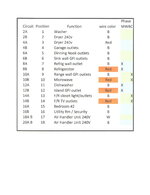
So if you look at one of my photos, the first breaker (top) on the right side is a 120v feeding the washing machine. The next two down is 240v service for the dryer. Counting the individual wires down the first red wire for 120v is wire number eight...just below the breaker that has a white dot on it. So what positions would the MWBC's be on? Or what would be the first breaker that is a MWBC?Slim breakers have two breakers per leg. So each pair would be together.
So if you take the right side, top to bottom and number the breakers starting at one, with full size breakers, 1, 3, 5, etc would be on the same leg. With tandem (half size), 1, 2, 5, 6, 9, 10, etc would be on tbe same leg. So a MWBC would need to go on 2 and 3 instead of 1 and 2 or 3 and 4

It’s super simple to do, dependents on how far each circuit is away from your breakers in your house. And dependents on your comfort level of working the electricals of cause.Looking in my panel the wires are really bundled and tied together. Really hard to see what black/red wires are coming from the same cable. Any other ways to determine what shares the neutral?
So that aligns with my post. Combining 2 and 3 gives you 240v.So if you look at one of my photos, the first breaker (top) on the right side is a 120v feeding the washing machine. The next two down is 240v service for the dryer. Counting the individual wires down the first red wire for 120v is wire number eight...just below the breaker that has a white dot on it. So what positions would the MWBC's be on? Or what would be the first breaker that is a MWBC?
You can’t find magic cure over the internet here, only way to find out is to map it out. It’s easier if it is a sub panel and you have reaching distance to alll plugs and switchesI'm beginning to wonder if all of my MWBC's are already on the same phase. I say this because wire/breaker #13 (black) and wire/breaker #14 (red) look to be smaller gauge (maybe 14 gauge) whereas the wires above them look to be 12 gauge. You're not going to get a cable with two different size gauge of red and black...right...or can you? And being in position 13/14 would put them on the same leg. It would need to be in position 12/13,or 14/15 to be on different legs. I'm going down a rabbit hole. Looks like I may need to cut the ties and see what I can trace.
Ah, c'mon man. That would way too easy and make way too much sense. This is garage journal, where what seems like the simplest of tasks turn out to be more difficult than moving a mountain with a teaspoon.Why don’t you just cut the zip ties and trace the individual conductors back to their entry end of the panel? You’re making this more difficult than it has to be
For the sake of all things holy, don't do that. There are a lot of other ways to accomplish the task that will eat up more time and if you do it right, money.I'm beginning to wonder if all of my MWBC's are already on the same phase. I say this because wire/breaker #13 (black) and wire/breaker #14 (red) look to be smaller gauge (maybe 14 gauge) whereas the wires above them look to be 12 gauge. You're not going to get a cable with two different size gauge of red and black...right...or can you? And being in position 13/14 would put them on the same leg. It would need to be in position 12/13,or 14/15 to be on different legs. I'm going down a rabbit hole. Looks like I may need to cut the ties and see what I can trace.
Raising the concern to run the house. The toaster. The microwave. On a 3500 watt generator. Says a better master plan is required. Individual wires are not the main factor.Ah, c'mon man. That would way too easy and make way too much sense. This is garage journal, where what seems like the simplest of tasks turn out to be more difficult than moving a mountain with a teaspoon.
An even easier solution would be to not use the toaster and microwave at the same time if it's that big of a concern. But what do I know? I obviously am clueless as to what the ramifications could be. And, as I already stated, it's too effin' easy.
It will do it, just need to keep in mind that it's a 3500 watt generator and watch what is running. I've done it for three days with a 3500 watt 120 volt generator. I was single at the time so there no wife and kids doing stupid stuff to worry about, but I did laundry, microwaved dinner, ran the dishwasher, etc. And it was in the middle of winter so the furnace ran a lot.Raising the concern to run the house. The toaster. The microwave. On a 3500 watt generator. Says a better master plan is required. Individual wires are not the main factor.
It appears your MWBC's are not MWBC's If this is confirmed, I'd open all those boxes and inspect.So I thought I would give a follow-up as to what I found...plus I have a few questions depending upon what I might do. I first validated what each circuit actually powered, top to bottom of the right side of the panel. Actually found a few labeling mistakes which were all within the MWBC's. No big deal. Next I cut the ties and using two zip ties (removed the locking tap) I trace each red wire to the cable, and traced back the black. Every MWBC was arranged exactly as I expected....for example, the microwave and the two outlets below the microwave between the range share the neutral. The refrigerator, and the single outlet next to it share a neutral...and so on. Remember, in my situation every 120v breaker is an individual breaker....no tandems. And in every case for the four MWBC's the black wired circuit is just above the red wired circuit.
But here is what I also found...which I suspected...and that each MWBC is on the same phase. Been that way for 20+ years. So the refrigerator and the 1,500 watt air fryer use the same neutral. The microwave and the 1,000 watt toaster share the same neutral, etc.
So....I need to decide if I 1) do nothing, 2) move those eight breakers up one spot and move something down, or 3) move those eight breakers down and move something up. I think I have enough wire slack for number 3. So here are my questions:
When I move anything, should I leave the wire intact on the breaker and move the entire wire/breaker as a unit...or disconnect each wire and just move wires?
If I find that its best to move the MWBC's up one spot and thus move something down (like the Garage outlet circuit) which requires additional wire to be added, what is code for adding length to a 12 gauge 120v circuit inside a panel?
Is there another option that I not seeing?
Here is what I found:
Also....thank you to whoever suggested using a zip tie to trace the wires....that worked really well.
How did you determine that? When you first posted this I did a brief web search which indicated that the layout of that panel wasn't so intuitive. Did you measure line-to-line on those circuits and you got zero volts? That would indicate that they are indeed on the same phase.But here is what I also found...which I suspected...and that each MWBC is on the same phase.
yes......and did that for each MWBC. Each one is in a position of A/B. To get 240V (different phase) each one needs to be in position B/A.How did you determine that? When you first posted this I did a brief web search which indicated that the layout of that panel wasn't so intuitive. Did you measure line-to-line on those circuits and you got zero volts? That would indicate that they are indeed on the same phase.
Are the wires run on those 15a circuits #12 or #14?I checked a couple of ways....
1) I installed an extension cord into the frig outlet, and took a reading with the outlet that I thought might share the neutral (which it does based on the tracing that I did later), making sure I went into the hot inputs.....got zero volts.
2) traced the wires to determine what shared the neutral (power was off) and then after turning the power back on took readings with the meter and got zero volts. I kept track of the tracing....plus it turned out how I expected. This is why I suspected that they were on the same phase as I posted a while back...when I was still somewhat confused.
3) looked at it physically...which you can do too. Look at the attachment and look where the 240V breakers are. See the location...its on 2/3 position...which is a B/A position. All the MWBC's are on a A/B position...same phase.
I think what I need to do is remove and disconnect breaker #15 (Bedroom #2) 15 amp....then working from bottom up move each of the breakers/wires from #14 through #6 down one position, then reinstall the #15 breaker into spot #5 along with disconnected Bedroom feed. Part of the problem is that the last MWBC (Family Room) is 15 amps, whereas the kitchen MWBC's are 20amps. I need to keep to same breaker ratings. And the Bedroom breaker is also 15 amps. I can't just move wires.
Because none of these breakers are tandem, I think its an easy mistake for the electrician to make...and the breakers are individual and can go in any spot. Maybe that's why the code was changed to tandem breakers so that this kind of mistake doesn't happen.
They look to me as #14. Go back to page 1 and see actual photos....Are the wires run on those 15a circuits #12 or #14?
that is the front cover part number.... but regardless, based on several panel labels ive seen with the same cover, you are correct in that an AB arrangement for 2 breakers feeding a MWBC or 240v load will not have 240v potential as they both connect to the same bus.TM20EC
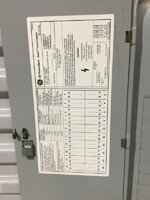
its actually easy to do on a GE panel. on other panel brands, they dont have AB arrangements like GE does. so the busses alternate in each breaker space. with GE's AB breaker arrangement, both A and B position on each circuit # connect to the same buss. its because GE has slim half space breakers.... so whoever wired this panel wasnt paying attention...But WOW, it's hard to imagine someone was so careful in wiring the panel so neatly and made a major screw up like this.
You really need to open those boxes and inspect the neutrals.
Just to confirm - you went in the kitchen and stabbed your voltmeter probes into the line side of the pairs of outlets and confirmed zero volts? I'd want to be 1000% sure before I moved a wire.
Make a label up in excel. You can buy adhesive sheets at places like Staples, or just print and tape it on the inside of the coverI wonder if I could get a new blank panel label? I'll need one.
Somewhere around post 10 you expressed concern about overloading the neutrals in your MWBC's if you were to use a 120V generator. As others have said - a 3500W generator with a few loads connected does not leave a lot of headroom to run a toaster and a microwave too. I think those were the loads you were worried about.What would I confirm? I confirmed by clearly tracing each individual red wire up to the individual cable that contained its white, black, red, and ground wires. Then I carefully traced the black back down to its breaker/circuit. Each set of MWBC were:
1) black wire/circuit directly above the red wire/circuit in the panel, and
2) each MWBC was exactly wired how I thought it would be based on what the red wired circuits supplied...in other words the black wired circuits were what I expected based on location of what the red circuits powered.
Example: kitchen island outlet and the dishwasher share the same neutral becasue they share the same cable. Why? Because the kitchen island is fed by an under-slab conduit that originates in the wall behind the dishwasher, so it makes sense that the electrician would run those wires in that fashion...feeding the black of the cable to the dishwasher and using the red to power the kitchen island outlet. Simular situation for the other three MWBC's. Each one is close together in location.
So far the only possible over-loading would be using the toaster (1,000 watts max, with all slots being used) at the same time as the microwave (1,700 watts at full power) is being used, which is fairly unusual and would not last very long. Nonetheless, I still want to correct the wiring because I don't like it being incorrect.