
You are using an out of date browser. It may not display this or other websites correctly.
You should upgrade or use an alternative browser.
You should upgrade or use an alternative browser.
How do I wire this?
- Thread starter Markinred
- Start date
paulsomlo
Well-known member
The light doesn't need to (and shouldn't be) GFI'd, and I doubt that the fan needs to be GFI'd. Take the upstream side of the GFI and feed each switch with it.
Shiftless
Well-known member
Better check with your local inspector. When I rewired our master bathroom (in a 70 year old house) after a full gut job remodel, the inspector insisted on a dedicated 20 amp circuit with all of the receptacles, lights and the exhaust fan protected by GFCI. All wire had to be 12 ga. as well, even though the lights were LED and the fan drew less than 100 watts.
So I fed lights and the fan off the LOAD side of the first in line GFCI receptacle.
So I fed lights and the fan off the LOAD side of the first in line GFCI receptacle.
If the lights and fan are in a wet location, don't they have to be GFCI protected?don't route the lights via GFCI protected portion of the gfci plug... just put them in parallel if you are sharing the same breaker. Everything else is pretty straight forward.
laser3kw
Well-known member
can a person touch them in normal circumstances?If the lights and fan are in a wet location, don't they have to be GFCI protected
mike93lx
ALLIANCE MEMBER
How tall is this hypothetical person?can a person touch them in normal circumstances?
I can reach the lights in my 8' bathroom ceiling, but my wife would need a ladder.
mike93lx
ALLIANCE MEMBER
If you want them gfi protected, feed the switches from the second set of terminals on the receptacle. If you don't, feed the switches in parallel to the line feeding the receptacle.I need to wire two switches, one to light, one to bath exhaust fan, through a gfci outlet. Like attached picture.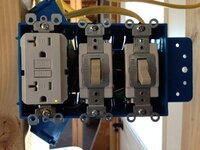
I wouldnt protect the switches in my house
If the lights and fan are in a wet location, don't they have to be GFCI protected?
Those other comments + also it dependents on definition of wet location, if it is just inside the bathroom and the fan/lights are not directly over your shower (means your shower or water doesn't spalsh to it and you are touching it.), probably not. If your wet location is your steam bath room like those Japanese/Chinese shower bath toilet/washroom/ bathtub /wet room... then probably a good idea to GFCI it. Not that I even know what GFCI means. pretty sure NEC doesn't require GFCI on fan/lights if it is not directly over something wet. So... I dunno.
dave*99
Well-known member
There are examples of damp and wet location light fixtures the have a requirement to be connected to a GFCI. This requirement would appear in the instructions for the fixture and likely part of the UL listing info.
justsam
Well-known member
Whether it is required by code or not seems to be uncertain, but what is certain is running them through the GFCI is very easy for you to do right now and no one has been chastised by doing more than NEC requires.
Shiftless
Well-known member
RightWhether it is required by code or not seems to be uncertain, but what is certain is running them through the GFCI is very easy for you to do right now and no one has been chastised by doing more than NEC requires.
As I said earlier, my city inspector called my little 40 sq. ft. remodeled bathroom with a 3x3 stall shower tiled all the way up to the ceiling and open above the glass door a wet area. Wiring the lights and the fan after the GFCI receptacle was the same amount of work and no extra material. The only disadvantage I can see is that if somebody drops a running hairdryer into a sink full of water and trips the GFCI and it’s nighttime, they will end up in the dark. Anybody else think of a downside?
acer66
Well-known member
This would be my concern also, I am a bit paranoid when it comes to stuff like that and try to have if multiple lights are present to have them on different circuits.Right
As I said earlier, my city inspector called my little 40 sq. ft. remodeled bathroom with a 3x3 stall shower tiled all the way up to the ceiling and open above the glass door a wet area. Wiring the lights and the fan after the GFCI receptacle was the same amount of work and no extra material. The only disadvantage I can see is that if somebody drops a running hairdryer into a sink full of water and trips the GFCI and it’s nighttime, they will end up in the dark. Anybody else think of a downside?
Terry D
Well-known member
Unless the fan is in the shower, it does not need to be GFCI protected. Unless of course your local jurisdiction requires it. The light also does not need to be GFCI protected.
Leaflessshadetree
Well-known member
Doe the light include a nightlight? If so another switch and wire.
snyder
Well-known member
Our bathroom fan and light share the gfci. If you turn the fan and light off at the same time the gfci trips and leaves you in the dark..
Just_Steve
Well-known member

The above light/exhaust fan combo unit in my just remodeled bathroom is on a GFCI and timer. My understanding is if the light and fan are in the foot print of shower/tub it needs to be on a GFCI.
Usually gfci is for protection when something can be touched or dropped in water. Codes change but I've never heard of lights needing to be on it, that seems more dangerous if the lights go out then the electrical risk. My first thought was that if anything it would be a switch issue if for some reason there was no way of keeping the proper distance between the switch and shower and they allowed for gfci instead.
You identify the cable from the power source into the box Black =hot, White = Neutral, Bare copper = Ground.
Typically the outlets will have a copper colored screw a Silver screw, and a green screw.
On the LINE end of the GFCI land the Black wire from the source to the copper colored screw and the White wire to the Silver screw.
On the LOAD end of the GFCI connect a Black wire to the first switch and from there to the second switch.
Connect one each Black wire from the lights to the other terminals on the switches.
Put a new White wire on the Silver screw on the Load side of the GFCI and wire nut it to the White wires for the fan and lights
Connect all green screws to the bare copper wire.
Typically the outlets will have a copper colored screw a Silver screw, and a green screw.
On the LINE end of the GFCI land the Black wire from the source to the copper colored screw and the White wire to the Silver screw.
On the LOAD end of the GFCI connect a Black wire to the first switch and from there to the second switch.
Connect one each Black wire from the lights to the other terminals on the switches.
Put a new White wire on the Silver screw on the Load side of the GFCI and wire nut it to the White wires for the fan and lights
Connect all green screws to the bare copper wire.

exranger06
Well-known member
210.8(A)(1) says that all RECEPTACLES in the bathroom need to be GFCI protected. It doesn't say anything about luminaires or fans, except that if a luminaire has a convenience receptacle built-in, then it needs GFCI. 210.8(C) says that luminaires in crawl spaces need GFCI, and nothing about bathrooms. 210.8 doesn't say anything else about GFCI being required for luminaires or fans, except that there may be additional requirements in Chapters 4, 5, and 6. I know Chapter 6 mentions GFCI required on luminaires and fans near swimming pools, but aside from that, I don't believe there's anything in those chapters that mentions GFCI for luminaires or fans.
410.10(D) addresses luminaires in bathtub and shower areas and just says where they can be located and that they need to be rated for damp or wet locations. No mention of GFCI being required.
410.10(D) addresses luminaires in bathtub and shower areas and just says where they can be located and that they need to be rated for damp or wet locations. No mention of GFCI being required.
dave*99
Well-known member
Yes and the next place to look is in the instructions for the luminaire. Some will say that if you locate this damp or wet rated fixture in a (whatever the manual states) location then this fixture must be GFCI protected. NEC is one piece of the detail. The manufacturers directions are another part.210.8(A)(1) says that all RECEPTACLES in the bathroom need to be GFCI protected. It doesn't say anything about luminaires or fans, except that if a luminaire has a convenience receptacle built-in, then it needs GFCI. 210.8(C) says that luminaires in crawl spaces need GFCI, and nothing about bathrooms. 210.8 doesn't say anything else about GFCI being required for luminaires or fans, except that there may be additional requirements in Chapters 4, 5, and 6. I know Chapter 6 mentions GFCI required on luminaires and fans near swimming pools, but aside from that, I don't believe there's anything in those chapters that mentions GFCI for luminaires or fans.
410.10(D) addresses luminaires in bathtub and shower areas and just says where they can be located and that they need to be rated for damp or wet locations. No mention of GFCI being required.
nadogail
Well-known member
The “Code” lists the minimum requirements for electrical installations. We are free to build better than the minimum.
35Ford
Well-known member
Use a dual function arc fault / ground fault breaker to feed the circuit and everyone will be happy.
BreeStephany
ALLIANCE MEMBER
As 35Ford suggested, if the circuit for the bathroom is on its own circuit and your panel is new enough to find AFCI/GFCI breakers for, I would simply just wire in a AFCI/GFCI breaker at the start of the circuit and then just pigtail off the line coming into the box to the receptacle and to each switch.
With that said, you can also simply run incoming power into the line side of the GFCI receptacle, then run a short neutral and line wire out of the load side of the GFCI, which you can pigtail to both switches.
Either would be code compliant solutions. As others have said though, as long as your light fixtures / fan are not within reach of the envelope of the shower / bathtub, they do not need to be GFCI protected.
Just my two cents.
With that said, you can also simply run incoming power into the line side of the GFCI receptacle, then run a short neutral and line wire out of the load side of the GFCI, which you can pigtail to both switches.
Either would be code compliant solutions. As others have said though, as long as your light fixtures / fan are not within reach of the envelope of the shower / bathtub, they do not need to be GFCI protected.
Just my two cents.
dcg9381
Well-known member
Well, NEC will be happy. Inspectors will be happy. Residents happy? They sure aren't in my home.. These dual function breakers work great for anything with moderate loads and are a great "code solution". But try running a hair dryer or vacuum cleaner on one.Use a dual function arc fault / ground fault breaker to feed the circuit and everyone will be happy.
Running a hair dryer or *any* vacuum cleaner on AFI/GFI breakers in my home - they have a 100% trip rate. Do not recommend.