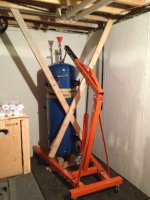
I may be wrong here, I thought the grease gun was used just to pressurize the tank? I still need to test a couple of tanks.

Found this online;
Oil in air tanks is not a bad thing. The coating of the interiors helps prevent the moisture caused rust. The bad thing about oil in pressurized air is DO NOT use the air for breathing air. The oil will cause severe health problems.
Draining air receivers. Drain, Drain, Drain! This should be done daily when you find moisture in the drain output. The draining period can be extended in areas where you don't find moisture in your drain output. I suggest you set up your own drain periods as follows. Start on a daily basis. If you get no moisture move to a weekly basis. If you get no moisture, move to a monthly basis. Never go more than a month between drains. It is important to get moisture OUT of the receiver. Various times of the year, and different weather patterns will also affect your drain periods.
Storage. Many professionals keep pressure in their tanks at all times. They do not keep the compressors on, they just "lock" the pressure in, by isolating the tank, when the compressor is off. The idea is: If there is already pressure in the tank, the compressor runs less, and thus less moisture in the receiver.
Hydro testing. With ALL types of tanks, we are talking about energy storage. Compressed gasses will store more energy than liquids. Thus the stories of great damage from failures involving compressed gasses. Using liquids to hydro test, is much safer since a failure will allow pressure to drop almost instantly.
Safety: Most manufacturers will recommend no more than 150% of maximum operating pressure for hydro testing. Most of the newer receivers will have a max. pressure listing stamped into the tank. Some will even have the test pressure stamped in. If you are concerned about failure consequences, cover the receiver with a tarp or blanket. This will minimize the spread of liquid and movement of the receiver in the event of a failure.
Use a fluid pump to pressurize. Two gauges to verify pressure is a good idea. Ensure there is a way of venting pressure and a relief valve should be included in the hydro rig. Testing should be done with the vessel in it's normal position i.e. standing up or laying down. The most likely failure point will be where rust has weakened the vessel. This will usually, but not always, be at the bottom where the moisture collects.
Duration: The majority of hydro testing lengths are 1/2 or 1 hour. If the vessel does not fail in that time period it is safe for use. Hydro testing spans (time between hydros), are usually 5 or 10 years. Use your judgment. If you are concerned about the receiver safety, conduct a hydro test.
One thing that wasn't addressed in previous posts: Dry the receiver as best possible prior to placing it back in service.
Also, as mentioned before, it is perfectly fine to put some oil back into the tank prior to return to service. I recommend adding oil, to a dry tank, and rolling the tank around to coat as much of the interior as possible. Then drain the excess oil.
Do not ignore inspection of relief valves, control switches, connecting piping, and any cooling coils or fins. All should be clean and lubricated, as appropriate, for proper operation. Relief valves should be tested for proper operation and set points. Use your hydro rig and fluid to do this. Cover the relief valve as appropriate to control any spraying.
One last comment: WEAR protective gear when conducting hydro testing. Face Shield, gloves, heavy clothing, will provide protection from any jets or sprays and flying debris.
I hope this helps clarify things and makes everyone be and feel safer.