purchased a forever home with dream garage. well somewhat. P/O had killer garage built and IMO, never completed. 22x26, 12ft ceiling, 4 post lift, wired for 220v. Then, lost interest in state and fled south. I have brought nothing from my other home yet cause im not fully moved in and still have to unload other home. Anyway before i can figure out how to set up workbench, tools cabinets welder,etc I need to move lift back like a foot or so because truck doesnt clear garage door if i nose her in. Also cant fit car underneath cause truck would hit rafters. Was wondering if i could raise them up or eliminate so i can have garage door flow up roof line (also a problem) Garage would be primary storage for hot rod and truck would basically be in for inclement weather and PM maintenance. That being said if this would be a major to do, i will leave rafters and start focusing on how to insulate and what to do for a flooring. Any suggestions would be appreciated.


You are using an out of date browser. It may not display this or other websites correctly.
You should upgrade or use an alternative browser.
You should upgrade or use an alternative browser.
how high can i move rafters?
- Thread starter montes57
- Start date
![109278[1].jpg](/forum/data/attachments/957/957751-1169e50547114e6b014c5274b16d7746.jpg)
![102302[1].jpg](/forum/data/attachments/957/957771-92a073ef827168e94b5920c394966bbe.jpg)
![98399[1].jpg](/forum/data/attachments/957/957788-f08a0f8e0efb0cab7884c39e454fc7f4.jpg)
![98398[1].jpg](/forum/data/attachments/957/957795-a78ba44d193fb7c9f4860268b449b212.jpg)
![20201117_172752[1].jpg](/forum/data/attachments/957/957811-4b38efc9e6d58998cc245932cf319afc.jpg)
You'd be hard-pressed to modify those rafters without unsatisfactory results down the road. Changing them over to a scissor style truss while in-place would be a pretty big headache. The tension running through that bottom chord is what keeps the slope of the roof. If you cut or compromise those, your walls will start bulging out at the top as the weight of the roof pushes the whole building apart.
I've seen guys raise their roof, literally, by cutting the hurricane ties near the rafter ends, jacking the whole roof assembly up, and framing a pony wall beneath it, sitting atop the original wall. You're looking at redoing some of the siding in this scenario, but at least you don't have to mess with wall or garage door framing/plumbing/wiring. You would have to deal with any wiring that's running through the rafters.
Another option is to jack up the entire building and build a wall under it with concrete block. This is pretty common. This method is also used to salvage garages that have a bit of rot at the bottom from excess ground contact. You'll now have to deal with anything that runs from walls to ground, like wires and such. You'll also have to make sure you deal with the garage door framing appropriately, and may need a taller door depending on how you decide to handle it. You might get by without messing with the siding in this scenario though.
I've seen guys raise their roof, literally, by cutting the hurricane ties near the rafter ends, jacking the whole roof assembly up, and framing a pony wall beneath it, sitting atop the original wall. You're looking at redoing some of the siding in this scenario, but at least you don't have to mess with wall or garage door framing/plumbing/wiring. You would have to deal with any wiring that's running through the rafters.
Another option is to jack up the entire building and build a wall under it with concrete block. This is pretty common. This method is also used to salvage garages that have a bit of rot at the bottom from excess ground contact. You'll now have to deal with anything that runs from walls to ground, like wires and such. You'll also have to make sure you deal with the garage door framing appropriately, and may need a taller door depending on how you decide to handle it. You might get by without messing with the siding in this scenario though.
ovilla
Well-known member
You should be able to easily convert from a flat ceiling to a vaulted one. I’d reach out to a structural engineer to help validate if your existing trusses just need to be beefed up a bit (by sistering bigger trusses next to current ones) or if you simply need to install collar ties, hopefully just 1/3 to halfway down from the top.
You could also buy scissor trusses - in half sections, and sister them in place next to your current rafters, and also install the plates that are needed to finish installing them.
Sent from my iPad using Tapatalk
You could also buy scissor trusses - in half sections, and sister them in place next to your current rafters, and also install the plates that are needed to finish installing them.
Sent from my iPad using Tapatalk
Last edited:
Renegade1LI
Well-known member
Those are not trusses, they're joist & rafters, engineered trusses will have steel gusset plates and a few more cords. I would speak to an architect but you could install collar ties 1/3 to 1/2 down from the ridge & then remove all the ceiling joists, looks like you have a double top plate so you would be fine. If it was me, I would remove 1 joist at a time & reuse it for the collar ties, good luck.
Don1357
Well-known member
Those are not trusses, they're joist & rafters, engineered trusses will have steel gusset plates and a few more cords. I would speak to an architect but you could install collar ties 1/3 to 1/2 down from the ridge & then remove all the ceiling joists, looks like you have a double top plate so you would be fine. If it was me, I would remove 1 joist at a time & reuse it for the collar ties, good luck.
Collar ties are not used to provide support for downward forces, they are designed to strengthen the roof from blowing upwards. There is a lot of wind on my area, you would use collar ties so the wind doesn't blow the roof up.
thanks for input everyone. So to recap collar ties are the beams up higher to the peak and merely assist in the event of wind. rafters sit on top of wallplate and stop weight of roof from bowing walls out, correct? they cant be just "moved up" i wanted to grab a foot to 18in so i could fit both 57 chevy and pick up truck. looks like truck loses yet again. paying to have garage raised costs more than my budget allows
Pluribus
Well-known member
To me, those look suspiciously like home built trusses. As Renegade11 said, there are no pressed in plates at joints. There are also no diagonals. If that's all 2x4's, I'd be wondering about how adequate they are for an area with any snow load, since there are no diagonal braces. Do you know if this was permitted and inspected?
I'd be really tempted to talk to a PE. It will cost you, but they might be able to come up with a good solution. Their solution might save you time & money over doing something else, too. This recommendation goes double if those are home built "trusses."
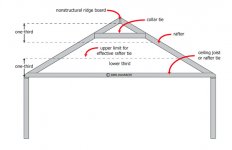
The horizontal member that sits on the top plate is the bottom chord of the truss, not a rafter. In a non-truss roof, the dimensional lumber piece that goes from top plate of the wall to the peak of the roof would be the rafter. Might still be called that in a truss, but I don't know.
*Edit: Added image explaining rafter/collar ties in conventional roof framing.
I'd be really tempted to talk to a PE. It will cost you, but they might be able to come up with a good solution. Their solution might save you time & money over doing something else, too. This recommendation goes double if those are home built "trusses."
The horizontal member that sits on the top plate is the bottom chord of the truss, not a rafter. In a non-truss roof, the dimensional lumber piece that goes from top plate of the wall to the peak of the roof would be the rafter. Might still be called that in a truss, but I don't know.
*Edit: Added image explaining rafter/collar ties in conventional roof framing.
Attachments
Last edited:
Don1357
Well-known member
thanks for input everyone. So to recap collar ties are the beams up higher to the peak and merely assist in the event of wind. rafters sit on top of wallplate and stop weight of roof from bowing walls out, correct? they cant be just "moved up" i wanted to grab a foot to 18in so i could fit both 57 chevy and pick up truck. looks like truck loses yet again. paying to have garage raised costs more than my budget allows
I'm not a structural engineer but looking at it with a beer on my hand I would say you don't need to mess with all your rafters, only with the ones under the lift. Removing 3 of them would clear 7.5 feet?
So (again, picture me with beer in hand) you could double up the rafters to each side of the hole, install strong backs, and honest to God purlins on the rest which you don't have. The strong backs would help distribute the load (as I waive with beer in hand) for the part where you cleared the bottom members.
skulldrinker
Well-known member


CombatNinja
Well-known member
- Joined
- Aug 24, 2013
- Messages
- 1,456
That's a 4-post parking lift. You can use it to work on vehicles, but that is not the primary purpose. Does the truck need to park on it nose in? Does the truck need to park on it at all? You indicate that the garage would primarily be for storing a hotrod. As long as that fits with no issues, you are good to go. Moving the lift shouldn't be too bad if you insist but that rafter situation is going to be a lot more work. I'm not saying not to to do it, but have an engineer look at your situation and let you know what needs to be done. You've already gotten 3 different answers on the first page from a bunch of armchair engineers here.
MushCreek
Well-known member
The only sensible answer is to pay an engineer to come up with a solution. Raising the bottom chord will put a new bending stress on the rafters where the bottom chord attaches. It can be done, but I don't know if your existing rafters are adequate.
As said, you don't have to change all of them; just the ones where you need additional clearance. Also as said, you could probably sister in properly engineered scissors trusses. They would have to be fabricated in place, and securely attached to the existing rafters prior to removing the bottom chord.
There are all sorts of solutions, all of which require engineering. You see it all of the time on various home improvement shows. What they rarely disclose is the cost. I've seen it a number of times where they install a massive ridge beam and remove the bottom chord altogether for a cathedral ceiling. $$$$
As said, you don't have to change all of them; just the ones where you need additional clearance. Also as said, you could probably sister in properly engineered scissors trusses. They would have to be fabricated in place, and securely attached to the existing rafters prior to removing the bottom chord.
There are all sorts of solutions, all of which require engineering. You see it all of the time on various home improvement shows. What they rarely disclose is the cost. I've seen it a number of times where they install a massive ridge beam and remove the bottom chord altogether for a cathedral ceiling. $$$$
CombatNinja
Well-known member
- Joined
- Aug 24, 2013
- Messages
- 1,456
I second that $$$$ sentiment from MushCreek. A shop is all about prioritizing what is important to you and ultimately only you can decide that. Just from looking at your situation, I would be much more willing to spend money on a proper driveway than messing around with rafters. But that's me.
CraigStu
Well-known member
Also check w/ the lift manufacturer to see if it needs to be bolted down. One of the advantages of many 4 posts is that they can be moved pretty easily because they have no need for bolts to the floor.
ace10
Well-known member
Can't say that I've ever seen roof framing like that.
Sure does look like a lot of load on what would normally be a collar tie. Maybe it all works as a system, but I'm not seeing it.
Were it my place, I'd definitely seek a the advice of a professional engineer. As built, it's likely suitable for purpose, but you're wanting to make a change to the ceiling joist/bottom chord which is significant.
Was this building permitted/inspected?
Around here, I don't think all those nailed framing connections would pass.
$0.02
Sure does look like a lot of load on what would normally be a collar tie. Maybe it all works as a system, but I'm not seeing it.
Were it my place, I'd definitely seek a the advice of a professional engineer. As built, it's likely suitable for purpose, but you're wanting to make a change to the ceiling joist/bottom chord which is significant.
Was this building permitted/inspected?
Around here, I don't think all those nailed framing connections would pass.
$0.02
What's a truss ?
Even in the late 90's I needed a stamped plan for an outbuilding in NJ -- can you ask the previous owner ?
While the construction you have could have been "overbuild" by builder or owner -- it looks too "planned" to not be for some reason. We have snow loads in NJ and it's hard to tell the size of all the materials. My architect designed what I called a scissor truss for a building I did and he corrected me ... evidently "truss" has a meaning.
The ideal solution would be to first see if there are plans and then to get a structure guy to take a look at it ... it's a one look kind of thing.
The NJ towns I have built in all keep the records -- so getting the plans is easy and often the code office know of retired architects or other professionals in the area that work on these small things.
To me it looks like it was a way to make sure the ceiling did not bow in the middle .....hold up the drywall
Even in the late 90's I needed a stamped plan for an outbuilding in NJ -- can you ask the previous owner ?
While the construction you have could have been "overbuild" by builder or owner -- it looks too "planned" to not be for some reason. We have snow loads in NJ and it's hard to tell the size of all the materials. My architect designed what I called a scissor truss for a building I did and he corrected me ... evidently "truss" has a meaning.
The ideal solution would be to first see if there are plans and then to get a structure guy to take a look at it ... it's a one look kind of thing.
The NJ towns I have built in all keep the records -- so getting the plans is easy and often the code office know of retired architects or other professionals in the area that work on these small things.
To me it looks like it was a way to make sure the ceiling did not bow in the middle .....hold up the drywall
Last edited:
TractorJeff
Well-known member
The HotRod would go up on the Lift, if the Truck was/is the Daily Driver?
Is there a clearance issue in that Scenario?
Is there a clearance issue in that Scenario?
firebirdparts
Well-known member
thanks for input everyone. So to recap collar ties are the beams up higher to the peak and merely assist in the event of wind. rafters sit on top of wallplate and stop weight of roof from bowing walls out, correct? they cant be just "moved up" i wanted to grab a foot to 18in so i could fit both 57 chevy and pick up truck. looks like truck loses yet again. paying to have garage raised costs more than my budget allows
This "wind" thing is not helpful to you. Rafters are the one at the roof itself. Let's call the horizontal framing a ceiling joist. That's what you're trying to move. You are making progress leaning the language. The ceiling joists stop the weight of the roof from simply pushing the walls apart, and they also support the ceiling if you had one.
What you want is a higher ceiling. Starting with this garage as it is, you want to remove the ceiling joists, (let's call them), and you want to reinstall them about a foot higher. We'll call that a rafter tie. Structurally, the effect of that is pretty minor. You'd expect that to be okay.
The higher you install those low rafter ties, the less minor it becomes.
You could also re-create this as a scissor truss, and that's more work. You'd get less improvement at the edges and more improvement in the middle, which might suit you.
Last edited:
firebirdparts
Well-known member
Some person might call this a truss, and that would be technically and semantically reasonable to say, but structurally, it's not important. Structurally, where math is important, you have the equivalent of stick built rafters and joists. They just did it with two piece joists. It doesn't really effect the math.
Kaizen
Well-known member
Spend the money on a structural engineer. It’s a lot cheaper then a problem.
That said I would say they can be moved up 1/3 of the height as well as adding 2x10 collar ties.
The size of the ceiling joists will probably have to be increased as well when moving up as well as structural attachment brackets. Spec a floor up there to the engineer if you want for some storage.
Sent from my iPhone using Garage Journal
That said I would say they can be moved up 1/3 of the height as well as adding 2x10 collar ties.
The size of the ceiling joists will probably have to be increased as well when moving up as well as structural attachment brackets. Spec a floor up there to the engineer if you want for some storage.
Sent from my iPhone using Garage Journal
Toolfool
Well-known member
PVC air lines ?
Renegade1LI
Well-known member
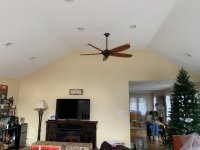
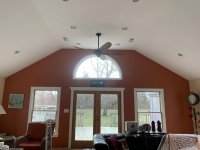
Again this is my opinion & you should consult a RA as they do this all the time, what you want to do isn't a big deal, lots of buildings with cathedral ceilings. Here are a couple of pics from a room im my house, very similar. The soffit is 4' above the plate, 3' below the ridge a little more than 1/2, the joists are the same size as the rafters. When it's living space you have to meet the energy code, garage is a little different, but depends on local code, it's really all about code compliance. I'm sure if you sent a architect a few pics he could give you a quick answer & approximate price to draw it up & fill it. If this is your forever home do it right, set it up for what you may do down the line, it's never cheaper to go back & do it again.
What you want to do is very typical renovation work, done all the time, just get a local RA and you be all set.
What you want to do is very typical renovation work, done all the time, just get a local RA and you be all set.
Attachments
fourbyford
Well-known member
As others have mentioned, the offending framing members are ceiling joists... more importantly, they are collar ties. Their function is to prevent the tops of your walls from pushing out as a load is applied to the roof.
It is possible to move collar ties upward, as long as three things are considered.
First, there are limits as to how much a collar tie can be raised and still function. IIRC, as long as the tie is positioned in the lower third of the overall "height" of the roof structure, they'll work. You should research that number but, if you're just looking to raise them 12" to 18", I'd think you're OK.
Second, you'd need to see how the rafters are attached to the wall top-plate. Ideally, the rafters would be bird-mouthed and secured with hurricane clips. If not, you could install the clips from the inside. Simpson Strong Tie makes one that would be ideal. If the rafters are not bird-mouthed (or maybe even if they are) you could/should install 2x blocking between the rafters to prevent them moving side to side.
Finally, when you raise the collar ties, the method of attachment to the rafters is crucial! As mentioned, when a load is applied to the roof, forces will be trying to "stretch" the collar tie... or seperate it from the rafter. Again, Simpson makes products that will help with this. Personally, I'd take a good look at how those collar ties are joined in the center... whether you raise the ceiling or not.
I think your project is do-able. A couple more things to consider...
If you do raise the collar ties, do one at a time... don't remove all of them at once!
Personally, I wouldn't undertake this job with a ton of snow on the roof. Either keep it shoveled off or wait for a thaw.
Good Luck! If you do this, post pics!
...D
It is possible to move collar ties upward, as long as three things are considered.
First, there are limits as to how much a collar tie can be raised and still function. IIRC, as long as the tie is positioned in the lower third of the overall "height" of the roof structure, they'll work. You should research that number but, if you're just looking to raise them 12" to 18", I'd think you're OK.
Second, you'd need to see how the rafters are attached to the wall top-plate. Ideally, the rafters would be bird-mouthed and secured with hurricane clips. If not, you could install the clips from the inside. Simpson Strong Tie makes one that would be ideal. If the rafters are not bird-mouthed (or maybe even if they are) you could/should install 2x blocking between the rafters to prevent them moving side to side.
Finally, when you raise the collar ties, the method of attachment to the rafters is crucial! As mentioned, when a load is applied to the roof, forces will be trying to "stretch" the collar tie... or seperate it from the rafter. Again, Simpson makes products that will help with this. Personally, I'd take a good look at how those collar ties are joined in the center... whether you raise the ceiling or not.
I think your project is do-able. A couple more things to consider...
If you do raise the collar ties, do one at a time... don't remove all of them at once!
Personally, I wouldn't undertake this job with a ton of snow on the roof. Either keep it shoveled off or wait for a thaw.
Good Luck! If you do this, post pics!
...D
firebirdparts
Well-known member
^^^^ Good advice.
Again this is my opinion & you should consult a RA as they do this all the time, what you want to do isn't a big deal, lots of buildings with cathedral ceilings. Here are a couple of pics from a room im my house, very similar. The soffit is 4' above the plate, 3' below the ridge a little more than 1/2, the joists are the same size as the rafters. When it's living space you have to meet the energy code, garage is a little different, but depends on local code, it's really all about code compliance. I'm sure if you sent a architect a few pics he could give you a quick answer & approximate price to draw it up & fill it. If this is your forever home do it right, set it up for what you may do down the line, it's never cheaper to go back & do it again.
What you want to do is very typical renovation work, done all the time, just get a local RA and you be all set.
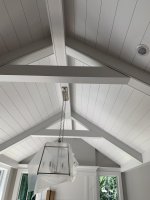
It's all math .. as you raise the tie -- the whole structure must grow in strength
The first picture shows a ridge beam -- it was the only way to pull this off. The rest of the trim is boxed and is not structural except at the end of the room. The ridge is the structure. The next two show another way .... no ridge .... but, this still needed the lower collar ties to make it work. That was fine as it was the look I wanted - the flat ceiling was always wanted. Ridge beams solve many problems -- but, they are ugly and hard to hide.
Attachments


Garage is legit with proper permits. Just got into house this sept and mortgage company was all over every damn detail. Theres more to it than just wanting to have dodge tucked away, wanted to button up inside, insulate and figure out a heating system. Wasnt sure how to address ceiling. At 1st i wanted to just plywood a section to the rear of garage for storage. I was at that point told by a co worker to consult a engineer. Combat ninja is right, do i "need" these changes? No. I spent the last 30yrs spinning wrenches and even painting a few vehicles out of a 1.5 car garage. Honestly reality hasnt set in that this is my garage yet. All ive done so far is inside home renovations. driveway was never finished, some crushed stone. Maybe i should do that? Im all over the map and just excited to have a gentlemans workspace. Friends dont want to hear my garage woes, they wanna puch me when i bring up my dilemma!
Attachments
![IMG-20201227-WA0003[1].jpg](/forum/data/attachments/880/880951-6a9553189896ed438da320bcdab87f6c.jpg)
Renegade1LI
Well-known member
After years of not having a heated, cooled shop, I would never go back, as a builder I should have done it years ago, you know how that goes. Finish, heat & cool your shop, make it as comfortable as possible you won't regret it. A comfortable space with good lighting makes you way more productive too, nothing like having my son or a friend stop by with a project, have a beer & enjoy the time.
Don1357
Well-known member
Ok, ok, I got another beer, hear me out...
So if you bolt the 4-lift post to the slab, all struckturally and stuff and what not, use them 4 big metal posts to connect into the roof?
If you do make sure you post pictures on thereIfixedit
So if you bolt the 4-lift post to the slab, all struckturally and stuff and what not, use them 4 big metal posts to connect into the roof?
If you do make sure you post pictures on thereIfixedit
firebirdparts
Well-known member
Just how many was that beers total, though
Kaizen
Well-known member
I find that I like to plan and research things even if I don’t do them for years. Your garage is a good example. Make a big plan so anything you do is a step in that direction.
I have a multi page to do list. Room by room that I make and a whiteboard in garage. Helps keep it from feeling overwhelming.
Sent from my iPhone using Tapatalk
I have a multi page to do list. Room by room that I make and a whiteboard in garage. Helps keep it from feeling overwhelming.
Sent from my iPhone using Tapatalk
theoldwizard1
Well-known member
To me, those look suspiciously like home built trusses.
Concur ! The issue I see (and only a professional engineer can answer) is if you switch to a "rafter tie" (1/3 above the distance between the current bottom chord and the peak) are the rafters strong enough ? They look like 2x6s but they also appear to be 24" O.C. If they were 16" O.C. is would say go ahead.
BTW, those vertical members do very little (if anything) in supporting the roof. Typically something like that is temporary to support the ridge board (note I said "board" not "beam"; big difference).
firebirdparts
Well-known member
^^^^^^ bad advice. Do not listen to this.
Slick111
Well-known member
You have every thing you need to raise the whole building up as Pvfjr said the concrete slab with a automotive lift installed get some timbers bolt them to the lift fasten to the walls disconnect bottom sill / studs walls raise the building up frame a lower stud 2-3 foot wall lower down done
ovilla
Well-known member
How tall are the ceilings now? If they’re at least 10’ then I’d just get a nice roll around seat for now and maybe spend money on a nice shop heater. This way it will make it really comfortable out there this winter and come spring time, or even summer, you can start raising the ceiling. This also gives you more time to really plan things out, and see how you really need to use your shop, and take some measurements too.
Also, people think they need to raise the ceiling because the whole car will be 6-7’ up in the air but what they really need space for is just the roof/window part of their car/truck. This is not a 2 post lift, where everything will be hanging down. For suspension work you’re going to want the car just 3’ or so off the ground and then you’ll use your air Jack to get it another foot or so off the lift. Anyway, they make really low seats on rollers that will allow you to comfortably sit upright and change the oil or do other work with your car just 3-4’ off the ground (I’m talking 3-4’ from the floor to the bottom of your drive on ramps). Keep in mind that the bottom of your car will easily be a good foot higher than top of your ramps, which will give you even more height.
Also, people think they need to raise the ceiling because the whole car will be 6-7’ up in the air but what they really need space for is just the roof/window part of their car/truck. This is not a 2 post lift, where everything will be hanging down. For suspension work you’re going to want the car just 3’ or so off the ground and then you’ll use your air Jack to get it another foot or so off the lift. Anyway, they make really low seats on rollers that will allow you to comfortably sit upright and change the oil or do other work with your car just 3-4’ off the ground (I’m talking 3-4’ from the floor to the bottom of your drive on ramps). Keep in mind that the bottom of your car will easily be a good foot higher than top of your ramps, which will give you even more height.
shadetree_mech
Active member
Not like this is anything I would ever need to do, but I can't stop reading this type of thing. Waiting to see how this turns out.
The Tool Tyrant
ALLIANCE MEMBER
Here we go again...The downward force exerted at the top of the 'triangle' is resisted by the horizontal tie at the bottom of the 'triangle'. If you remove the horizontal tie, the 'triangle will collapse flat. If the horizontal tie is removed, you must now change the load path.
You can add a continuous ridge beam under the existing 2x ridge, with 4x posts at both ends to transfer the load to the footings. This is very doable...BUT, you would want to involve a structural engineer to calc. your ridge beam sizing and verify if your existing footings are sufficient to handle the point loading at the posts. Worst case scenario is that you would need to underpin the footings at those two locations which isn't really that big a deal.
My favorite saying that my boys hate to hear..."Ain't nothing to it, but to do it!"
You can add a continuous ridge beam under the existing 2x ridge, with 4x posts at both ends to transfer the load to the footings. This is very doable...BUT, you would want to involve a structural engineer to calc. your ridge beam sizing and verify if your existing footings are sufficient to handle the point loading at the posts. Worst case scenario is that you would need to underpin the footings at those two locations which isn't really that big a deal.
My favorite saying that my boys hate to hear..."Ain't nothing to it, but to do it!"
Last edited:
TRWham
Well-known member
...
BTW, those vertical members do very little (if anything) in supporting the roof. Typically something like that is temporary to support the ridge board (note I said "board" not "beam"; big difference).
They do the opposite of supporting the roof because they are transferring some of the dead load of the rafter ties to the rafters via the collar ties. They probably did this to avoid the rafter ties sagging over time, because they are spliced at the mid-point. It's unconventional and I would not have done it, but it's not the worst thing I've ever seen done in framing.
ace10
Well-known member
They do the opposite of supporting the roof because they are transferring some of the dead load of the rafter ties to the rafters via the collar ties. They probably did this to avoid the rafter ties sagging over time, because they are spliced at the mid-point. It's unconventional and I would not have done it, but it's not the worst thing I've ever seen done in framing.
I agree.
The verticals are supporting the joist.
And the framer could have sandwiched them in instead of face nailing them. Which would have been a huge improvement. And run the scabs longer on the joint.
Too much reliance on nails for my liking.
R6 Racer
Well-known member
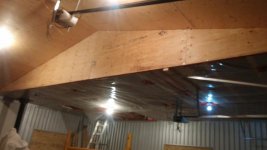
I recently finished what you want to do via scissor trusses. I only removed 3 bottom cords & with 2ft on center spacing of the trusses this gave me a 8ft wide raised section.
From the pics it looks like your spacing & truss orientation are the same as mine. Your pitch looks better than mine. It looks to be a 9/12 pitch or maybe even greater. What is it?
Mine was a fairly easy process.
Had an engineer come out & do his thing. A week or so later he came back with drawings for 3 piece scissor trusses that could be installed directly to the existing ones. I OK'ed the order threw a local truss company & paid him for the trusses & the drawings. He placed the order & the trusses were dropped off about a month later.
Install took a few hours & a LOT of nails.
It wasn't even that expensive(I thought anyway).
Here is a pic of it after it was sheeted.
If you want more info on what I did Let me know.
Steve
From the pics it looks like your spacing & truss orientation are the same as mine. Your pitch looks better than mine. It looks to be a 9/12 pitch or maybe even greater. What is it?
Mine was a fairly easy process.
Had an engineer come out & do his thing. A week or so later he came back with drawings for 3 piece scissor trusses that could be installed directly to the existing ones. I OK'ed the order threw a local truss company & paid him for the trusses & the drawings. He placed the order & the trusses were dropped off about a month later.
Install took a few hours & a LOT of nails.
It wasn't even that expensive(I thought anyway).
Here is a pic of it after it was sheeted.
If you want more info on what I did Let me know.
Steve
Attachments
Nowater
Well-known member
Those look a lot like homemade trusses, which are not legal here in windy Florida, and we don't even have any snow load.
My seat of the pants engineering says that you can raise the bottom chord of some of those trusses a foot or two, but it is not that easy without some thought. IF possible, put in the replacement ceiling boards bottom chord before cutting out the old.
As previously stated, you may need to strengthen the top chord of the modified trusses to attach the new members.
The bottom chord keeps the building from spreading apart, as said above. One can strengthen that center joint where two by lumber is nailed on both sides. One idea is to purchase structural strapping to span that joint and nail it on with lots of nails, the idea being that the steel strapping in tension resists the spreading forces better than the wood scabs do.
Hope this helps.
My seat of the pants engineering says that you can raise the bottom chord of some of those trusses a foot or two, but it is not that easy without some thought. IF possible, put in the replacement ceiling boards bottom chord before cutting out the old.
As previously stated, you may need to strengthen the top chord of the modified trusses to attach the new members.
The bottom chord keeps the building from spreading apart, as said above. One can strengthen that center joint where two by lumber is nailed on both sides. One idea is to purchase structural strapping to span that joint and nail it on with lots of nails, the idea being that the steel strapping in tension resists the spreading forces better than the wood scabs do.
Hope this helps.