To avoid these ads, REGISTER NOW!

How much can I reduce the temp inside detached garage?

five_one_oh

Member
Joined
Jun 21, 2023
Messages
12
Location
Bay Area, CA
How much can insulation and a ceiling reduce the temperature inside a detached garage?

I have an unfinished garage/workshop (plywood/pegboard interior walls, no ceiling just a pitched roof with exposed beams, stucco exterior) and I'd like to convert it into a work/hangout space where I can keep some heat-sensitive items.

I live in an area that doesn't get super hot temps (monthly average highs are low-mid 70s in the hottest time of year. Maybe a couple days a year, if that, when it hits the 90s) but there is a lot of sunshine and the garage as it is now gets pretty hot on sunny days.

As it is now I'm thinking of having a ceiling built and the space filled in with insutlation, as well as insulating the walls. Would that be enough? I don't want to deal with HVAC, but I'd be open to ideas about adding vents, fans, etc. Thanks in advance for any ideas you may have.
 
Last edited:
To avoid these ads, REGISTER NOW!

NBN

Well-known member
Joined
Jun 6, 2008
Messages
190
Location
SE Tejas
Addition of a roof vent will help reduce interior temps a little. Same with insulation. Unfortunately, you will still have the ambient temperature. So you're not going to see a drop of more than a few degrees compared to what you see pre insulation.
The addition of a small window unit (or wall unit) will help tremendously.
 

AE2

Well-known member
Joined
Nov 28, 2012
Messages
305
Location
Atchison KS
I friend of mine is fighting this same issue right now. His doors face due west and the afternoon/evening sun is brutal. He just installed two roof vents and has a window open most of the time to help the draft. I think we are going to try an cobble together a solar fan to put in the roof vent and see if that helps any.

Insulation will help but you need some airflow also to help with humidity. My old garage was insulated and in the shade but the high humidity rusted some of my tools and caused mold/mildew to grow on the interior of my mustang.
 

P0234

Well-known member
Joined
Aug 6, 2012
Messages
3,241
Location
NoVA
How much hanging out are you going to do in there? As stated above a window or wall unit will do the most at the least initial cost. I have an uninsulated garage with a wall unit and it brings the temps down from the upper 80's to the mid 70's in an hour or two. I have it on a wifi thermostat that I can hit and pre-cool when I need it.

And what is heat sensitive enough other than food that can't deal with 90's?
 
OP
F

five_one_oh

Member
Joined
Jun 21, 2023
Messages
12
Location
Bay Area, CA
Addition of a roof vent will help reduce interior temps a little. Same with insulation. Unfortunately, you will still have the ambient temperature. So you're not going to see a drop of more than a few degrees compared to what you see pre insulation.
The addition of a small window unit (or wall unit) will help tremendously.
Thanks for the reply. I was feeling optimistic after reading another thread:


Where a bunch of people say insulation could help a lot. Someone even says his non-AC garage keeps 10 degrees cooler than outside temp in the summer because it's insulated.

Maybe I'll consider a window or wall unit. For context, I don't have AC in my house (almost no one does where I live).
 
OP
F

five_one_oh

Member
Joined
Jun 21, 2023
Messages
12
Location
Bay Area, CA
How much hanging out are you going to do in there? As stated above a window or wall unit will do the most at the least initial cost. I have an uninsulated garage with a wall unit and it brings the temps down from the upper 80's to the mid 70's in an hour or two. I have it on a wifi thermostat that I can hit and pre-cool when I need it.

And what is heat sensitive enough other than food that can't deal with 90's?
Ideally it would be a home office as well as a music room of sorts, so I want it to be a place I can spend time comfortably. But actually the main reason I'm concerned about the heat is I want to keep some instruments (drums, guitar), stereo system, and vinyl records in the space, and I'm concerned too much heat could damage this stuff.

In most parts of the country it might be advisable to keep these sorts of things in a truly climate controlled space, but the climate is relatively mild where I live so I'm wondering if I can make it work without AC.
 

Ilikeike

ALLIANCE MEMBER
Joined
Jan 8, 2015
Messages
2,452
Location
Northern Ca.
Can you install a 120v powered gable type fan, the kind with a built in thermostat? home depot has them, I put one in a metal shed with 3 walls that covers some electric motors and VFDs, a white roof also helps.

One of our conex storage containers I installed a solar powered vent fan, and also applied snow roof up top. helps a lot.
 
OP
F

five_one_oh

Member
Joined
Jun 21, 2023
Messages
12
Location
Bay Area, CA
Heat reduction is usually a factor of how much money you have to apply to the problem. If you have enough money to to throw at the problem, you can build a walk-in freezer.
Sure, but my initial thought was to try to do this without AC, that's the gist of my question. But if reducing temps really isn't possible more than a few degrees with only insulation, fans, etc. I might consider AC.
 

NUTTSGT

Super Moderator
Staff member
Joined
Sep 14, 2009
Messages
51,155
Location
Northern Central Ohio
Insulation will keep it 10-15° for a while when it seasonal warms up, same with the temp change when fall rolls around. If you fully insulation the structure, what you're using to heat/cool the space is the big heat sink concrete floor.

The insulation is an investment and will continually pay you a return when you heat/cool the space. Fully insulating and adding a mini-split with a heat strip would probably be enough for you to climate control the space.
 
OP
F

five_one_oh

Member
Joined
Jun 21, 2023
Messages
12
Location
Bay Area, CA
Insulation is not climate control. It cannot make it colder or warmer.

It can only so the movement of heat to a cooler space
Understood. Actually, I was thinking adding a ceiling would be what makes the most difference, if anything. As it is now it's a pitched roof with exposed rafters/joists, so adding a ceiling will create a lot of space between the roof and the room itself.

For comparison, my house stays pretty cool, except for the bedroom on the third floor (it's a split level). I assume this is because that bedroom, like the garage, is fully exposed to the sun and doesn't have much space between the roof and the ceiling--but admittedly I have a pretty limited understanding of this stuff.
 
  • Like
Reactions: NBN

u3b3rg33k

Well-known member
Joined
Dec 18, 2017
Messages
4,051
Insulation is not climate control. It cannot make it colder or warmer.

It can only so the movement of heat to a cooler space
This right here.

it's a rabbit hole tho:

insulation will also make it retain more heat at night, taking longer to cool down. of course, a fan will help with that.

once you start insulating you need to figure out other HVAC-y things. like humidity control. is it 60F 50% rh inside, and 80F 60% RH outside? now when you open the door, all your tools are instantly wet. now you close the door, and it'll be 68F 80% rh inside. now your building will slowly rot.

so you need a dehumidifier.

dehumidifier adds heat to the building. now you want AC more often to keep the heat in check if you want to be in there.

park a wet car inside? park a snow covered car with a hot engine inside? park a hot car inside? etc.

insulation leads to needing to treat it like a building. but for the most part you can get away with just a dehumidifier. it's pretty trivial to keep a well insulated garage above freezing/around 40F in the winter and humidity under 55%. a fan on a differential thermostat (won't run when it's hotter outside than inside, even if it's hotter than the "cool" setting) will do wonders for "good 'nuff" cooling.
 

dcg9381

Well-known member
Joined
Jun 20, 2018
Messages
11,927
Location
Austin, TX
How much can insulation and a ceiling reduce the temperature inside a detached garage?

We all know what you're asking. But you're kinda asking it the wrong way. All insulation does is increase the amount of time it takes for the building to reach the ambient temp outside. No matter how much insulation you add, if it's always 90 degrees outside, eventually you're going to reach 90 degrees. How long that takes is a factor of insulation.

What you "can" do - as you have a relatively "mild" climate is insulate and then take advantage of ambient. You bring in air when it's cool (perhaps by some sort of push/pull fan system) and turn off that ventilation when it's hot out.

If you're trying to simply avoid the highs in the 90s, I think that you can accomplish this without going to HVAC, but it will require insulation and being mindful of outside temps - you vent the building when it's cool and keep it tight when it's hot.

Even if you were willing to do HVAC, you'd still need insulation, so the first step is the same - give it a try and see if you can live with the results.

And people are right - in mild climates with humidity, having a cool building without HVAC can sometimes trigger moisture problems...

Biggest bang for the buck is ceiling insulation if you're concerned about heat. Most of the R value should go there. But if you're about to engage in the cost of building an attic, you might consider spray foam (it's generally a superior insulator) over attic construction and traditional insulation - it can be done in a day, costs more than traditional insulation but I dont know if it costs more than building an attic with traditional insulation. Traditional attic design with traditional insulation needs a vented roof... The opposite is true if you use foam, so consider your existing roof design.

I think comparing it to your home without running AC would give you a good idea of what you might accomplish.
 

ycgoat

Well-known member
Joined
Mar 28, 2020
Messages
971
Location
S.E. Va
Foil radiant barrier on walls that get sunshine and ventilation is the best bang for the buck without insulation
 

HPRifleman

Member Emeritus
Joined
Nov 18, 2019
Messages
767
Location
Wayne, IL
My garage has in-floor heat but no active cooling. While our house is very shaded, the garage roof is exposed to the sun.

On hot days (85º+F) I am amazed at how much cooler the garage is compared to outside air temperature. The interior is typically about 5º (or more) cooler than the exterior temperature. This is provided I keep the doors and windows closed.

The garage is insulated with R-21 in the walls and R-49 in the ceiling. You can see photos of the insulation in my build thread link in my signature.
 

545_days

Well-known member
Joined
Oct 30, 2016
Messages
588
Location
Texas
Insulation is not climate control. It cannot make it colder or warmer.

It can only so the movement of heat to a cooler space
While true, the above is also a bit misleading. Insulation on my west facing garage door greatly reduced the radiant heat entering my garage. Before insulating by the time I got home from work in the afternoon, my garage would routinely be far hotter inside than the ambient temperature outside due to the sun. (I live south of Houston near the Gulf Coast.)

That said, I cut a hole in my garage and installed a window unit. the window unit is too small for the space, but still makes a huge difference.
 

ycgoat

Well-known member
Joined
Mar 28, 2020
Messages
971
Location
S.E. Va
While true, the above is also a bit misleading. Insulation on my west facing garage door greatly reduced the radiant heat entering my garage. Before insulating by the time I got home from work in the afternoon, my garage would routinely be far hotter inside than the ambient temperature outside due to the sun. (I live south of Houston near the Gulf Coast.)

That said, I cut a hole in my garage and installed a window unit. the window unit is too small for the space, but still makes a huge difference.
A foil radiant barrier would do the same thing but would be much cheaper. To me full insulation only makes sense if you have the money or plan on adding Air or heat later
 

racecougar

Well-known member
Joined
Jan 26, 2021
Messages
5,190
Location
Missouri
I've only glanced, but one thing I haven't seen mentioned is the heat sink effect of the slab (assuming there is a concrete slab floor). You WILL notice a reduction in peak temps and in temp swings by insulating the building.

Whether you end up installing some form or HVAC or not, insulating is the first step.
 

MovingAlong

Well-known member
Joined
Aug 17, 2013
Messages
1,261
You might look at some automation with attic and whole house fans.

Insulation will help "if" you can pull enough cool air through at night to reduce the temp of the slab/walls/equipment/etc and then close it up to keep the heat out during the day.

Same as you probably do with your house now without thinking about it...
 
To avoid these ads, REGISTER NOW!

mrbill55

Well-known member
Joined
Jun 23, 2016
Messages
1,263
Location
Greenville, SC
How much can insulation and a ceiling reduce the temperature inside a detached garage?

I have an unfinished garage/workshop (plywood/pegboard interior walls, no ceiling just a pitched roof with exposed beams, stucco exterior) and I'd like to convert it into a work/hangout space where I can keep some heat-sensitive items.

I live in an area that doesn't get super hot temps (monthly average highs are low-mid 70s in the hottest time of year. Maybe a couple days a year, if that, when it hits the 90s) but there is a lot of sunshine and the garage as it is now gets pretty hot on sunny days.

As it is now I'm thinking of having a ceiling built and the space filled in with insutlation, as well as insulating the walls. Would that be enough? I don't want to deal with HVAC, but I'd be open to ideas about adding vents, fans, etc. Thanks in advance for any ideas you may have.
Having a ridge vent retrofitted is a cost effect tool for venting hot air from your ceiling. Adding insulation to the ceiling (pitched or otherwise) will also assist in preventing excessive heat buildup from the sun beating down on the uninsulated roof. Your choice of insulation, but the ridge vent is the way to go.

Bill S.
 

bdbecker

ALLIANCE MEMBER
Joined
Nov 18, 2015
Messages
5,584
Location
Iowa
Where a bunch of people say insulation could help a lot. Someone even says his non-AC garage keeps 10 degrees cooler than outside temp in the summer because it's insulated...

I believe you are referencing my comment in that thread. Most of that post was related to heating in the winter, so I'll elaborate about how I keep my space cool in the summer...

Insulation is one part of the equation (I've got R38 batts in the ceiling), but so is ventilation. Having adequate attic ventilation keeps the hot air moving so it doesn't get stuck up there and soak down into the shop. A lot of people skip the math on this and create a sauna in their attic. Admittedly, I did not do the math either when I was replacing my roof and installing my ridge vent, but I got lucky and later found that I had it sized appropriately for the space. I did do the math when I installed soffit vents and have really good airflow in the attic. When I've poked my head up there for one reason or another during the summer months, it is actually not much warmer than the ambient temp. You can tell there is some heat coming through the shingles, but it is not nearly as stuffy as other attics I've been in. I'm not sure if this will apply to your space because of the way your garage is built, but figured I'd mention it.

The other trick is to keep the doors and windows shut when the outside temperature is higher than the indoor temperature. On a hot day, it is really tempting to open the windows and doors to get a nice cross breeze rolling through the shop. The breeze feels good, but you are also pulling hot air into your space. When you shut down the doors/windows when you are done for the day, you've now trapped that warm air in the space. Insulation works both ways and it takes a very long time for that heat to dissipate.

As long as the humidity isn't crazy, I crack my overhead door a few inches before I go to bed at night and have a fan circulating the cool night air throughout the space. When I leave for work in the morning, I shut the door. This week, our lows have been in the mid 60's with highs around 90. Yesterday when I got home, the garage was at 77 and the ambient temp was at 91 according to my indoor/outdoor thermometer. I know leaving the door open at night isn't practical for everyone. I do have the advantage that my garage is detached from the house and sits in the back corner of my lot behind a gate and fence, well away from the prying eyes of anyone walking down the sidewalk looking to get into some mischief. My garage door is also black, so it is not easy to tell that it is open either. I also use a pair of vise grips on the track to keep the door from moving up or down.

When the humidity is high and I can't leave my door open at night, the temperature in the garage is still noticeably lower than the ambient temp in the afternoons. Not always 10-15 degrees lower, but still 7-8 degrees, which is enough to make a difference. I believe this is due to the attic ventilation preventing a lot of the heat from making its way into the main space.
 
OP
F

five_one_oh

Member
Joined
Jun 21, 2023
Messages
12
Location
Bay Area, CA
This right here.

it's a rabbit hole tho:

insulation will also make it retain more heat at night, taking longer to cool down. of course, a fan will help with that.

once you start insulating you need to figure out other HVAC-y things. like humidity control. is it 60F 50% rh inside, and 80F 60% RH outside? now when you open the door, all your tools are instantly wet. now you close the door, and it'll be 68F 80% rh inside. now your building will slowly rot.

so you need a dehumidifier.

dehumidifier adds heat to the building. now you want AC more often to keep the heat in check if you want to be in there.

park a wet car inside? park a snow covered car with a hot engine inside? park a hot car inside? etc.

insulation leads to needing to treat it like a building. but for the most part you can get away with just a dehumidifier. it's pretty trivial to keep a well insulated garage above freezing/around 40F in the winter and humidity under 55%. a fan on a differential thermostat (won't run when it's hotter outside than inside, even if it's hotter than the "cool" setting) will do wonders for "good 'nuff" cooling.
I was hoping to avoid rabbit holes! Seriously though, I get that it's all a little more complicated than "add insulation and be done with it" and I appreciate these detailed responses.

I'm thinking whatever else I do, some kind of fan/vent system will be crucial. In terms of humidity, I'm actually not sure how to approach that. Where I live isn't usually described as "humid" because we don't get very high temperatures but I believe the absolute humidity level of the air tends to be higher than it feels because I'm near the ocean and we get summer fog that rolls in off the SF Bay.

I won't be parking any cars in there, or bringing anything else wet (or snow covered) inside. Seems like insulation, fans/vents, and maybe a dehumidifier could be the way to go?
 
Last edited:

FredWanaker

Well-known member
Joined
Mar 27, 2021
Messages
1,470
Location
NorCal
depends on money spent. In 2009 preparing to work more in the garage, I insulated and drywalled the garage here. Added ceiling bats and ceiling drywall. Added insulation to the walls that had none. Added soffit vents to work with an existing gable vent. Added insulated rollup doors. In summer the temperature dropped from about 120F at 5pm to 85F on a 100F day. With a detached garage white roofing shingles will help too. In winter when it is 25F here the temperature went from about 40F to 65F. HOWEVER pull a hot car into the garage and park it, the temp goes way up. Adding some form of HVAC will help too but only once it is insulated. Otherwise the conditioning is lost because there is no insulation.
 

P0234

Well-known member
Joined
Aug 6, 2012
Messages
3,241
Location
NoVA
10 degree heat difference from insulation only sounds like the stuff legends are made of. There are a few studies you can google that show temps with insulation and without, spoiler alert.... not 10 degrees.
 

428PI

Well-known member
Joined
Jul 14, 2018
Messages
1,976
Location
Peabody, KS
A foil radiant barrier would do the same thing but would be much cheaper
The insulation on the garage door does either come with a radiant barrier or acts like one. My insulation kit on my garage door has foil on one side. Most insulated doors would have a metal interior surface.
 
OP
F

five_one_oh

Member
Joined
Jun 21, 2023
Messages
12
Location
Bay Area, CA
We all know what you're asking. But you're kinda asking it the wrong way. All insulation does is increase the amount of time it takes for the building to reach the ambient temp outside. No matter how much insulation you add, if it's always 90 degrees outside, eventually you're going to reach 90 degrees. How long that takes is a factor of insulation.

What you "can" do - as you have a relatively "mild" climate is insulate and then take advantage of ambient. You bring in air when it's cool (perhaps by some sort of push/pull fan system) and turn off that ventilation when it's hot out.

If you're trying to simply avoid the highs in the 90s, I think that you can accomplish this without going to HVAC, but it will require insulation and being mindful of outside temps - you vent the building when it's cool and keep it tight when it's hot.

Even if you were willing to do HVAC, you'd still need insulation, so the first step is the same - give it a try and see if you can live with the results.

And people are right - in mild climates with humidity, having a cool building without HVAC can sometimes trigger moisture problems...

Biggest bang for the buck is ceiling insulation if you're concerned about heat. Most of the R value should go there. But if you're about to engage in the cost of building an attic, you might consider spray foam (it's generally a superior insulator) over attic construction and traditional insulation - it can be done in a day, costs more than traditional insulation but I dont know if it costs more than building an attic with traditional insulation. Traditional attic design with traditional insulation needs a vented roof... The opposite is true if you use foam, so consider your existing roof design.

I think comparing it to your home without running AC would give you a good idea of what you might accomplish.
Thanks for the detailed response. You say "No matter how much insulation you add, if it's always 90 degrees outside, eventually you're going to reach 90 degrees." The thing about where I live is that even on days when it does hit 90 (pretty rare), it cools down a lot at night. It's almost never hot or even really warm at night, so I'm hoping this will make it a bit easier to keep the space cool.

Focusing insulation on the roof seems to be the way to go. What R-level of insulation would be good? As high as possible?

Comparing my home without AC--most rooms never get uncomfortably hot, although the top floor bedroom does. Cracking windows and running ceiling fan in the evening help make it comfortable, so I'm thinking if I can create a situation similar to that in the garage, it will work.
 

racecougar

Well-known member
Joined
Jan 26, 2021
Messages
5,190
Location
Missouri
A little data to add:

I have a Wifi thermometer/hygrometer in my shop that plots out a graph of the interior temp and humidity. Looking at just this past week, where I haven't run the HVAC nor had the doors open, the interior temp has sat between 70.5F and 73.6F. Exterior temp highs have ranged from 80F to 91F, and lows between 68F and 71F.

Good insulation and air sealing works.
 

dcg9381

Well-known member
Joined
Jun 20, 2018
Messages
11,927
Location
Austin, TX
Thanks for the detailed response. You say "No matter how much insulation you add, if it's always 90 degrees outside, eventually you're going to reach 90 degrees." The thing about where I live is that even on days when it does hit 90 (pretty rare), it cools down a lot at night. It's almost never hot or even really warm at night, so I'm hoping this will make it a bit easier to keep the space cool.
I get it. Again, the best simulation is to run your home without HVAC. We do this in a home up north - basically open it up at night (when it's cool) and then button it up during the day.


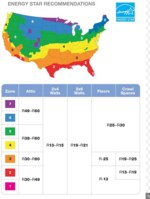
Focusing insulation on the roof seems to be the way to go. What R-level of insulation would be good? As high as possible?
Most heat gain/loss comes through the roof. That doesn't mean walls are not important. They're just less important. There's a "guide" that answers your question per climate zone, but this applies to "residences" - so these are residential recommendations.

1687448064855.png


Note, I'm in climate zone 2 or 3. Our shop is foam insulated but it's probably R-12 to R-15. I don't cool it all the time, so to me it makes more sense to over HVAC a bit (ductless) and under insulate as insulating a big building with foam was expensive and it only runs HVAC 5% of the time or so.


Comparing my home without AC--most rooms never get uncomfortably hot, although the top floor bedroom does. Cracking windows and running ceiling fan in the evening help make it comfortable, so I'm thinking if I can create a situation similar to that in the garage, it will work.

I think you'll have good luck comparing it to the house. My garage has an "exhaust" fan system so I can **** in cool air when the air is cool.. Or I can also push out the heat from heat soaked cars when they park (assuming it's reasonable temp outside).
 

bdbecker

ALLIANCE MEMBER
Joined
Nov 18, 2015
Messages
5,584
Location
Iowa
10 degree heat difference from insulation only sounds like the stuff legends are made of. There are a few studies you can google that show temps with insulation and without, spoiler alert.... not 10 degrees.

I would be genuinely interested in reading through those... is there a website or keywords you could share to find these studies?

To be clear, I did not say insulation alone was what makes the difference for me (both in the other thread and in this one). Proper attic ventilation, keeping doors shut during the peak temps, and pulling in cool air at night also factor into the equation.
 
Last edited:

duneslider

Well-known member
Joined
Jan 20, 2013
Messages
2,272
Location
Riverton, Utah
Just some more stuff to think about...

If you can let the cool in at night so everything cools down and then shut everything up and are well insulated you can probably maintain a nice temp in the area. I am doing this in my house right now, windows open at night and it cools down then we shut the windows in the morning and it stays nice in the house most of the day.

Number two, you climate is nice so once the temps do get up if you have fans the air movement will make it feel a lot nicer than the temp might be. Just like sitting on the patio in the shade with a nice breeze. Same air temp as off the patio but being in the shade and having some air movement is nice.

I don't think there is anything wrong with insulating, it helps and isn't that expensive but if you aren't going to run ac know that you might need to open up the door and run some fans.

My garage in the summer gets hot by the end of the day but if I open the doors and run a fan it feels pretty nice even though its 90 degrees.
 
OP
F

five_one_oh

Member
Joined
Jun 21, 2023
Messages
12
Location
Bay Area, CA
I get it. Again, the best simulation is to run your home without HVAC. We do this in a home up north - basically open it up at night (when it's cool) and then button it up during the day.


Most heat gain/loss comes through the roof. That doesn't mean walls are not important. They're just less important. There's a "guide" that answers your question per climate zone, but this applies to "residences" - so these are residential recommendations.

1687448064855.png


Note, I'm in climate zone 2 or 3. Our shop is foam insulated but it's probably R-12 to R-15. I don't cool it all the time, so to me it makes more sense to over HVAC a bit (ductless) and under insulate as insulating a big building with foam was expensive and it only runs HVAC 5% of the time or so.


I think you'll have good luck comparing it to the house. My garage has an "exhaust" fan system so I can **** in cool air when the air is cool.. Or I can also push out the heat from heat soaked cars when they park (assuming it's reasonable temp outside).
Thanks. I'm in climate zone 3 in coastal California, but that zone includes areas which have very different climates, including a lot of places where it gets far hotter than it ever gets near me. Even the Bay Area gets radically different conditions because of all the microclimates, so 10 miles west of where I live it's notably colder and wetter, 10 mi east it gets much hotter in the summer than me, etc.

Anyway, I'm thinking: insulate the newly-created attic (using R-30 to R-60, maybe toward the lower end of that scale?), walls with R-13 to -15, and put in a gable vent fan in the attic, then an overhead fan in the main space, and see if all that gets me where I want to be in terms of temp? There is one window in the garage, but it's not that big so I'd rather keep it clear, but I guess if things are still too hot in there I can add some kind of AC unit or fan to the window.
 
  • Like
Reactions: NBN

dcg9381

Well-known member
Joined
Jun 20, 2018
Messages
11,927
Location
Austin, TX
Anyway, I'm thinking: insulate the newly-created attic (using R-30 to R-60, maybe toward the lower end of that scale?), walls with R-13 to -15, and put in a gable vent fan in the attic, then an overhead fan in the main space, and see if all that gets me where I want to be in terms of temp? There is one window in the garage, but it's not that big so I'd rather keep it clear, but I guess if things are still too hot in there I can add some kind of AC unit or fan to the window.
This is vastly better insulation that what I have in my shop and I'm in a more extreme climate. I think it's a good plan. And if it doesn't do what you want it to do, you add a ductless system - you'll need the insulation anyway.
 

Jagmandave

Well-known member
Joined
Nov 6, 2011
Messages
6,305
Location
Overland Park, Ks.
You must be east bay? Cause the coldest place I've ever been is San Francisco in the summer!

I think a wall unit/window unit is your best bet - it takes down the humidity and if you get one with a heat strip you can warm the garage/music room up in winter too.

My garage/shop is somewhat insulated but in hot, muggy Kansas summers it got too hot to work in there, and too cold in winter. I put a big ol window unit in ($600 on Amazon) and it works a treat, since it also has the heat strip. It adds about $20 in the summer to my electricity bill, less in winter because our other electrical use is far lower since we aren't running the whole house A/C too.

Edit: One like this requires 220V and about 30 amp service
 
OP
F

five_one_oh

Member
Joined
Jun 21, 2023
Messages
12
Location
Bay Area, CA
The insulation on the garage door does either come with a radiant barrier or acts like one. My insulation kit on my garage door has foil on one side. Most insulated doors would have a metal interior surface.
And the foil radiant barrier would go on top of the (hypothetical) insulation on the (hypothetical) attic floor, correct?
 

428PI

Well-known member
Joined
Jul 14, 2018
Messages
1,976
Location
Peabody, KS
And the foil radiant barrier would go on top of the (hypothetical) insulation on the (hypothetical) attic floor, correct?
No, you want the foil on the inside and have air space. That's what I understand. They make a foil based osb board for roofing and you want the foil facing down into the attic space if using it that way. It has to have air space.
 

NUTTSGT

Super Moderator
Staff member
Joined
Sep 14, 2009
Messages
51,155
Location
Northern Central Ohio
I've only glanced, but one thing I haven't seen mentioned is the heat sink effect of the slab (assuming there is a concrete slab floor). You WILL notice a reduction in peak temps and in temp swings by insulating the building.

Whether you end up installing some form or HVAC or not, insulating is the first step.
It's what I was alluding to in my post above.

We're on the same page.
 

NUTTSGT

Super Moderator
Staff member
Joined
Sep 14, 2009
Messages
51,155
Location
Northern Central Ohio
10 degree heat difference from insulation only sounds like the stuff legends are made of. There are a few studies you can google that show temps with insulation and without, spoiler alert.... not 10 degrees.
A fully detached garage will see a difference in temps, easily 10° at the beginning of Spring or as Fall sets in with temperature changes. As the new season comes in full swing, you will see the difference gei smaller and smaller.

Granted, it will also be dependent on the area you live in, do you actually have 4 different seasons like the Midwest ?

Our fully insulated house garage, unheated, is routinely 10-15° warmer than outside temps with heat loss from the house.
 

P0234

Well-known member
Joined
Aug 6, 2012
Messages
3,241
Location
NoVA
A fully detached garage will see a difference in temps, easily 10° at the beginning of Spring or as Fall sets in with temperature changes. As the new season comes in full swing, you will see the difference gei smaller and smaller.

Granted, it will also be dependent on the area you live in, do you actually have 4 different seasons like the Midwest ?

Our fully insulated house garage, unheated, is routinely 10-15° warmer than outside temps with heat loss from the house.
Than outside temps sure. Folks talking about 10 degrees cooler than without insulation are the tall tales.
 
To avoid these ads, REGISTER NOW!
Top Bottom