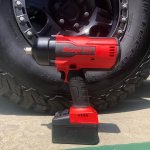
Mass is everything with impact guns because the torque they produce is a function of impulse.
Torque ratings of impact guns really are meaningless. For instance, if you have a small diameter standard depth socket on an impact gun, you can put loads of torque down to the nut. If with the same impact gun you now use a very large deep wall socket, the torque it will put down to the bolt/nut will be substantially less. The lighter weight the hammer mechanism, the bigger the problem. It’s the difference between hitting a golf ball or a bowling ball with a golf club. It is a heck of a lot harder to get a bowling ball moving with a golf club than it is to move a gulf ball. The bigger the mass of the stuff you are trying to move, the more hammer you need to achieve a given torque.
My 1/2” stubby impact will strip the threads on a class 10.9 M12 bolt with a standard depth socket. With a 36mm deep wall socket, it won’t tighten a nut on an M24 bolt worth anything. With my clicker torque wrench, I can rotate the nut almost 1/8 a turn before it clicks at 50 fy*lbs. So realistically, the impact gun that can strip an M12 bolt might be getting the M24 close to 20-30 Ft Lbs. if you put the impact on the bolt instead of the nut, it is even worse because the bolt is heavier still than the nut.
Mass is everything.
Generaly, the larger the hammer mechanism, the less things like socket mass and fastener mass screw with your output torque. For this reason, on large fasteners, I prefer a 3/4 with heavier hammers which runs slower than a 1/2 with lighter hammers that runs faster. Even if they have the same rating measured at the drive square, by the time you add sockets, fasteners, extensions, etc into the mix, the end result will be surprisingly different between the two.