Years ago I found a way to stop destroying 1/2" breaker bars.
3/4" breaker bars
then
Impact wrenches.
I think that's true for 99% of 3/4" breaker bars but I bought one that bends and deforms with hardly any effort. The beam is 1" thick but must be made with the cheapest metal possible. My Wright 3/4 breaker bar is thinner but way stronger. It was a great $15 find at the flea market.This. It's fun, loading the handle of a 1/2" bar like a spring when it breaks. That energy has to go somewhere.
Go 3/4" if you're worried/concerned about strength in a 1/2". The lowliest 3/4" bar will beat the fanciest 1/2". A 3/4" bar and specific sockets for your applications is so cheap nowadays. There's almost no excuse not to have them.
-Ryan
Maybe I will do the same. I like the first one without comfort grip. I like the second one for access. Maybe getting the icon is the way to get both.I couldn't find a Pittsburgh 1/2" breaker bar that didn't have slop in the head assembly, which seemed bad for a breaker bar. The Icon unit was tighter with a smooth action, I picked it up with a 20% off coupon and it has been good one some pretty tough jobs so far.
The bar is like a leaf spring.a breaker bar will fail in two places. The drive lug or the yoke. The first one looks to have a heavier yoke
Several channels already have. Just search on Youtube. Some of the cheap ones were embarrassingly close to the high dollar ones. That's why I said to buy those and spend more somewhere else.maybe we could get "Project Farm" or the Torque channel to compare them!
Might check to see if the bolt can be made tighter. On a cheap model the bolt may be able to bind the head completely (no flex) but on the (better?) designs the bolt will seat and can be snugged to,say,60 inch lbs.,the flex friction being controlled by a split washer or spring held in a countersink in the side of the bar or drive.I couldn't find a Pittsburgh 1/2" breaker bar that didn't have slop in the head assembly, which seemed bad for a breaker bar. The Icon unit was tighter with a smooth action, I picked it up with a 20% off coupon and it has been good one some pretty tough jobs so far.
Or 1" breaker bars and 1" impacts. I always size the tools to the task, so it is seldom that I break Any tool. My Pittsburgh 1/2" drive, 24 inch long breaker bar broke with a moderate one hand even pull. I also had the open end of a Pittsburg long length 3/4" combination wrench split with a light one hand pull. When buying these things from Harbor Freight, the position of quality control automatically comes with the purchase.Years ago I found a way to stop destroying 1/2" breaker bars.
3/4" breaker bars
then
Impact wrenches.
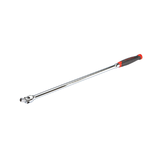
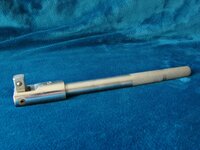
Beefiness. HF "pro" and ICON are obviously stronger by the feel and weight.So besides soft handle, why is the 2nd better and more popular? Just curious.
This is what I tell everyone when a tool fails. They should of went up a size.Years ago I found a way to stop destroying 1/2" breaker bars.
3/4" breaker bars
then
Impact wrenches.
Who exactly are you replying too?You can’t possibly be a professional mechanic if you treat your tools like that. Or you are using up somebody else’s. Must be all junk. Even best quality tools won’t last long if you claim those kinds of torque. Must spend a fortune on replacing broken ****
This guyThis is what I tell everyone when a tool fails. They should of went up a size.
1/4in 70ft lbs.
3/8in 250ft lbs.
1/2in 500ft lbs.
3/4 1000ft lbs.
Depending on the tool quality/brand it may fail or exceed those numbers.
Why are you getting your ******* in a bunch? Have you not watched any stress test videos on youtube for tools? Most tools go far beyond ASME spec. Also I never said I was a professional. We're literally talking about breaker bars here. My point is using the right tool for the job.This guy
Again, back to the whole right tool for the job...You will if you try and get 250 ft.lb. On a 3/8 handle. Just saying not safe
I suspect rust also played a role here.
I do all my own work except wheel balancing and 4 wheel alignment.I suspect rust also played a role here.
Now you know why many of us have not let another person work on our vehicles.
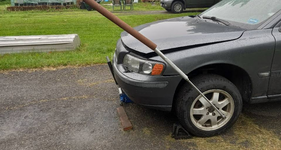
Be careful, your setup looks like a imminent trip to the emergency room.
Are new wheel studs and lug nuts in your future?
1/2 inch.Is this a 1/2 or 3/4 breaker bar?
Yes, those figures fall within the failure points for those sizes. The "Safe Working Limits" or "Recommended Working Limits" would more likely be around 25, 100, 250, and 600 ft lbs for those respective sizes.This is what I tell everyone when a tool fails. They should of went up a size.
1/4in 70ft lbs.
3/8in 250ft lbs.
1/2in 500ft lbs.
3/4 1000ft lbs.
Depending on the tool quality/brand it may fail or exceed those numbers.
Good to hear you do your own work.I do all my own work except wheel balancing and 4 wheel alignment.
No lugnuts on volvos, they use bolts.