To avoid these ads, REGISTER NOW!

How To: Remove a Jacobs chuck arbor

A_Pmech

Well-known member
Joined
May 8, 2007
Messages
8,002
Location
IL
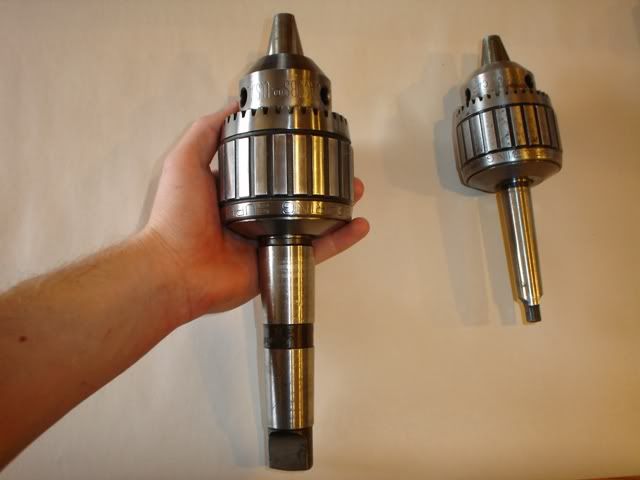
I recently bought a Jacobs #18N 3/4" chuck with a #4 Morse Taper arbor. For my application I'll need to use the chuck with both the existing #4 Morse Taper arbor and a 3/4" straight shank arbor.

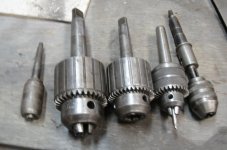
Here's the chuck when I bought it with a #4 Morse Taper arbor installed. The smaller chuck to the right is a 1/2" Jacobs with a #2 Morse Taper arbor installed:
chuck1.jpg


To give an idea of scale, here it is next to a standard 1/2" Jacobs economy drill chuck:

chuck.jpg


What is a Jacobs Taper?

Before I get into removing the shank, I'll start by explaining just what a Jacobs taper is.

Basically, there are two standards for fixing drill chucks to the drilling machine. The first type of chuck is called a "threaded back" chuck. These are often used on hand drills and small import drill presses. The back of the chuck is threaded, usually 3/8 - 24 or 1/2 - 20 although other standards exist. The chuck screws onto the driving shaft and seats against a shoulder. As the drill spins, the chuck is tightened further onto the shoulder.

Here's an example of a 1/4" Jacobs chuck partially unscrewed from a shop-made arbor:

Threadedback.jpg


The threaded back chuck has two drawbacks:

1) The thread does not accurately locate the chuck concentric to the axis of the driving shaft.

2) A threaded chuck cannot operate in reverse, the chuck would simply screw off the shaft.

These drawbacks are solved by the Jacobs Taper. Like the Morse Taper, the Jacobs Taper is a type of self-holding machine taper. Although similar in dimensions to the Morse stub taper, the Jacobs Taper is proprietary to the Jacobs company. Due to geometric advantages, self-holding machine tapers accurately center themselves into their mating socket. They resist torque and disassembly by elastically deforming the socket when assembled, causing the female socket to tightly grip the male taper. Friction alone holds the two together in semi-permanent assembly. Axial thrust only increases their holding power.

Unfortunately, what makes them accurate can also make them hard to disassemble!

The usual method for removing a Jacobs chuck from it's arbor, a drill motor or drill press quill is the Jacobs Removal Wedge. Two wedges are placed between the arbor and the chuck and driven together with a hammer or a bench vise. However, this particular arbor and chuck combination does not lend to this approach as there is very little shoulder on the Morse Taper for the wedges to bear on. Even with a sufficient shoulder, the wedges can be difficult to use in the best of times.

This Jacobs company illustration shows how they are used:

tapered-spindle-chuck-removal.jpg
 
Last edited:
To avoid these ads, REGISTER NOW!
OP
A

A_Pmech

Well-known member
Joined
May 8, 2007
Messages
8,002
Location
IL
For this chuck, I decided to use another method Jacobs suggests, drilling the chuck body and pressing the arbor out.

Drilling the Body

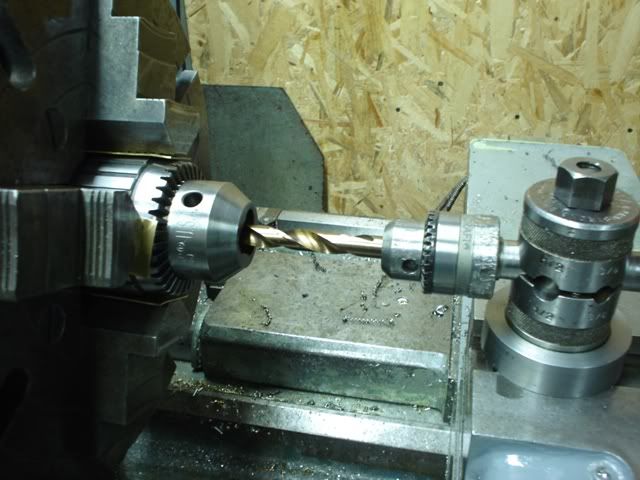
I began by chucking the drill up in the lathe, using brass stock to protect the ring from damage. Then, using a 29/64 drill I drilled though the back of the chuck and into the arbor space:

Drilling1.jpg


You can see the leading edge of the Jacobs taper through the hole in the back of the chuck body:

drilling2-1.jpg


With access to the leading edge of the Jacobs taper, I drilled it 1.5" deep with a 3/8" drill. This may release some of the holding force of the taper, but it also places the pressing force at the back of the arbor rather than the front.

When compressive forces are applied to an object, it tends to enlarge in the unconstrained directions. Whereas, when a tensile force is placed on an object, it tends to cause the object to "neck". The 3/8" hole places the pressing force near the end of the taper, "pulling" the leading edge of the taper out and causing it to "neck" slightly. This can aid removal:

Drilling3.jpg


Here you can see the hole in the arbor:

Drilling4.jpg


Pressing out the #4 Morse Taper arbor

I located a piece of pipe slightly larger than the OD of the #4 Morse Taper arbor and a couple inches longer. I placed it over the arbor so that it would bear on the chuck body.

Then, I took a 3/8" bolt and ran it down though the chuck body and through the 3/8" hole drilled in the arbor. I gently closed the chuck jaws on the bolt and placed the whole assembly in the press:

Drilling5.jpg


After a few pumps with the handle, the arbor and chuck separated with a BANG! I'll try to upload the video later.

The separated chuck and arbor:

Separated.jpg


Assembling With the New 3/4" Straight Shank Arbor

After cleaning the mating taper surfaces I retracted the chuck jaws and placed the chuck body on a piece of scrap aluminum on the concrete floor. Then, I placed the new arbor in the chuck and gave it a couple sharp blows with a soft faced hammer.

It is important that the taper be seated firmly, otherwise it could spin and gall the mating surfaces. Per Jacobs' instructions, DO NOT press the two together in any kind of a press as it will permanently lock the taper and may distort the chuck body:

installingthenewarbor.jpg


Here's the result!

Installed.jpg


There's been some discussion about removing chucks here on GJ and I thought my experience would prove useful to others.

:thumbup:
 
Last edited:

Bolster

Well-known member
Joined
Jul 8, 2008
Messages
4,056
Location
Mexifornia
If you are taking requests, I'd like to know how to disassemble a Jacobs chuck. I have one of my grandfather's I'd like to rehabilitate and use in my mill, but it "sticks." Thought it just pressed apart but no luck so far.
 

balrog

Well-known member
Joined
Mar 31, 2009
Messages
162
A Pmech,

Can you reuse the #4 arbor after it has been drilled? If so, will it be much more difficult to press it out the second time around?

Thank you for the excellent tutorial.
 

Bruce Lancaster

Well-known member
Joined
Apr 3, 2006
Messages
1,642
If you google "jacobs chuck" disassembly or "jacobs chuck disassembly" you'll get multiple sites with instructions. There are also removal sites. Don't personally know if any of them are worth anything.
 
OP
A

A_Pmech

Well-known member
Joined
May 8, 2007
Messages
8,002
Location
IL
emeraldcoupe said:
i have no answer for you but thats the biggest chuck i've ever seen! totally awesome. what are you using it for?

It's a good size, that's for sure. It will replace the small 1/2" chuck that was used to drill it out. The straight shank arbor allows me to use it on the carriage and the #4 Morse Taper arbor allows me to use it in the tailstock of the lathe.

Eventually, I'll buy another 18N and then I can avoid swapping arbors all the time. :)

If you are taking requests, I'd like to know how to disassemble a Jacobs chuck. I have one of my grandfather's I'd like to rehabilitate and use in my mill, but it "sticks." Thought it just pressed apart but no luck so far.

Hi Bolster,

Have a look here for Jacobs chuck servicing instructions:

http://www.jacobschuck.com/pdf/s2.pdf

If I come across a chuck in need of repair, I'll be happy to post up when I do the repair. However, the 18N I just worked on is essentially brand new so I'm in no hurry to take it all apart just yet. :bounce:

balrog said:
A Pmech,

Can you reuse the #4 arbor after it has been drilled? If so, will it be much more difficult to press it out the second time around?

Thank you for the excellent tutorial.

Certainly. It should come out just as easily the second time, so long as it is seated only with a hammer. Easily being relative, of course. I would say it took in the neighborhood of 5-10 tons to force the arbor out.

You're welcome!

:beer:
 

Charles (in GA)

Well-known member
Joined
Jan 11, 2006
Messages
12,489
Location
50 mi south of Atlanta
I bought a nice used 18N on a #3 morse taper arbor to replace the smaller (about 5/8" chuck and arbor) in my Grainger/Dayton drill press. The chuck did not run true (typical drill bit had 3 to 4 thousand wobble in it) and I was not able to separate it, finally gave up before I got stupid and damaged it.

Took it to work and gave it to the foreman of the machine shop and it was handed back to me in two hours, running true within a half a thousandth.

They dipped the arbor end in liquid nitrogen which caused it to rapidly shrink and the chuck came right off. They then cleaned the tapers, checked the arbor alone in their equipment and found it dead on, and reinstalled the chuck squarely.

Most drill presses with a Morse taper in the quill have a slot for a drill press "drill drift"

http://www.grainger.com/Grainger/items/4H102?Pid=search

http://www.grainger.com/Grainger/items/4H100?Pid=search

4H106.JPG


and this is how you remove the chuck and arbor as a unit (or the arbor alone) from the quill of the drill press. Arbors are inexpensive, chucks are not really that bad, keep one for every purpose, already set up and checked for trueness.

Charles
 
OP
A

A_Pmech

Well-known member
Joined
May 8, 2007
Messages
8,002
Location
IL
Charles,

I tried liquid nitrogen alone and it wouldn't budge! I figured if I ran out of tonnage on the press I'd bathe the arbor in liquid nitrogen and try again. Fortunately, it wasn't THAT stuck. :)

Now that I have the chuck drilled it shouldn't take more than a couple minutes to swap arbors when the occasion arises but a 20N and a few more 14N's are planned.

In my experience, the usual cause of a self-holding taper running out is a burr in the socket or on the male taper and/or swarf between the two. Needless to say, it's important to religiously clean the two before mating!

Good addition on the drill drifts, I forgot to discuss those!

:beer:


Video

As promised, here's the video of the press operation. Unfortunately, I made the mistake of taking the video "sideways" to capture the whole thing from close-in.

So, turn your head sideways and watch it here:


Stick Figure

Well-known member
Joined
Aug 3, 2009
Messages
1,395
Location
Omaha, Ne
very nice info..... this is one of those things that i've often wondered while working on some things, but never remembered to do any research. Now i may have to take a second look at some of those chucks that i have boxed up.
 

Bolster

Well-known member
Joined
Jul 8, 2008
Messages
4,056
Location
Mexifornia
Hi Bolster,

Have a look here for Jacobs chuck servicing instructions:

http://www.jacobschuck.com/pdf/s2.pdf

LOL, those are the exact instructions I tried to use a month ago, when I failed. My only explanation is that I was using an arbor press with insufficient "grunt." Does it take a large amount of pressure, or just a little? Thanks.

Needless to say, it's important to religiously clean the two before mating!

Good advice for a whole range of human endeavors!
 
OP
A

A_Pmech

Well-known member
Joined
May 8, 2007
Messages
8,002
Location
IL
LOL, those are the exact instructions I tried to use a month ago, when I failed. My only explanation is that I was using an arbor press with insufficient "grunt." Does it take a large amount of pressure, or just a little? Thanks.


Good advice for a whole range of human endeavors!

Hi Bolster,

I have never disassembled a Super Chuck, so I can't comment on the tonnage required. If the arbor press didn't work and you were following the instructions properly as I'm sure you were, I'd say more grunt was required.

Very true! :bounce:
 

ourkid2000

Well-known member
Joined
Jul 1, 2008
Messages
927
Location
Nova Scotia
Great post! I always was interested in this operation. You continue to impress me dude.....

Instead of being a cocky arrogant *** wipe, like some of the people who are good at this stuff around here are, you are informative, thorough, and professional.....you'd make a great teacher! Very impressive for a young guy!

Keep up the great posts!
 

TheGrooveking

Well-known member
Joined
Dec 30, 2007
Messages
3,233
Location
An alternate reality in a parallel universe.
You neglected to factor in the retaining screw that goes into the chuck and threads into the threaded arbor to properly hold the chuck on, which in many cases these are left hand threaded screws, thus providing the retention needed for reversing a drill.

I have mucho experience when it comes to drilling, having designed and built multi spindle CNC drilling machines and having managed very large tool and die shops (150+ employees) I've worked with more than a few hundred chucks myself.

TheGrooveking
 
To avoid these ads, REGISTER NOW!

TheGrooveking

Well-known member
Joined
Dec 30, 2007
Messages
3,233
Location
An alternate reality in a parallel universe.
I'd imagine you have, dealing with all those employees, there are sure to be some! :lol:

No kidding we only had one "Chuck" and he was an autistic savant, literally a rainman. He would do multiplication or division in his head and only would commit to be accurate to within 10 decimal places.

We used to have him manually review the old punch tapes for the old CNC equipment early on. He would read them as fast as you could pull them through his hands and he would find errors. He was a walking caluclator, but could not tie his own shoes.

He was our document control person, where he stood at a counter and handed out the prints, coordinate charts and program print outs to all of the machinists and tool makers.

We couldn't give him anything to write with, one time I made the mistake of giving him a sharpie and he drew a beard, moustache and full head of hair on his bald head.

Chuck was probably the nicest most loveable guy anyone could ever know.

TheGrooveking
 
OP
A

A_Pmech

Well-known member
Joined
May 8, 2007
Messages
8,002
Location
IL
I was wondering the very same thing. It has to be common, so just drill them up to start with.

Charles

Charles,

It's interesting to note that the chuck back was only around 1/4" thick.

My guess is they did it to save production time. The hole though the chuck back must be significantly smaller than the drill used to rough out the jaw space. That would require putting a second drill down the hole.
 

Moose-LandTran

Well-known member
Joined
Mar 8, 2008
Messages
15,945
Location
The Brink of Insanity (England)
No kidding we only had one "Chuck" and he was an autistic savant, literally a rainman. He would do multiplication or division in his head and only would commit to be accurate to within 10 decimal places.

We used to have him manually review the old punch tapes for the old CNC equipment early on. He would read them as fast as you could pull them through his hands and he would find errors. He was a walking caluclator, but could not tie his own shoes.

He was our document control person, where he stood at a counter and handed out the prints, coordinate charts and program print outs to all of the machinists and tool makers.

We couldn't give him anything to write with, one time I made the mistake of giving him a sharpie and he drew a beard, moustache and full head of hair on his bald head.

Chuck was probably the nicest most loveable guy anyone could ever know.

TheGrooveking

That's heart warming. :eek:
 

s_ontario

Well-known member
Joined
Jan 5, 2006
Messages
552
Location
canada
I had one i couldn't get apart long time ago put it the deep freezer actually forgot about it month later took it out and droped it on a piece of 3/4" plywood and it came right apart

and they do multiply plus they will get taller in the dark :bounce:
 

Attachments

  • DSC00539.JPG
    DSC00539.JPG
    131.9 KB · Views: 51
  • DSC00545.JPG
    DSC00545.JPG
    143.7 KB · Views: 46
  • DSC00555.JPG
    DSC00555.JPG
    110.9 KB · Views: 36
  • DSC00566.JPG
    DSC00566.JPG
    107.3 KB · Views: 36
  • DSC00570.JPG
    DSC00570.JPG
    111.7 KB · Views: 37

Stick Figure

Well-known member
Joined
Aug 3, 2009
Messages
1,395
Location
Omaha, Ne
you guys are lucky, all of my Jacobs chucks are threaded, and I can't seem find a Morse #2 to 1/2 Jacobs thread for a decent price.
 
OP
A

A_Pmech

Well-known member
Joined
May 8, 2007
Messages
8,002
Location
IL
you guys are lucky, all of my Jacobs chucks are threaded, and I can't seem find a Morse #2 to 1/2 Jacobs thread for a decent price.

MSC doesn't appear to have Jacobs brand Morse Taper arbors with threaded mounts, but they do have various "import" brands with a 1/2"-20 mount:

http://www1.mscdirect.com/CGI/NNSRIT?PMPXNO=25262229&PMT4NO=84414378

See also Victor Machinery:

http://victornet.com/report/Adapters-for-Drill-Chucks-Arbors-/1595.html

Both are inexpensive, but likely Chinese. For a Made In USA arbor, Ebay is possibly the best choice and no more expensive.

(As an aside, I recently called McMaster-Carr as their arbors are significantly more expensive than the "imports" listed above. They get their arbors from "various manufacturers" and can't give a country of origin.)
 

wormwood

Well-known member
Joined
Apr 9, 2010
Messages
950
Location
Dixie
I recently bought a Jacobs #18N 3/4" chuck with a #4 Morse Taper arbor.
chuck1.jpg


.

Oh my, that's a chuck.

I admit, for the first time in my life I am suffering Chuck Envy and Acute Drill Performance Anxiety Syndrome.


.
 

cnc-me

Well-known member
Joined
Jan 6, 2010
Messages
1,183
Location
MI
If the chuck was tapped, would that push the arbor off, without using a press?
Also, some screw on chucks, have a left hand retaining bolt that needs to be
removed before unscrewing from the drill motor ect.
 
OP
A

A_Pmech

Well-known member
Joined
May 8, 2007
Messages
8,002
Location
IL
If the chuck was tapped, would that push the arbor off, without using a press?
Also, some screw on chucks, have a left hand retaining bolt that needs to be
removed before unscrewing from the drill motor ect.

Many people tap the body for a fine thread bolt. I drilled mine for 1/2-20. Run the bolt up tight with a wrench, then give the end of the bolt a couple sharp whacks with a hammer. That's sometimes all it takes.

True on the screw-on chucks. They work OK, so long as you don't jam up the drill in reverse and pop the retention screw head off. :)
 

cnc-me

Well-known member
Joined
Jan 6, 2010
Messages
1,183
Location
MI
and they do multiply plus they will get taller in the dark
Damn! I wish mine would breed, I have them sitting next to each other for years.
Always have to buy them,Even tried a Rohm and an Albrecht still no luck.
Maybe I need to try a Chinese chuck-Don't think I would like the offspring though.
-John
 

jxxxoxxxe

Well-known member
Joined
Feb 15, 2007
Messages
265
another 18N taken popped apart...This had a MT5 in it, while I need a MT4...

18nv.jpg


Not bad for an ebay find. Still need to clean it a bit...now to find a smaller one...Part of me just wants to buy a 20N just for the size...

Is there anyway to date these things? Apparently this one is pre ball bearings...?
 
OP
A

A_Pmech

Well-known member
Joined
May 8, 2007
Messages
8,002
Location
IL
Is there anyway to date these things? Apparently this one is pre ball bearings...?

The model 18N is a ball bearing chuck in all cases, I believe. If it was a 3/4" plain bearing taper mount it would be a model 36, I think.

I'm not aware of any way to date them other than the change in styles or the change in factory location. The original factory was in Hartford, CT. The change to the distinctive "Super Chuck" style was before the move from Hartford down to their recently closed plant in SC.

They now manufacture in China, best as I can tell. They definitely no longer have any manufacturing in America.
 

Davefr

Well-known member
Joined
Jan 7, 2010
Messages
11,849
Location
OR
I have a related question. My Milwauke 3/8" drill has a Jacobs 2A tapered chuck. I removed it for cleaning.

How do I reset the chuck on the drill?? I don't want to apply much pressure on the chuck or it might ruin the drill's bearings. Will it hold with only a couple light taps? Should I use locktite?.
 

TheGrooveking

Well-known member
Joined
Dec 30, 2007
Messages
3,233
Location
An alternate reality in a parallel universe.
Be careful running a large drill chuck on a small diameter shank/shaft, if you are drilling/counterboring/reaming a large size hole the force maybe too much and crack/break the shaft at the back of the drill chuck. I've seen this a few times, we had a 16" x 72" lathe and the guys would keep a 1/2" chuck in the tailstock and then two large chucks with shanks that fit in the next small chuck. You would see these lazy guys stacking chucks together only to come walking into the office with a shank in one hand and a chuck with a broken arbor in it in the other.

TheGrooveking
 
To avoid these ads, REGISTER NOW!
Top Bottom