To avoid these ads, REGISTER NOW!

How to turn a bolt 60 degree (semi) precisely?

qqzj

Well-known member
Joined
Nov 28, 2017
Messages
3,747
Need to do a Honda V6 timing belt soon. The crank pulley bolt tightening calls for a two step process. First torque it to 47 ft lbs. Then turn it another 60 degrees. I am having a whole bunch of questions for the 2nd step. Hopefully someone more enlightened can pass on valuable lessons. Thanks in advance!

1 Why turn it another 60 degrees? Why not just torque to a number like 180 ft lbs?

2 What is the correct tool to turn it 60 degrees?

3 Foreseeing that the correct tool is not going to be cheap and probably will be rarely used and need subsequent calibration, is there a home-garage way to turn it 60 degrees semi accurately?

4 Can I simply torque to 200 ft lbs? As long as the bolt survive the initial test, engine by itself will keep tightening it, right? It takes way more than 200 ft lbs to remove it. So why not tightening it to a high number like 240 ft lbs and call it a day? (My torque meter goes up to 250 ft lbs.)

5 I have a DeWalt heavy duty 1/2 inch battery impact wrench. The max torque @ level 2 according to the following website is 400 ft lbs

https://powertoolspros.net/dewalt-dcf899m2-review/

Can I simply bang it at the 2nd setting and call it a day? This way, I don't even need to buy a crank pulley bolt holder.
 
To avoid these ads, REGISTER NOW!

2ndGearRubber

Well-known member
Joined
Mar 24, 2014
Messages
14,185
Location
Pittsburgh
1) Choosing an angle value means the actual clamp/load on the threads is more consistently achieved, ignoring issues which may change specific torque numbers. Imagine you lube the threads, which decreases friction, which increases applied torque. Angle makes that a non issue.

2)
https://www.amazon.com/dp/B0002STSW6/?tag=atomicindus08-20

This is an angle gauge. Take the preload out of the socket/ratchet/bar and observe the measurement. Rotate to 60 degrees. Buy it where ever from whoever, just an example.


Based on thread size, bolt material, and condition of threads, there is probably a calculator to show estimated ft/lb equivalent. I can almost promise you that you will need the crank pulley holding tool to break it free, a 400ft/lb impact isn't going to touch breaking that bolt free.

While I personally torque crank bolts in basically 100% of cases - hundreds of thousands of crank bolts have been "brap-brapped" with an impact. I once tightened my own crank bolt on my civic to 180*, instead of 90*. That bad boy was damn tight. :lol:
 

KnurledNut

Well-known member
Joined
Jan 28, 2011
Messages
8,064
Location
n/a
360 degrees divided by 6 flats on a bolt is 60 degrees.
Put the socket on the bolt.
Take a sharpie and make a mark on both your 6 point socket and something stationary like the pulley.
Remove and put the socket one notch back on the bolt and tighten up to the stationary mark.
 
Last edited:

vanapplebomb

Well-known member
Joined
Jul 2, 2019
Messages
385
Location
Holland, MI
It’s called the torque angle method. It results in more accurate bolt tension than torquing alone. You need a tool called a torque angle gauge. Any auto parts store will have you. They are pretty cheap. It’s just a degree wheel on a 1/2 drive socket extension. First, torque the bolt to snug things up which removes all play from the assembly. Then put the socket on the torque angle gauge, put it on the bolt, adjust the rest arm of the gauge so it bears against something solid, and zero the gauge. Finally, that a heavy ratchet/breaker bar and continue turning the bolt until the gauge reads 60 degrees.

Bolts torqued using the torque angle method, are typical torque to yield bolts, meaning they are stretched beyond their elastic limit and will no longer return to their original shape when tension is relieve. As such, torque to yield bolts can only be used once. Once used, throw it in the trash/recycle bin and get a new one.

Also, check to see if there is a lubrication specification for the bolt. Often with torque angle, they will say to use grease or oil on the threads. If it doesn’t say anything, a light coat of a light weight oil should do the trick.

Also note, there are modern didgital torque wrenches which have this feature included, but $$$ for a good one. Personally, I would go with a standard torque wrench, and then use a separate angle gauge.

Here is a link to a good example of a basic angle gauge. $13 currently at Autozone. Most parts stores have one just like it.

https://www.autozone.com/test-scan-and-specialty-tools/torque-angle-tool/oemtools-torque-angle-gauge/141510_0_0?spps.s=2185&cmpid=LIA:US:EN:AD:NL:1000000:TLS:71700000060668368&gclid=EAIaIQobChMItvn95KKo7QIViuazCh2CyQr3EAQYAiABEgIfJfD_BwE&gclsrc=aw.ds

Hope that clears things up for you. Good luck!
 

joshmodelskidoo

Well-known member
Joined
Apr 18, 2012
Messages
872
Location
mid western michigan
Think i got one from Autozone for $10 about 4-5 years ago. I was doing head gaskets on the wife’s equinox and was like wtf is going on. I had never herd of that before. It’s probably more accurate or to keep the DIYers away.
 
OP
Q

qqzj

Well-known member
Joined
Nov 28, 2017
Messages
3,747
1) Choosing an angle value means the actual clamp/load on the threads is more consistently achieved, ignoring issues which may change specific torque numbers. Imagine you lube the threads, which decreases friction, which increases applied torque. Angle makes that a non issue.

2)
https://www.amazon.com/dp/B0002STSW6/?tag=atomicindus08-20

This is an angle gauge. Take the preload out of the socket/ratchet/bar and observe the measurement. Rotate to 60 degrees. Buy it where ever from whoever, just an example.


Based on thread size, bolt material, and condition of threads, there is probably a calculator to show estimated ft/lb equivalent. I can almost promise you that you will need the crank pulley holding tool to break it free, a 400ft/lb impact isn't going to touch breaking that bolt free.

While I personally torque crank bolts in basically 100% of cases - hundreds of thousands of crank bolts have been "brap-brapped" with an impact. I once tightened my own crank bolt on my civic to 180*, instead of 90*. That bad boy was damn tight. :lol:

Thanks a lot! I see. So the torque wrench measures the friction force when turning the bolt. What we really care about is the clamping force of the bolt on the two parts it bolts together, which is more related to how much thread of the bolt we can manage to squeeze into the bolt hole.

You mentioned that there is typically some kind of relationship between the two kinds of forces, are you aware of such relationship on a typical 19mm bolt?

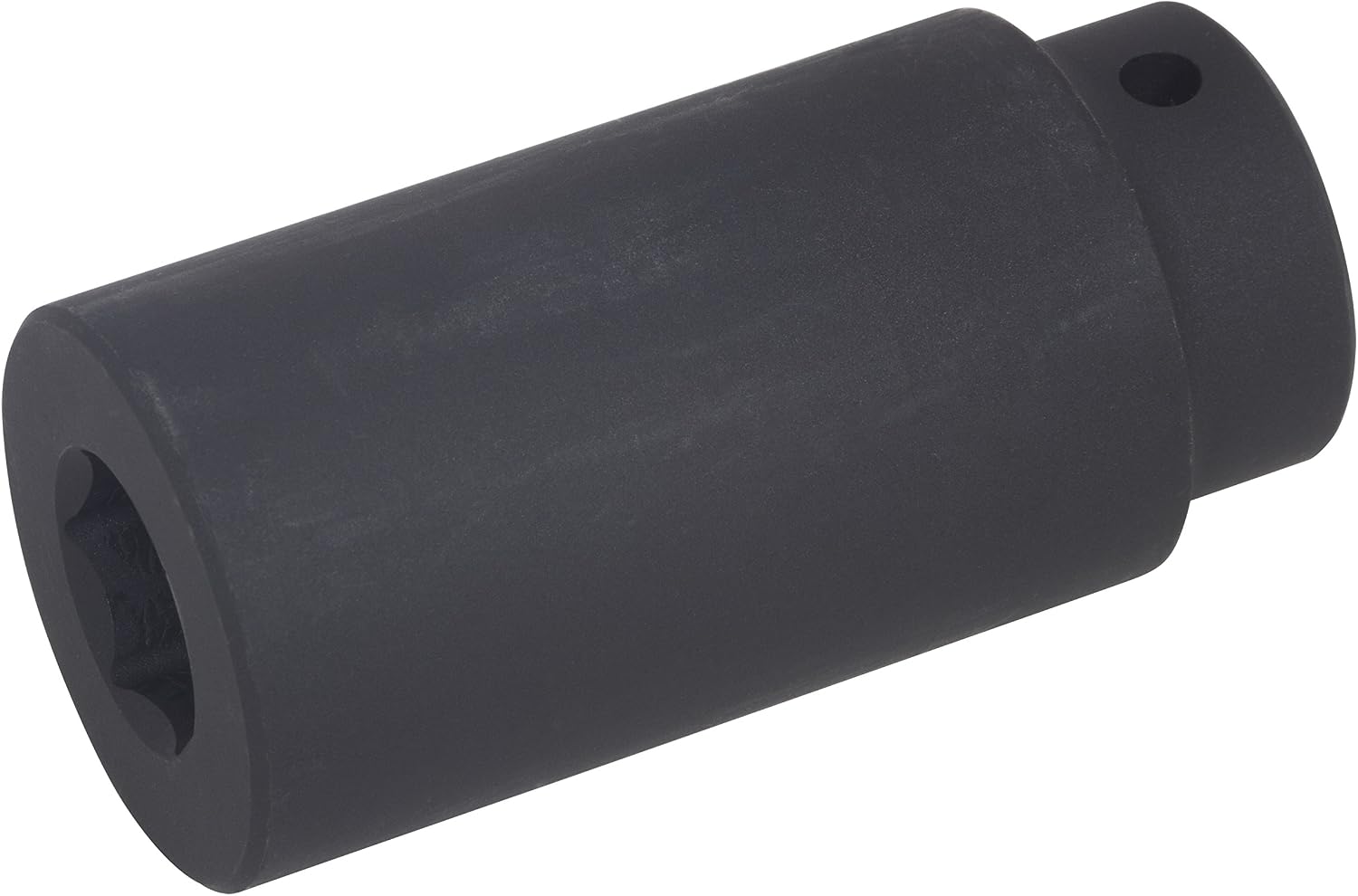
I actually do not need to the holder to break it free. I have the Lisle 19mm super duty impact socket. I can set my impact wrench @ level 3 and use the super duty socket to remove it. When I put it back, I can set the torque wrench at @ level 2 and use a normal impact socket to tighten. Are you foreseeing any catastrophic failure here?
 

2ndGearRubber

Well-known member
Joined
Mar 24, 2014
Messages
14,185
Location
Pittsburgh
Thanks a lot! I see. So the torque wrench measures the friction force when turning the bolt. What we really care about is the clamping force of the bolt on the two parts it bolts together, which is more related to how much thread of the bolt we can manage to squeeze into the bolt hole.

You mentioned that there is typically some kind of relationship between the two kinds of forces, are you aware of such relationship on a typical 19mm bolt?

I actually do not need to the holder to break it free. I have the Lisle 19mm super duty impact socket. I can set my impact wrench @ level 3 and use the super duty socket to remove it. When I put it back, I can set the torque wrench at @ level 2 and use a normal impact socket to tighten. Are you foreseeing any catastrophic failure here?


While I'm sure a mechanical engineer could explain the ratio/formula, that's outside my area of expertise. Bolt size, pitch, metal used, lube used, etc are all relevant. Perhaps a calculator or formula is available online?


Forsee? Nope, it's done like that by many. IMO due to the extreme nature of possible failure (broken bolt while tightening or bolt falling out), I lean towards the proper procedure. Not to say I've never just snugged one up with a gun, but I wouldn't recommend it as the first choice. If you do, I'd throw a kiss of blue locktight on it for insurance.
 
OP
Q

qqzj

Well-known member
Joined
Nov 28, 2017
Messages
3,747
Bolts torqued using the torque angle method, are typical torque to yield bolts, meaning they are stretched beyond their elastic limit and will no longer return to their original shape when tension is relieve. As such, torque to yield bolts can only be used once. Once used, throw it in the trash/recycle bin and get a new one.

Also, check to see if there is a lubrication specification for the bolt. Often with torque angle, they will say to use grease or oil on the threads. If it doesn’t say anything, a light coat of a light weight oil should do the trick.

Hope that clears things up for you. Good luck!

Great advice! Thanks. I was wondering about this as well. I am sure in theory you are correct that I probably should use a new bolt. But I have watched 4 YouTube videos and no one used a new bolt. (I did a Toyota TB replacement before and used the old bolt fine. But Toyota just used a torque number. So the bolt is not a torque to yield bolt.)

For lubricating the bolt, the initial 47 ft lbs is measured with torque wrench. If I lube it, the 1st step would be off. So I am not sure that I should do it, right?
 

2ndGearRubber

Well-known member
Joined
Mar 24, 2014
Messages
14,185
Location
Pittsburgh
Only lube if service info says to. I don't believe it does. I've never replaced a honda crank bolt, not required in service info.
 

FuzzyTiger

Well-known member
Joined
Aug 17, 2020
Messages
429
Location
Canada
I've always just used a sharpie. As someone mentioned above, the hex shape easily divides into 60 degree increments. 45, 90, 180 are all pretty easy to eyeball or use some random object to mark it off with. I've personally never seen angle specs that aren't some multiple of those above. And even if they're out there, one of the 4 above are probably within an acceptable margin of error.

Of course I'm still saving up for a fancy digital torque + angle torque wrench because not needing a tool is never a good excuse for not buying it! :p
 

vanapplebomb

Well-known member
Joined
Jul 2, 2019
Messages
385
Location
Holland, MI
It is pretty rare that torque figures are given Specifically for dry threads. My rule of thumb is always assume a light machine oil if nothing otherwise is called out. Most bolts come out of the package with a light oil on them. To torque dry, would would need to clean the bolt with mineral spirits or acetone before installing.

Also, just because you use a torque wrench does not mean the bolt is not torque to yield. That just means bolt tension accuracy is not as specific. An M8x1.25 class 12.9 bolt can be torqued to 25 FtLbs over and over, because the bolt remained in its elastic zone, and always returned to its original shape. That same bolt torqued to 33 FtLbs should be a one and done bolt. At that point, you are pushing up against the limit of how much the bolt can elongate before it will no longer snap back to its original size once tension is released.

When you want to sneak up on the yield point of a bolt, torquing is a pretty rough way to get there. An given torque can give wildly different bolt tensions because tension will be largely affected by surface mating conditions (roughness, average contact area diameter, material, lubrication, etc) that manipulate the coefficient of friction. The more torque you apply beyond simply snugging things up, the more these factors screw with bolt tension.

To solve that problem with critical fasteners, they give a low torque figure, simply for snugging an assembly up. Then, to stretch the bolt properly to yield, they specify a turning angle. This way you get a known amount of elongation of the bolt because it is related to the thread pitch, which is not affected by surface mating conditions.

The next step up for extremely critical fasteners is a gauge to directly measure how many thousands of an inch you are stretching a bolt. You typically see this with high performance rod bolts in performance engines. Keep tightening until the bolt stretches x amount, then stop once the bolt has stretched to that length.

At the end of the day, we don’t care how hard a bolt is to turn (torque). What we care about is clamping load, which is directly related to now much elongation over a given length a bolt has undergone.

Make sense?

Hope so. :beer:
 

GrantCee

Well-known member
Joined
Aug 23, 2010
Messages
808
Location
Willamette Valley, Oregon
Great advice! Thanks. I was wondering about this as well. I am sure in theory you are correct that I probably should use a new bolt. But I have watched 4 YouTube videos and no one used a new bolt. (I did a Toyota TB replacement before and used the old bolt fine.

I can't speak for Honda engines...but in the Mitsubishi V6 world, they specify the crank bolt is to be replaced. Lots of shadetree mechanics don't; some even make YouTube videos about it. A year or so down the line, when they've sold the vehicle to someone else, the problems crop up. Lots of folks end up replacing engines because the end of the crank was destroyed by the corner-cutting of the tinkerer who thought he didn't need to follow the instructions.

If the factory service manual says to use a new bolt, and to torque it to a specification, you can bet there's a reason why. Deviate from that at your own risk.
 

pizza

Well-known member
Joined
Dec 4, 2019
Messages
1,739
Location
Midwest, USA
you can also note the position of your ratchet, count 60° worth of clicks while reversing (the number of clicks depends on the number of teeth), and then tighten back to original position.

clicks = n*θ/360°,
where n is number of teeth your ratchet has, and θ is desired angle.

e.g. 90 teeth * 60° / 360° = 15 clicks

note that you get better resolution with more ratchet teeth and that this is a free solution. :)
 
Last edited:
OP
Q

qqzj

Well-known member
Joined
Nov 28, 2017
Messages
3,747
Thanks for the knowledge. Makes a lot of sense!
It is pretty rare that torque figures are given Specifically for dry threads. My rule of thumb is always assume a light machine oil if nothing otherwise is called out. Most bolts come out of the package with a light oil on them. To torque dry, would would need to clean the bolt with mineral spirits or acetone before installing.

Also, just because you use a torque wrench does not mean the bolt is not torque to yield. That just means bolt tension accuracy is not as specific. An M8x1.25 class 12.9 bolt can be torqued to 25 FtLbs over and over, because the bolt remained in its elastic zone, and always returned to its original shape. That same bolt torqued to 33 FtLbs should be a one and done bolt. At that point, you are pushing up against the limit of how much the bolt can elongate before it will no longer snap back to its original size once tension is released.

When you want to sneak up on the yield point of a bolt, torquing is a pretty rough way to get there. An given torque can give wildly different bolt tensions because tension will be largely affected by surface mating conditions (roughness, average contact area diameter, material, lubrication, etc) that manipulate the coefficient of friction. The more torque you apply beyond simply snugging things up, the more these factors screw with bolt tension.

To solve that problem with critical fasteners, they give a low torque figure, simply for snugging an assembly up. Then, to stretch the bolt properly to yield, they specify a turning angle. This way you get a known amount of elongation of the bolt because it is related to the thread pitch, which is not affected by surface mating conditions.

The next step up for extremely critical fasteners is a gauge to directly measure how many thousands of an inch you are stretching a bolt. You typically see this with high performance rod bolts in performance engines. Keep tightening until the bolt stretches x amount, then stop once the bolt has stretched to that length.

At the end of the day, we don’t care how hard a bolt is to turn (torque). What we care about is clamping load, which is directly related to now much elongation over a given length a bolt has undergone.

Make sense?

Hope so. [emoji481]

Sent from my Pixel 3 XL using The Garage Journal mobile app
 
OP
Q

qqzj

Well-known member
Joined
Nov 28, 2017
Messages
3,747
Good advice too. I shall look up a manual to see how many bolts are torque to yield type. Anyone familiar with Honda Acura please chime in!

Also thanks to all guys who have helped, I think I am going to buy the holder and angle guage and do it right. A lot of extra dollars are silently gone through!
I can't speak for Honda engines...but in the Mitsubishi V6 world, they specify the crank bolt is to be replaced. Lots of shadetree mechanics don't; some even make YouTube videos about it. A year or so down the line, when they've sold the vehicle to someone else, the problems crop up. Lots of folks end up replacing engines because the end of the crank was destroyed by the corner-cutting of the tinkerer who thought he didn't need to follow the instructions.

If the factory service manual says to use a new bolt, and to torque it to a specification, you can bet there's a reason why. Deviate from that at your own risk.

Sent from my Pixel 3 XL using The Garage Journal mobile app
 
To avoid these ads, REGISTER NOW!

danski0224

Well-known member
Joined
Jan 29, 2005
Messages
13,324
Location
Near Naperville, IL
A fastener with a torque and angle specification is almost always a torque to yield fastener that needs to be replaced.

I'd suggest looking up the repair procedure in Alldata or a factory service manual before trusting random stuff from YouTube or forums without some vetting.
 

ChevyEFI

Well-known member
Joined
Sep 2, 2012
Messages
8,691
Location
Phoenix, AZ
Bolts torqued using the torque angle method, are typical torque to yield bolts, meaning they are stretched beyond their elastic limit and will no longer return to their original shape when tension is relieve. As such, torque to yield bolts can only be used once. Once used, throw it in the trash/recycle bin and get a new one.

Also, just because you use a torque wrench does not mean the bolt is not torque to yield. That just means bolt tension accuracy is not as specific. An M8x1.25 class 12.9 bolt can be torqued to 25 FtLbs over and over, because the bolt remained in its elastic zone, and always returned to its original shape. That same bolt torqued to 33 FtLbs should be a one and done bolt. At that point, you are pushing up against the limit of how much the bolt can elongate before it will no longer snap back to its original size once tension is released.

When you want to sneak up on the yield point of a bolt, torquing is a pretty rough way to get there. An given torque can give wildly different bolt tensions because tension will be largely affected by surface mating conditions (roughness, average contact area diameter, material, lubrication, etc) that manipulate the coefficient of friction. The more torque you apply beyond simply snugging things up, the more these factors screw with bolt tension.

To solve that problem with critical fasteners, they give a low torque figure, simply for snugging an assembly up. Then, to stretch the bolt properly to yield, they specify a turning angle. This way you get a known amount of elongation of the bolt because it is related to the thread pitch, which is not affected by surface mating conditions.

The next step up for extremely critical fasteners is a gauge to directly measure how many thousands of an inch you are stretching a bolt. You typically see this with high performance rod bolts in performance engines. Keep tightening until the bolt stretches x amount, then stop once the bolt has stretched to that length.

At the end of the day, we don’t care how hard a bolt is to turn (torque). What we care about is clamping load, which is directly related to now much elongation over a given length a bolt has undergone.

A fastener with a torque and angle specification is almost always a torque to yield fastener that needs to be replaced.
It's not a torque to yield fastener unless the shank between threads and under-head is equal or less than the thread minor diameter. There's no functional way to have a TTY bolt be full-thread, nor a shank larger than the minor diameter be part of a TTY bolt. The bolt

"Uses a torque angle" is not a qualifier. That is, as vanapplebomb elaborated, a more accurate way to torque fasteners.

"Mfgr says toss it after one use" is not a qualifier. That is done for multiple reasons on non-TTY bolts. Even just because the bolt had sealant or locker.

An actual stretch of the bolt applied to a non-threaded portion of the bolt that is smaller than the thread minor diameter is what makes a bolt torque-to-yield, literally. What happens when you try to apply "stretch" with thread smaller than the smooth shank when the threaded section is weaker than the bolt shank? The thread fails.

It's not a torque to yield fastener unless the shank between threads and under-head is equal or less than the thread minor diameter. Anything else is accounting, loss-prevention, "less hassle than just putting new stuff in" or another method of economics. Not actual "torque-to-yield."
 

vssjim

ALLIANCE MEMBER
Joined
Aug 5, 2007
Messages
2,713
Location
McLean Va.
Use a paint marker and go 1 flat.
or
360 degrees divided by 6 flats on a bolt is 60 degrees.
Put the socket on the bolt.
Take a sharpie and make a mark on both your 6 point socket and something stationary like the pulley.
Remove and put the socket one notch back on the bolt and tighten up to the stationary mark.

The above guys have it right for these engines and it works correctly every time


This is how I do them and I have done atleast a 100 of them and yea I have torque angle gauges and wrenches but for these hondas v6's this is the best way
As a warning the 47 pounds is easy the 60 degrees is all i got using a SIR Tools bar to hold crank pulley and a three foot 3/4 ratchet to tighten and when done that is about as far as you can turn the bolt period
As far as crank bolt honda just says to clean it up and oil threads and it is fine to reuse
 

matt_i

Well-known member
Joined
Mar 14, 2008
Messages
10,714
Location
SE Michigan
Its a fastener you want to get correct. No sense having a crank pulley get loose and rattle around on the nose, trashing the fit until you finally notice it.

Because then, you get to change a crankshaft.

And I'd much rather get the right $15 tool than have to change a crank in any known engine......I wonder what the dealership charges for "R&R Crankshaft"....:shocking:
 

KnurledNut

Well-known member
Joined
Jan 28, 2011
Messages
8,064
Location
n/a
Its a fastener you want to get correct. No sense having a crank pulley get loose and rattle around on the nose, trashing the fit until you finally notice it.

Because then, you get to change a crankshaft.

And I'd much rather get the right $15 tool than have to change a crank in any known engine......I wonder what the dealership charges for "R&R Crankshaft"....:shocking:

...or having the bolt break off in the crank.
Ask me how i know...

:lol_hitti
 
OP
Q

qqzj

Well-known member
Joined
Nov 28, 2017
Messages
3,747
I see. I modified the plan now. I shall buy the tty bolts and holder. No need to buy the angle gauge. First turn it 47 ft lbs. Then mark the bolt, go back one flat, and try to turn it to the mark with the impact wrench. This way it is totally legit, and easier on myself.
Use a paint marker and go 1 flat.
or
360 degrees divided by 6 flats on a bolt is 60 degrees.
Put the socket on the bolt.
Take a sharpie and make a mark on both your 6 point socket and something stationary like the pulley.
Remove and put the socket one notch back on the bolt and tighten up to the stationary mark.

The above guys have it right for these engines and it works correctly every time


This is how I do them and I have done atleast a 100 of them and yea I have torque angle gauges and wrenches but for these hondas v6's this is the best way
As a warning the 47 pounds is easy the 60 degrees is all i got using a SIR Tools bar to hold crank pulley and a three foot 3/4 ratchet to tighten and when done that is about as far as you can turn the bolt period
As far as crank bolt honda just says to clean it up and oil threads and it is fine to reuse

Sent from my Pixel 3 XL using The Garage Journal mobile app
 

RedneckWelder

Well-known member
Joined
Nov 12, 2013
Messages
5,693
Location
The Ghetto Kingdom of Methlandia
Paint pen and mark the hex corners is how I always do it. Also any TTY bolts I always replace with new, plus any critical bolts such as internal to an engine I always replace with new. Fasteners are cheap cheap cheap insurance.
 

richfinn

Well-known member
Joined
Jan 29, 2011
Messages
4,809
Location
Leeds, Yorkshire, England
I see. I modified the plan now. I shall buy the tty bolts and holder. No need to buy the angle gauge. First turn it 47 ft lbs. Then mark the bolt, go back one flat, and try to turn it to the mark with the impact wrench. This way it is totally legit, and easier on myself.

Sent from my Pixel 3 XL using The Garage Journal mobile app

If you have the special crank bolt socket, I would do it without the pulley holder tool

If you mark the pulley and the bolt and just impact it through the final 60 degrees
 

visionguru

Well-known member
Joined
Jan 2, 2017
Messages
1,233
Location
Chicago
I need the holder to torque it to 47 ft lbs in the first step. Am I missing something?
...

Yes, you need Lisle 77080 or something similar. Also, you need long 1/2" extension if the car is only on jack stands. Don't under estimate that bolt, as powerful as you think your impact is.

81HnLSCaK%2BL._AC_SL1500_.jpg


Lots of Honda holder and socket on Amazon for this job:
https://www.amazon.com/honda-crank-pulley-tool/s?k=honda+crank+pulley+tool

Also, this is a page from Honda factory service manual of similar V6 models:
View media item 108250
I'd follow the service manual to the T. After all, it's a job that my local Honda dealer charges more than $1500. Do it right. Don't use impact for tightening the bolt.
 
Last edited:

dnschmidt

Well-known member
Joined
Oct 3, 2014
Messages
7,260
Location
Phoenix, AZ
All of this ink for something so simple. This is ridiculous. It's a six point bolt. Do the initial tightening with the torque wrench to get the slop out of the system. Then bring out the Lisle socket and your impact and put a paint mark on the bolt at one of the hex points and another paint mark on the pulley where the next bolt hex point lies. This is EXACTLY 60 degrees further. Bring out the impact and start blasting away check every couple of ugga-duggas until the two paint marks line up. DONE.
 

eyeball

Well-known member
Joined
Jul 14, 2011
Messages
407
All of this ink for something so simple. This is ridiculous. It's a six point bolt. Do the initial tightening with the torque wrench to get the slop out of the system. Then bring out the Lisle socket and your impact and put a paint mark on the bolt at one of the hex points and another paint mark on the pulley where the next bolt hex point lies. This is EXACTLY 60 degrees further. Bring out the impact and start blasting away check every couple of ugga-duggas until the two paint marks line up. DONE.


The service manual specifically says don't do this...
 

dnschmidt

Well-known member
Joined
Oct 3, 2014
Messages
7,260
Location
Phoenix, AZ
And I guarantee you every single Honda mechanic on earth does it the way I mentioned. There is absolutely no reason not to. How does a bolt know whether it reaches the desired stretch position by means of a breaker bar or an impact wrench. Complete an utter nonsense.

The idea of an excessively loose crank bolt is not going to happen either. The reason the crank bolt is so damn tight to begin with is that Honda engines rotate counterclockwise. In other words the crank bolt gets tightened on every revolution of the engine.
 

craig1980

Well-known member
Joined
May 28, 2012
Messages
87
Location
NEW YORK
I know this is an old thread but i just removed and installed a crankshaft on a 2007 honda pilot. i used a normal deep impact socket and extension to remove it very easily using a snap on mg725 with 125 psi. For the install i did the 47 foot pounds then marked the bolt and crank pulley. I was not even an 1/8 inch off from my mark at 190 foot pounds. I left it there considering it was so close. I used the honda crank holding 50mm socket with a 1/2 breaker bar wedged up against the frame. Wife helped keep everything aligned. It was very simple.
 
OP
Q

qqzj

Well-known member
Joined
Nov 28, 2017
Messages
3,747
I know this is an old thread but i just removed and installed a crankshaft on a 2007 honda pilot. i used a normal deep impact socket and extension to remove it very easily using a snap on mg725 with 125 psi. For the install i did the 47 foot pounds then marked the bolt and crank pulley. I was not even an 1/8 inch off from my mark at 190 foot pounds. I left it there considering it was so close. I used the honda crank holding 50mm socket with a 1/2 breaker bar wedged up against the frame. Wife helped keep everything aligned. It was very simple.
I would just mark the crank and the bolt, then use impact to turn the bolt to align the marks
 
To avoid these ads, REGISTER NOW!
Top Bottom