And now for the rest of the story. Between waiting for tools and supplies, and a solid week of rain, I finally got good weather, and got the mini installed. I learned a lot, and now have a lot more tools to do the job right.
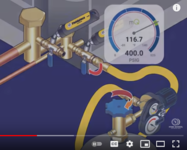
1) I agree that a high pressure test is a good idea. Although it appeared to hold vacuum, at 400 psi it leaked (more about that later). After pricing a nitrogen tank rental, it occurred to me that I have a 150 cu/ft tank of argon welding gas. I googled it, and it's fine to use for pressure testing, as welding gasses are dry. I bought a cheap nitrogen regulator. For some reason, the gauge on the nitrogen regulator does not agree with the HVAC gauges. I had to jack the regulator up to almost 500 psi to get 400 on the HVAC gauge. I'm not sure which one is wrong.
2) You need a micron gauge. The tiny little vacuum range on my cheap HVAC gauges was essentially useless. I bought a decent micron gauge.
3) You need a valve core removal tool. They make 'em specifically for the task, so you do a proper vacuum, release the refrigerant, and install the valve core.
4) I made up a vacuum manifold to hold the gauge with an additional shut-off to isolate the vacuum gauge prior to releasing the refrigerant.
5) Despite the warnings, I bought and attempted to use pre-made refrigerant lines. The flares were terrible. I could have done better with a hammer and a ball bearing. Of course, they leaked. I bought an eccentric flare tool which makes beautiful, perfect flares. I could have bought non-flared refrigerant tubes and the money I saved would have paid for the flaring tool, and then some.
6) The torque settings in the installation manual seem way too high. On the 1/4" line, it crushed the flare down to essentially foil. I used a little Nylog on the back of the flare as a lube. Looking up on-line, the torque for 1/4" tube should be 8-10 ft-lb, not the 14-15 the manual said. I don't know if it was my cheap torque wrench, the cheap tubing, or if the manual for the cheap mini-split was wrong. All three come from China, so who knows?
7) The cheap vacuum pump worked fine, but I found out that if you shut it off and leave it under vacuum, it will pull oil up into the hoses and gauge manifold. I know now to bleed off the residual vacuum in the hoses as soon as I shut it off. No more problems.
I'm all set up now to install mini-splits. I'm putting another one in the shop next year, and the two in the house are almost ten years old, so I expect to have to replace them at some point. The main one we use every day has already had issues. I still can't do full sevice, though. To do that, I'd need refrigerant recovery equipment ($$$) and a weigh-in scale to re-charge the system. The instructions that came with the mini said to vacuum it down, and if it doesn't leak in 15 minutes, it's good. I pressure-tested at 400 psi for 24 hours. Using their method, it would have failed in short order. Next up, I'm going to use my new-found equipment and knowledge to upgrade and repair the A/C in my '92 Miata.