To avoid these ads, REGISTER NOW!

Hydronic heating and cooling questions

Tysonbrown1

Member
Joined
Dec 15, 2019
Messages
7
Location
South eastern Washington state
Heard you all were a plethora of information when it comes to all shop related question and ideas. I’ve looked through some of the threads but have yet to find if anyone has tried what my mind is dreaming up! I’ll keep looking.

I’m building a lil shop in my back yard (50’deep, 100’ wide, 18’ eves, 27’ Ish peak) and looking into hydronic heat via a heat pump style water heater. There will be a small apartment taking up 20’x30’ of the shop with shower, sinks, washer etc.
So in my head I will have potable water via the hp water heater that will be incorporated with a heat exchanger to heat the floors and not contaminate potable water.

1: Has anyone incorporated hydronic cooling with hydronic heating system?

My though process is Possibly Installing valves just outside the water heater so in the summer a person could kill the hot water going to the heat exchanger and then opening valves that go to a buried piped loop 6-8’ under ground out front of the shop to take advantage of the 50-60deg cooling properties of the soil?

2. With heat naturally rising and heating a room evenly, and coolness staying down low, will I need to find a way to circulate the cool air and get it off the ground with either installing large ceiling fans to help push the air around or a return air duct on the ground to **** up the cold air and and then duct work throughout the ceiling to circulate it?
Or does it effectively cool the room without all that extra effort?

Thanks in advance for any advise everyone. Positive and negative feedback welcome, helps me know what I’m doing correctly and what I may need to rethink.
 
Last edited:
To avoid these ads, REGISTER NOW!

fitter30

Well-known member
Joined
Jun 23, 2019
Messages
3,033
Location
Peace Valley,mo
If you were in a desert high temp and low humidity you would get some relief. Cooling takes lowering humidity level (latent heat) and temp ( sensible heat). To remove humidity a system has to get down to dew point condensate is formed removed. If your floor system got dow to dew point how will remove the condensate. If humidity level gets over 50% mold grows. Heres a link to a dew point chart.
https://www.google.com/url?sa=t&sou...FjAUegQIBBAB&usg=AOvVaw0c6p89zREPCLyu_18bxng9
 
OP
T

Tysonbrown1

Member
Joined
Dec 15, 2019
Messages
7
Location
South eastern Washington state
So we are considered high desert, dry heat and ver low humidity.
I’ll Check that chart out and see if I can figure it out 👍🏻
 

Attachments

  • BA9AF479-DDB7-4019-A501-166FCD90FA87.jpg
    BA9AF479-DDB7-4019-A501-166FCD90FA87.jpg
    19.9 KB · Views: 20
Last edited:

99LeCouch

Well-known member
Joined
Apr 18, 2011
Messages
1,053
Location
Rochester, NY
So the floor would be heated by the HPWH? And then a separate circuit for geothermal cooled water?

Could work. I'd be really concerned about contaminating the potable water with whatever mixture is circulating in the floor when the heat exchanger corrodes. Or when the wrong valve for the geo gets opened.

Dedicated geothermal units that transfer heat from the geo loop to refrigerant and then back to air or water sidestep all the likely contamination issues, and wring a lot more energy out of the ground than a water to water system.
 
To avoid these ads, REGISTER NOW!
OP
T

Tysonbrown1

Member
Joined
Dec 15, 2019
Messages
7
Location
South eastern Washington state
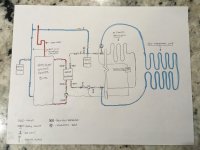
Yes, valves between the heat exchanger and water heater to stop the flow of hot water when going to cooling. And 3 way valves to open to allow the flow of geothermal and stop the flow toward and from the heat exchanger.
Now this drawing is just brainstorming so if you see anything wrong or that I should include please let me know. :thumbup:
 

Attachments

  • A439AEE0-D4D1-4153-A8BD-8C4316B94978.jpg
    A439AEE0-D4D1-4153-A8BD-8C4316B94978.jpg
    106.6 KB · Views: 31

yeldogt

Well-known member
Joined
Jan 2, 2012
Messages
18,184
You will find that the delta is not enough and the transfer will stop -- you will also need a lot of pipe even using a heat pump for a building that size.

fan convectors with cooling possibility have drains -- the efficient systems use very cold water
 

HoosierBuddy

Well-known member
Joined
May 9, 2006
Messages
2,960
Location
Southern Indiana
Well, the geothermal cooling option exists in my home, which is a 100+ year old farmhouse. A small area of the cellar was walled off to be a summer bedroom. When the heat upstairs became too brutal, even with the windows open, they would take a sheet down to the cellar and get some relief as the concrete floor and walls were cooled by the surrounding soil.

It stays about, I don't know, <=5 degrees below ambient down there in the summer time. So in 1925, when it was 85 upstairs they could bed down in the cellar and it was 80...which would be better.

I can't imagine you can make a system using a geothermal loop and water (with no additional chilling) that will be as good as my cellar works, because you are going to only be cooling through the floor, where I have the floor and all walls AND not only won't you be cooling through the walls, you'll be gaining heat through the walls. You will need a ton of insulation in the ceiling, and even then I don't think you'll see more than a degree or two of cooling by running coolish water through your hydronic loops.

I would recommend some sort of heat pump/air handler for your cooling...or perhaps a mini split.

Phil
 
Last edited:
OP
T

Tysonbrown1

Member
Joined
Dec 15, 2019
Messages
7
Location
South eastern Washington state
:beer: and that’s why I’m on here, needed some “real life” experiences to help point out the flaws in my planning. I will probably still do the hydronic heat through the floor, and look into other ways to incorporate cooling into the building. Guess I’ll just have to figure out the most efficient way to go, mini split, forced air. Any ideas you all may have are appreciated and considered. Thanks
 

brewchief

Well-known member
Joined
Sep 20, 2008
Messages
2,372
Location
Michigan
Where will the water heater be installed? If in the conditioned space then it's not going to work well, those work by extracting heat from the air to heat the water, it will cool the space it's installed in.

Sent from my SM-G965U using Tapatalk
 

fitter30

Well-known member
Joined
Jun 23, 2019
Messages
3,033
Location
Peace Valley,mo
Your piping diagram, the water fill and expansion tank need to between the main loop pump and the bottom three way valve to make them work properly. Plate heat exchanger is the most efficient type.
 

iowa4x4dieselman

Well-known member
Joined
Dec 5, 2012
Messages
224
Instead of using a heat exchanger for the floor heating, you could use a combi boiler, which has separate loops for DHW and heating. or a boiler with an indirect water heater. A boiler with indirect water heater will probably be better for the building size. Also, you could use the Geothermal as the heating if you plan to do that. A building the size you are looking at will require a large amount of tubes for the geo system, but i imagine with the building size there is some land available for the tubes.

Not much help on the cooling as i do not know how the geo systems work for that. My build i haven't thought of A/C, but most likely will be a mini split. (~1250 sq. ft. garage)

Either way you go, i look forward to following along!
 

tdkkart

Well-known member
Joined
Jun 17, 2006
Messages
6,887
Location
Eastern Iowa
:beer: and that’s why I’m on here, needed some “real life” experiences to help point out the flaws in my planning. I will probably still do the hydronic heat through the floor, and look into other ways to incorporate cooling into the building.


Here's some real life, based on my experience with floor heating over the past 10 years.


One thing that many people take as a "given" or a "rule" is that hot air rises.
Hot air might rise, but in this case, the heat does not rise.

You will find that in most properly designed systems, in a building with good insulation and "normal" heat loss, your concrete floor will typically be 3-5* warmer than what your wall thermostat is set at. Obviously depends on the current heat load on that day, but that's a good guideline number.
Given that, most people, including you, would expect that the temperature at the ceiling to be at least somewhat warmer. Not the case in this situation. If I climb a ladder in my shop with a thermometer in hand, my ceiling temp is 2-3* cooler than my floor. Again, exact deltas depend on the outdoor temp. being +30F or -30F, and if the wind is blowing.

This is why my building is so much more comfortable than a forced air enviroment, it's because my feet are warm. My shop thermostats are normally set at 52-55F, as long as I'm moving around I'm perfectly comfortable in a T-shirt, even when it's below 0F outside.

It's radiant, and it feels different than other heat. I was in my local home depot the other night, walked up to the checkout lane and I was suddenly very warm, and knew exactly where the heat was coming from, there was a 3ft square radiant heater right above my head. Couldn't feel it if I went 2 steps in any direction, but under it I was warm.
 
To avoid these ads, REGISTER NOW!
Top Bottom