To avoid these ads, REGISTER NOW!

(Hypothetically) Sharpening Small Chisels on Slow Bench Grinder?

trbeaupre

New member
Joined
Nov 10, 2024
Messages
4
I've read this all over the internet: when it comes to small carving chisels, bench grinders are too fast and will destroy the tool with heat. I believe this. Standard grinder rpm (1000-3500) is too fast for giving a fine edge to hand chisels, especially small carving chisels.

BUT... hypothetically speaking of course... if one were to effectively slow down the rpm to ~30-60. Would heat be a serious problem? Essentially this replaces a standard movement of hand grinding on a wetstone? I am familiar with some "power sharpeners" on the market that use slow moving flat disks and small belts, but I am more curious about using a legitimate bench grinder equipped with wheels.

I know nothing can replace the good-ole-fashioned, tried-and-true, traditional hand sharpening. No one needs to convince me of that. But I still dream of world in which I can achieve a sharp edge on my small carving chisels using as little elbow grease as possible. I'm human... thus lazy.
 
To avoid these ads, REGISTER NOW!

Vinny

Well-known member
Joined
Jul 14, 2011
Messages
632
Location
Simi Valley, CA
Unless your chisels are mangled, a bench grinder is overkill even if heat wasn't an issue. A belt sander is more appropriate, but really only for really mangled blades.
Fresh out the box chisels and planes I run over some wetted medium and fine sand paper I attach to a flat sheet of glass. That will get me a razor edge. Even on chipped chisels or planes I'll do by hand but use course sand paper to start.
 

Beerhippie

Well-known member
Joined
Oct 13, 2023
Messages
9,811
Location
Far NE Oregon
I've read this all over the internet: when it comes to small carving chisels, bench grinders are too fast and will destroy the tool with heat. I believe this. Standard grinder rpm (1000-3500) is too fast for giving a fine edge to hand chisels, especially small carving chisels.

BUT... hypothetically speaking of course... if one were to effectively slow down the rpm to ~30-60. Would heat be a serious problem? Essentially this replaces a standard movement of hand grinding on a wetstone? I am familiar with some "power sharpeners" on the market that use slow moving flat disks and small belts, but I am more curious about using a legitimate bench grinder equipped with wheels.

I know nothing can replace the good-ole-fashioned, tried-and-true, traditional hand sharpening. No one needs to convince me of that. But I still dream of world in which I can achieve a sharp edge on my small carving chisels using as little elbow grease as possible. I'm human... thus lazy.
A quick search over at YouTube will give you all the answers you want--plus a few you don't.
 

seber

Well-known member
Joined
May 31, 2016
Messages
4,196
Location
Deep East Tx.
I have one bench grinder with a VFD attached and a fine grit white wheel. It works well for dressing damaged edges but for final sharpening, I go to a set of Japanese water stones.
 

neophyte

Well-known member
Joined
Apr 23, 2012
Messages
9,679
Location
Pennsylvannia
See if you can get or make a leather belt for a belt sander.
Use stropping compound on the leather belt.
You might need more than one belt.
Proper honing on carving tools should be “razor sharp” like on a straight razor, and stropping is how straight razors are sharpened.
Plenty of systems sold for sharpening carving gouges are basically wool felt or leather wheels run on a grinder or polisher motor, with stropping compound applied.
If you’re screwing up the edge of your carving tools too quickly, enough that you actually need to grind the edge back, then there is an issue with the steel or hardness, or you are doing something wrong with the carving tools, (unless you’re trying to carve thru wood knots, or an ultra hard wood like purpleheart).
Diamond abrasive oaste is also available in numerous grits, from course to fine, and using the course grits on blocks of MDF, or even cereal box cardboard, can resharpen and shape a carving tool edge without the chance of screwing up a tool’s temper, and then finer grits can be used to hone the edge razor sharp,
Just make sure to clean the diamond past of the tool before switching to finer grits.
As far as overheating goes, usually it’s best to buy a “cool wheel” like the Norton white aluminum oxide wheels, and have a cup of water to quickly cool the tool edge and to keep the tool edge cool while grinding.
There may be some better wheels nowadays.
3M also makes micro graded abrasive sheets that sharpen tools well, and some sharpening systems just basically use those abrasive sheets. (Usually plastic backed).
 

Ohio Andy

Well-known member
Joined
Jul 31, 2024
Messages
2,303
Location
Columbus, Ohio
It seems like that would be hard to control, and still might be too fast.

The Wen wet sharpener is pretty low-effort, and has decent reviews. Built-to-purpose for under $200.
Yes this. I use a Tormek T8, which leaves a hollow grind making it trivial to hand sharpen because the hollow is easier to do by hand than a straight bevel.

But really, step 1 is to flatten and polish the back. Don't need the entire back, just liked 1/2" from the tip back. I usually have 1 to 2" but the reason is it helps the final edge.

If you live near the middle of Ohio, I can help you do this. I have a could of cheap loaner sets I need to prepare as loaners
 

Ohio Andy

Well-known member
Joined
Jul 31, 2024
Messages
2,303
Location
Columbus, Ohio
Another comment, I have friends who bring over there chisels and plain blades and then I sharpen them up every year or so and then they do the rust by hand as they all become dull. Even with a gentle grinder like the wen or tomek, you don't need to use it that often
 
Last edited:

1Bad55Chevy

Well-known member
Joined
Feb 20, 2025
Messages
623
A really old guy I am friends with has a Oliver 585 grinder in the corner of his shop. Its massive and idk how it works but when I saw this i thought of that machine. Its exactly like this one.


Couldn't this be used to sharpen things accurately? It has tanks to hold water or kerosene to cool and clean the wheels. It seems like a very capable machine.
 

Firebrick43

Well-known member
Joined
May 12, 2015
Messages
14,064
Location
West central Indiana
CBN wheels on a slow speed 8" 1750 rpm works well. CBN cuts so fast in comparison to aluminum oxide or silicone carbide wheel and on top its bonded to an aluminum wheel rim that absorbs and helps carry away the heat.

They are heavy, I run just one on my rokon 80-805 and it will start on its own but I give the wheel a spin before hitting the power button to help it.
 

Ohio Andy

Well-known member
Joined
Jul 31, 2024
Messages
2,303
Location
Columbus, Ohio
A really old guy I am friends with has a Oliver 585 grinder in the corner of his shop. Its massive and idk how it works but when I saw this i thought of that machine. Its exactly like this one.


Couldn't this be used to sharpen things accurately? It has tanks to hold water or kerosene to cool and clean the wheels. It seems like a very capable machine.
Absolutely, I think you're right.
 

Wamsutta

Well-known member
Joined
Jan 8, 2014
Messages
10,877
Location
Amarillo, Texas
I sharpen my chisels with a file. I push into the chisel, lift off, and push into the chisel again. Rinse and repeat.

It helps if your file is a little wider than the chisel.
 

dscheidt

Well-known member
Joined
Apr 26, 2017
Messages
2,894
A really old guy I am friends with has a Oliver 585 grinder in the corner of his shop. Its massive and idk how it works but when I saw this i thought of that machine. Its exactly like this one.


Couldn't this be used to sharpen things accurately? It has tanks to hold water or kerosene to cool and clean the wheels. It seems like a very capable machine.

The factory certainly used a power tool, probably a large diameter grinding wheel at relatively low speed, maybe with flood coolant.

I've reground lots of chisels for wood and metal, including as small as 3mm, on bench grinders. While you can totally ruin the temper of a chisel on a grinder, you can also not be a yahoo. You have to do a bit, dunk it in water, repeat until it's done. That oliver would make it a lot easier (300 rpm on the main 8" grinding wheels....).
 

johnre

Well-known member
Joined
Dec 1, 2016
Messages
1,051
Location
Portland, OR
Besides the slower speed, it's all about the stone compound used in the wheel, and using water to cool the blade so it doesn't lose temper.

And yes, the Tormek T8 that @Ohio Andy uses is indeed the best in its class, but the Wen that's been suggested, as well as my Grizzly T32720, are OK machines You will also need appropriate fixtures with it to hold the blades / devices at the proper angle to the sharpening wheel.
 

RoninB4

Well-known member
Joined
Jul 22, 2020
Messages
3,564
Location
Under My House
-Agree with many of the posts above concerning how to use a motorized grinding wheel and avoiding the temper being ruined. One other point to make besides using water and a prudent approach to grinding is to dress the wheel. Dressing the wheel removes embedded metal particles, exposes fresh/sharp edges of the abrasive for cooler grinding. Using a wheel that's glazed or clogged with particles will raise temperatures while reducing the amount of metal being removed. This applies to almost all types of abrasive methods/machinery. Just an FYI for those wanting to know.
 

Firebrick43

Well-known member
Joined
May 12, 2015
Messages
14,064
Location
West central Indiana
I sharpen my chisels with a file. I push into the chisel, lift off, and push into the chisel again. Rinse and repeat.

It helps if your file is a little wider than the chisel.
What brand of chisels are you using that are so soft that they will be sharpened by a file?

Good chisels are usually within a few points of 60 on the Rockwell hardness scale.

Good files are usually 62-65.
 
To avoid these ads, REGISTER NOW!

loganb

ALLIANCE MEMBER
Joined
Dec 29, 2011
Messages
5,534
Location
Omaha, NE
Slow speed grinder from Tormek or the copies from Grizzly, Vevor, Harbor Freight, Wen etc can do it....but a cup of water, a decent wheel and a standard 6" or 8" grinder will do just fine with a bit of patience. As mentioned after you set the bevel the first time, it takes a lot of resharpening on stones/sandpaper/diamonds to have to reset the bevel on the grinder
 

neophyte

Well-known member
Joined
Apr 23, 2012
Messages
9,679
Location
Pennsylvannia
What brand of chisels are you using that are so soft that they will be sharpened by a file?

Good chisels are usually within a few points of 60 on the Rockwell hardness scale.

Good files are usually 62-65.
Files used to be a standard tool used to sharpen industrial cutting blades before harder modern alloy steels started being used.
There were single cut fine files specifically made for very specific sharpening tasks.
Unless you’re buying dome of the better modern alloy steel chisels, such as lie-Nielsen, Veritas, Narex, etc. made to harder specifications, or the higher hardness traditional Japanese chisels, a fine single cut file may work for sharpening a steel chisel or gouge, at least a bit.
Most “regular” chisel brands, and even carving tools, are not hardened to as high a hardness as is sometimes stated, or desired.

Also, rubbing two pieces of steel together will actually potentially sharpen and hone the steel, due to molecular steel transfer from one piece of steel to the other.
This is how the finer knife honing steels actually work, as well as burnishers for scrapers.
 

Firebrick43

Well-known member
Joined
May 12, 2015
Messages
14,064
Location
West central Indiana
Files used to be a standard tool used to sharpen industrial cutting blades before harder modern alloy steels started being used.
There were single cut fine files specifically made for very specific sharpening tasks.
Unless you’re buying dome of the better modern alloy steel chisels, such as lie-Nielsen, Veritas, Narex, etc. made to harder specifications, or the higher hardness traditional Japanese chisels, a fine single cut file may work for sharpening a steel chisel or gouge, at least a bit.
Most “regular” chisel brands, and even carving tools, are not hardened to as high a hardness as is sometimes stated, or desired.
Old chisels that were forged welded steel with an iron backing will test over 60.

Even my slumming it chisels, Irwin blue chips test 59

My Ashley isles are 62
Also, rubbing two pieces of steel together will actually potentially sharpen and hone the steel, due to molecular steel transfer from one piece of steel to the other.
This is how the finer knife honing steels actually work, as well as burnishers for scrapers.
Knife steels don’t remove metal to “sharpen” nor does a burnisher

The straighten and edge and a burnisher does the opposite and rolls and edge. The only metal removed by either on a good knife is an edge that has been worked to many times will fracture and break off


Card scrapers are jointed with a file because they are purposely tempered to around 48-50 Rockwell. If not they would likely crack when flexed and you would have to joint them on a stone.
 
Last edited:

neophyte

Well-known member
Joined
Apr 23, 2012
Messages
9,679
Location
Pennsylvannia
Old chisels that were forged welded steel with an iron backing will test over 60.

Even my slumming it chisels, Irwin blue chips test 59

My Ashley isles are 62

Knife steels don’t remove metal to “sharpen” nor does a burnisher

The straighten and edge and a burnisher does the opposite and rolls and edge. The only metal removed by either on a good knife is an edge that has been worked to many times will fracture and break off


Modern “Western” chisels, are rarely if ever manufactured out of laminated steel nowadays, and I’m not sure whether any “Western Chisels” chisels have been manufactured on a commercial scale out of laminated steel since WWI, or earlier.
By WWI, most chisel manufacturing, and plane blade manufacturing had transitioned to solid steel construction, although one manufacturer, maybe Clifton in the UK, did try to reintroduce laminated plane blades at one point. (I think Garrett Wade used to carry the laminated blades).
The only other laminated Western chisels are likely hand made one off production by blacksmiths like Peter Ross, who used to routinely show up on the Woodright’s Shop on PBS.

If you actually have a Rockwell hardness tester, I might trust your numbers, but a lot of manufacturers used to fib about hardness numbers a bit, and outside tests used to usually show high 50s, and not measurements in the 60s.

Ashley Isles is a specialty tool manufacturer, and arguably one of the better ones.
He may actually hardness his tools to a higher degree.

The knifemaker who made the video on knife steels and sharpening, couldn’t even interpret his images correctly, and admits in that or another video, that he has practically never used a knife steel.
Anyone who has used a steel knife steel for years knows that knife steels remove steel, because knives that have been “sharpened” or “honed” with a knife steel, will start to have the edge hollow out slightly over time, like the profile of a boning knife, but much more subtly.
I have Michael Graves kitchen knives purchased from Target, which have to be at least 15 years old at this point, and probably closer to 20, and I have only sharpened the knives on stones a few times or less, and the slight hollowing effect to the front edge has happened to all the knives, just from a honing steel.
The same is true of old french butcher and kitchen knives, which are traditionally sharpened with knife steels (this is literally what Thiers Sabatier knives were supplied with for sharpening).
The same is true of the kukri knives hand made in Nepal out of truck springs, which still usually come with a small steel for sharpening, even if the makers use grinding stones for initial knife production.
This website foes a much better explanation of hone honing steels actually work, and how they remove material, than that stupid video that routinely gets linked to.
You can even see in the puctures in the video, results more consistent with the scinceofsharp explanation, than with that video knife makers conclusions.
 

Beerhippie

Well-known member
Joined
Oct 13, 2023
Messages
9,811
Location
Far NE Oregon
Modern “Western” chisels, are rarely if ever manufactured out of laminated steel nowadays, and I’m not sure whether any “Western Chisels” chisels have been manufactured on a commercial scale out of laminated steel since WWI, or earlier.
By WWI, most chisel manufacturing, and plane blade manufacturing had transitioned to solid steel construction, although one manufacturer, maybe Clifton in the UK, did try to reintroduce laminated plane blades at one point. (I think Garrett Wade used to carry the laminated blades).
The only other laminated Western chisels are likely hand made one off production by blacksmiths like Peter Ross, who used to routinely show up on the Woodright’s Shop on PBS.

If you actually have a Rockwell hardness tester, I might trust your numbers, but a lot of manufacturers used to fib about hardness numbers a bit, and outside tests used to usually show high 50s, and not measurements in the 60s.

Ashley Isles is a specialty tool manufacturer, and arguably one of the better ones.
He may actually hardness his tools to a higher degree.

The knifemaker who made the video on knife steels and sharpening, couldn’t even interpret his images correctly, and admits in that or another video, that he has practically never used a knife steel.
Anyone who has used a steel knife steel for years knows that knife steels remove steel, because knives that have been “sharpened” or “honed” with a knife steel, will start to have the edge hollow out slightly over time
, like the profile of a boning knife, but much more subtly.
I have Michael Graves kitchen knives purchased from Target, which have to be at least 15 years old at this point, and probably closer to 20, and I have only sharpened the knives on stones a few times or less, and the slight hollowing effect to the front edge has happened to all the knives, just from a honing steel.
The same is true of old french butcher and kitchen knives, which are traditionally sharpened with knife steels (this is literally what Thiers Sabatier knives were supplied with for sharpening).
The same is true of the kukri knives hand made in Nepal out of truck springs, which still usually come with a small steel for sharpening, even if the makers use grinding stones for initial knife production.
This website foes a much better explanation of hone honing steels actually work, and how they remove material, than that stupid video that routinely gets linked to.
You can even see in the puctures in the video, results more consistent with the scinceofsharp explanation, than with that video knife makers conclusions.
Yeah, he gets carried away and quite arrogant at times--even when he really doesn't know what he's talking about. I've been around kitchen, home and professional, more than a little bit and have never seen anyone "touching up" a knife on a steel edge-trailing.

A couple of weeks ago, I spent the better part of an hour removing the washed-out belly from using a sharpening steel on all of the pub kitchen knives. I hate sharpening or honing steels for this reason. I have a burnishing steel I use at home, but it is a shiny, smooth rod of very hard steel, not a longitudinal file like a sharpening steel.
 

JradM

Well-known member
Joined
Sep 4, 2019
Messages
1,817
Location
Alberta
I've read this all over the internet: when it comes to small carving chisels, bench grinders are too fast and will destroy the tool with heat. I believe this. Standard grinder rpm (1000-3500) is too fast for giving a fine edge to hand chisels, especially small carving chisels.

BUT... hypothetically speaking of course... if one were to effectively slow down the rpm to ~30-60. Would heat be a serious problem? Essentially this replaces a standard movement of hand grinding on a wetstone? I am familiar with some "power sharpeners" on the market that use slow moving flat disks and small belts, but I am more curious about using a legitimate bench grinder equipped with wheels.

I know nothing can replace the good-ole-fashioned, tried-and-true, traditional hand sharpening. No one needs to convince me of that. But I still dream of world in which I can achieve a sharp edge on my small carving chisels using as little elbow grease as possible. I'm human... thus lazy.
I bet it's possible. There's no magic involved - it's just about controlling the angle and heat. I don't think I would try it though - the juice isn't worth the squeeze.

A belt sander is a much better choice if you're trying to use a power tool to do a hand tool job. I've sharpened things on belt sanders before - you still have to watch the heat and use the right belt. There's a lot of ways for it to go wrong - but that's much more achievable.

However, what I would actually suggest is diamond sharpening stones. If you're "lazy" and want to do it fast, use coarse grits. The Sharpal stones on Amazon are excellent for the money. It's better to start out coarse, especially for reprofiling, anyway. You can remove a lot of material quickly with a coarse diamond stone.
 

JradM

Well-known member
Joined
Sep 4, 2019
Messages
1,817
Location
Alberta
Anyone who has used a steel knife steel for years knows that knife steels remove steel, because knives that have been “sharpened” or “honed” with a knife steel, will start to have the edge hollow out slightly over time, like the profile of a boning knife, but much more subtly.
I have Michael Graves kitchen knives purchased from Target, which have to be at least 15 years old at this point, and probably closer to 20, and I have only sharpened the knives on stones a few times or less, and the slight hollowing effect to the front edge has happened to all the knives, just from a honing steel.
How is it possible to hollow out a knife edge with a honing rod? I realize the rod is round, but when you run a knife across a rod perpendicularly, the part it contacts is straight.

It seems more likely that you have excellent angle control using a honing rod and are getting the secondary bevel very straight - but then struggle with angle control on a stone and end up with a convex bevel (giving you the illusion you're sharpening a hollow bevel since you're contacting each end of the flat surface).

Maybe I just misunderstand what you're saying.
 

milkovich

Well-known member
Joined
Oct 15, 2007
Messages
687
Location
Akron Ohio
I use this, as mentioned by snickers and a buffer. I buff the chisel back to a mirror polish, then hit it with the taylor tools kit and they are hair splitting in a few minutes. I've "restored" probably 100 chisels or more with this setup vs stones.


neophyte

Well-known member
Joined
Apr 23, 2012
Messages
9,679
Location
Pennsylvannia
How is it possible to hollow out a knife edge with a honing rod? I realize the rod is round, but when you run a knife across a rod perpendicularly, the part it contacts is straight.

It seems more likely that you have excellent angle control using a honing rod and are getting the secondary bevel very straight - but then struggle with angle control on a stone and end up with a convex bevel (giving you the illusion you're sharpening a hollow bevel since you're contacting each end of the flat surface).

Maybe I just misunderstand what you're saying.
The end of the knife edge near the bolster and handle tends not to get as worn from cutting tasks as the center, and possibly the knife tip does, and that end near the handle also tends not to get “rubbed” with a honing steel as much either, since when sharpening or honing, one is more concerned with getting the part of the edge used for cutting sharp, rather than the whole cutting edge.
Over time, this starts wearing the center of the edge back, leaving a concavity near the bolster.
If you need to remove more material with a diamond rod, and electric knife sharpener, (please don’t use these), or a coarse sharpening steel that is closer to a file, then this concaving action happens quicker.
The area next to the bolster is harder to sharpen so it tends to just concave with the steel or rods.
Still, I think the Michael Graves knives took about 20 years, and the concavity is only a mm or two, so it happens slowly.
 

Attachments

  • IMG_2820.png
    IMG_2820.png
    929.6 KB · Views: 6

neophyte

Well-known member
Joined
Apr 23, 2012
Messages
9,679
Location
Pennsylvannia
Yeah, he gets carried away and quite arrogant at times--even when he really doesn't know what he's talking about. I've been around kitchen, home and professional, more than a little bit and have never seen anyone "touching up" a knife on a steel edge-trailing.

A couple of weeks ago, I spent the better part of an hour removing the washed-out belly from using a sharpening steel on all of the pub kitchen knives. I hate sharpening or honing steels for this reason. I have a burnishing steel I use at home, but it is a shiny, smooth rod of very hard steel, not a longitudinal file like a sharpening steel.
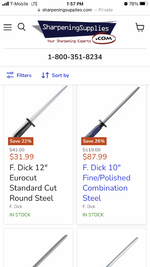
F **** makes everything from diamond and ceramic sharpening steels, to polished rod versions.
 

Attachments

  • IMG_2822.png
    IMG_2822.png
    764.4 KB · Views: 5
  • IMG_2823.png
    IMG_2823.png
    795.6 KB · Views: 2
  • IMG_2821.png
    IMG_2821.png
    863.5 KB · Views: 5

rlitman

Well-known member
Joined
Oct 18, 2010
Messages
24,609
Location
Long Island
Old chisels that were forged welded steel with an iron backing will test over 60...
I'm going to take exception to this. I've sharpened dozens of antique pairs of scissors made with forge welded inlaid high carbon steel edges (from mid 19th century to mid 20th), as well as a fair number of forge welded chisels (all 19th century) and a few axes of similar construction and ALL of these are soft enough to sharpen nicely using a mill file, just like chainsaw chain. When I step up to more modern one-piece steel equivalents, files no longer tend to cut effectively. Modern forged steel shears (Wolff kevlar shears and Centric Cricket beauty shears made with forged Hitachi steel) get sharpened with diamond stones.

I don't have a set of hardness testing files, and I'd probably trust them as much as I trust torque sticks, but maybe I can learn something from them...
 

JradM

Well-known member
Joined
Sep 4, 2019
Messages
1,817
Location
Alberta
The end of the knife edge near the bolster and handle tends not to get as worn from cutting tasks as the center, and possibly the knife tip does, and that end near the handle also tends not to get “rubbed” with a honing steel as much either, since when sharpening or honing, one is more concerned with getting the part of the edge used for cutting sharp, rather than the whole cutting edge.
Over time, this starts wearing the center of the edge back, leaving a concavity near the bolster.
If you need to remove more material with a diamond rod, and electric knife sharpener, (please don’t use these), or a coarse sharpening steel that is closer to a file, then this concaving action happens quicker.
The area next to the bolster is harder to sharpen so it tends to just concave with the steel or rods.
Still, I think the Michael Graves knives took about 20 years, and the concavity is only a mm or two, so it happens slowly.
I definitely misunderstood, thanks for clarifying.
 

dscheidt

Well-known member
Joined
Apr 26, 2017
Messages
2,894
The area next to the bolster is harder to sharpen so it tends to just concave with the steel or rods.
Still, I think the Michael Graves knives took about 20 years, and the concavity is only a mm or two, so it happens slowly.
Depends how much you use the steel. Production meat cutters can wear out a knife in a couple weeks, but they aggressively use a steel dozens of times a day.
 

Beerhippie

Well-known member
Joined
Oct 13, 2023
Messages
9,811
Location
Far NE Oregon
How is it possible to hollow out a knife edge with a honing rod? I realize the rod is round, but when you run a knife across a rod perpendicularly, the part it contacts is straight.

It seems more likely that you have excellent angle control using a honing rod and are getting the secondary bevel very straight - but then struggle with angle control on a stone and end up with a convex bevel (giving you the illusion you're sharpening a hollow bevel since you're contacting each end of the flat surface).

Maybe I just misunderstand what you're saying.
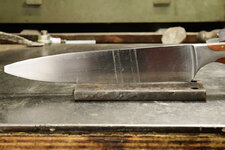
Knives that are used for cutting against a cutting board--chef's patterns of various kinds--need to have a convex profile to the blade. Since the "honing rod"--which is essentially a file with the teeth oriented parallel to the shaft--contacts the blade at one, and only one, very small point, it can easily hollow out the knife, leaving it useless for cutting on a board.

Like this:

54792484888_2b9ff0da5e_o.jpg

Reprofiled:

54791379817_2a37171a0c_o.jpg

The tip of a chef's pattern knife doesn't see much use, fortunately.

If you need more proof of what a "honing steel" can do, just use one aggressively over a sheet of paper and see how many filing are left on the paper.
F **** makes everything from diamond and ceramic sharpening steels, to polished rod versions.
My burnishing steel is an F. ****.

Ceramic rods are second in my book to honing steels for hollowing out blades.
 

Firebrick43

Well-known member
Joined
May 12, 2015
Messages
14,064
Location
West central Indiana
Modern “Western” chisels, are rarely if ever manufactured out of laminated steel nowadays, and I’m not sure whether any “Western Chisels” chisels have been manufactured on a commercial scale out of laminated steel since WWI, or earlier.
By WWI, most chisel manufacturing, and plane blade manufacturing had transitioned to solid steel construction, although one manufacturer, maybe Clifton in the UK, did try to reintroduce laminated plane blades at one point. (I think Garrett Wade used to carry the laminated blades).
The only other laminated Western chisels are likely hand made one off production by blacksmiths like Peter Ross, who used to routinely show up on the Woodright’s Shop on PBS.
A technical discussion is a real moving target with you. A direct quote from you

Files used to be a standard tool used to sharpen industrial cutting blades before harder modern alloy steels started being used.
So I used laminated cutting tools that were common across all industry as an example, So you try to move the target again. They had grindstones on every farm and shop, and later hand cranked bench grinders from the victorian era forward till electric powered ones became common.
If you actually have a Rockwell hardness tester, I might trust your numbers, but a lot of manufacturers used to fib about hardness numbers a bit, and outside tests used to usually show high 50s, and not measurements in the 60s.

O bless your heart. Not everyday I am called a liar. You have been on the forum for a long time. You are fully aware I worked in huge machine shop and logically had access to at least half a dozen Brinell testers over the 20 years of doing so. I tested my own tools as I was active on the swingley old tool list in its heyday. I am not sure if I gave you a 100's citations you wouldn't just chalk it up to the companies and people conspiring against you.
Ashley Isles is a specialty tool manufacturer, and arguably one of the better ones.
He may actually hardness his tools to a higher degree.
Yep, which is why I included the irwin blue chips (aka marples), one of the most common decent cheap chisels post this century and surprise, you ignored that point and only focused on the high end ones?
The knifemaker who made the video on knife steels and sharpening, couldn’t even interpret his images correctly, and admits in that or another video, that he has practically never used a knife steel.
Anyone who has used a steel knife steel for years knows that knife steels remove steel, because knives that have been “sharpened” or “honed” with a knife steel, will start to have the edge hollow out slightly over time, like the profile of a boning knife, but much more subtly.
I have Michael Graves kitchen knives purchased from Target, which have to be at least 15 years old at this point, and probably closer to 20, and I have only sharpened the knives on stones a few times or less, and the slight hollowing effect to the front edge has happened to all the knives, just from a honing steel.
The same is true of old french butcher and kitchen knives, which are traditionally sharpened with knife steels (this is literally what Thiers Sabatier knives were supplied with for sharpening).
I don't know how I let my self roped into this part of the discusion. No one uses a sharpening steel that I have seen for a chisel which is what we are talking about. And the fact that you believe that a scraper card burnisher actually removes metal, just wow.
The same is true of the kukri knives hand made in Nepal out of truck springs, which still usually come with a small steel for sharpening, even if the makers use grinding stones for initial knife production.
Scrap steel knives now brought into the discussion, ridiculous. What is the old adage in drowning someone in BS?
 

Firebrick43

Well-known member
Joined
May 12, 2015
Messages
14,064
Location
West central Indiana
I'm going to take exception to this. I've sharpened dozens of antique pairs of scissors made with forge welded inlaid high carbon steel edges (from mid 19th century to mid 20th), as well as a fair number of forge welded chisels (all 19th century) and a few axes of similar construction and ALL of these are soft enough to sharpen nicely using a mill file, just like chainsaw chain. When I step up to more modern one-piece steel equivalents, files no longer tend to cut effectively. Modern forged steel shears (Wolff kevlar shears and Centric Cricket beauty shears made with forged Hitachi steel) get sharpened with diamond stones.

I don't have a set of hardness testing files, and I'd probably trust them as much as I trust torque sticks, but maybe I can learn something from them...
I am not sure why the scissors were tempered like they are. After quenching the steel will be 80 or so on the rockwell scale but is very brittle.
They can pull the temper back to where ever they want.

I don't know if the slight spring in the shears needed to be less brittle due to the flex while cutting? I really don't know, scissors are not my thing.

Axes definitely are tempered to a lower hardness or they would be quickly destroyed from the shock or hitting knots.

Pairing chisels and plane blades however were used with clear wood typically when the virgin forest allowed for abundant straight grained lumber. Pairing chisels and plane blades usually were not struck with anything other than light taps from a mallet. Mortice chisels that were hammered in violently and then pry the waste out usually had a few points lower hardness.

Hell, many japanese laminated chisels are 65-68 hc

I am not using files, I have access to a Brinell tester
 

dscheidt

Well-known member
Joined
Apr 26, 2017
Messages
2,894
I am not sure why the scissors were tempered like they are. After quenching the steel will be 80 or so on the rockwell scale but is very brittle.
They can pull the temper back to where ever they want.

I don't know if the slight spring in the shears needed to be less brittle due to the flex while cutting? I really don't know, scissors are not my thing.

scissor blades hit each other at the cut point as they're closed, if they're too brittle, they chip.
 
To avoid these ads, REGISTER NOW!
Top Bottom