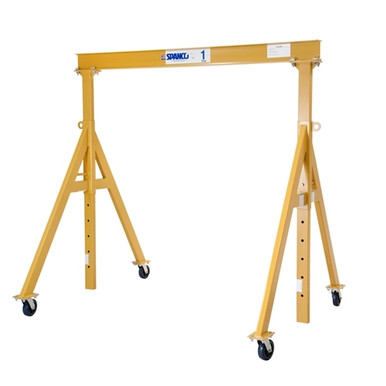
If you’re beam is 12” tall and 10” wide, it is wide flange beam. It’s either W12 x 58 or W12 x 53. Being conservative and assuming the latter, it has a cross sectional area of 15.6 in^2 and a moment of inertia of 425 i^4. We’ll assume a Young’s modulus of 29,000 KSI.
Assuming a desired maximum load of 6,000 lb and a safety factor of 5, we’re looking for 30,000 lb ultimate. Using the beam calculator at Clearcalcs, we plug in the section properties of our beam and then place 2 pinned supports 20ft apart. We apply a 30,000 lb load to the center of the beam and we get a maximum deflection of -.7”.
For maximum allowable deflection, we can use L/240 or 20/240 which is .083 feet or 1”. If we’re more conservative and use L/360, that’s 20/360 = .056 feet or .66”.
So, using the less conservative of the common metrics (international building code, etc.) for allowable deflection, you’re (barely) in the clear. However, OSHA seems to recommend L/450 for workstation bridge cranes and L/600 for overhead gantry cranes. The latter yields a maximum allowable deflection of .4”.
FYI, if you want to use the beam you’ve got, and maintain the L/600 standard, you would need to space your supports about 16.5 feet apart.
Now we’ve obviously missed some things, (weight of the beam itself, weight of the trolley, rigging, etc.) and of course we don’t know the condition of the beam, and we didn’t consider every possible (or compounding) modes of failure but the answer seems to be that, depending on the standard to which you are designing, you are either fine, just okay, or undersized.
Also keep in mind, I’m just a guy on the internet so all of this is of course at your own risk.
Cheers!
Edit - Of course while I was "mathing" someone beat me to it but I'll leave my post in case the work is helpful.
Edit 2 - I've revised based on the assumption of a pinned support since that's the better approximation here.