To avoid these ads, REGISTER NOW!

I beam load capacity

Cameronlunz12

Member
Joined
Mar 27, 2021
Messages
20
Location
Lakewood ny
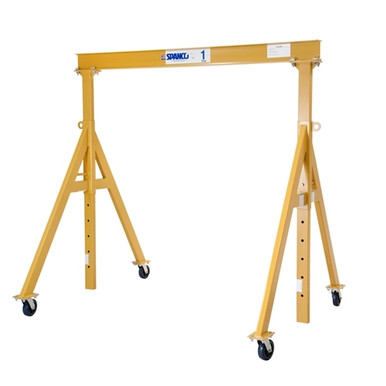
I’m building a gantry crane next to my barn and I can’t seem to find much information on center load capacity for I beam. I have some really heavy box beam and c channel I’m using for my supports that I got for free and have a chance to buy a 20’ section of I beam that is 12”tall by 10” wide, and it’s 1/2” thick for pretty cheap. Realistically the most I ever would probably lift is around 6,000lbs. The supports will be 20’ apart. I just wanted to see what the I beam itself should be able to support before I drive two hours to buy it. Any help or information will be greatly appreciated. The attached photo are what my supports will be made from
 

Attachments

  • 9F266D27-D173-43EB-8C17-B0411F38B990.jpeg
    9F266D27-D173-43EB-8C17-B0411F38B990.jpeg
    384.2 KB · Views: 130
To avoid these ads, REGISTER NOW!

mike93lx

ALLIANCE MEMBER
Joined
Dec 9, 2013
Messages
37,467
Location
Richmond, VA
3 tons is a huge amount. I seriously doubt you have any where near the right amount of steel.

The plants I work in have 3 ton gantry cranes and they are huge. And engineered
 

gearhead1

Well-known member
Joined
Oct 14, 2013
Messages
1,935
Location
NC
There’s a safety factor of 5 if I remember correctly for overhead lifting. So the calculations would be run with a 30,000lb load.

The formula for stress is Mc/I. Look in some old posts, it explains it better.
 

Kscardsfan

Well-known member
Joined
Apr 28, 2020
Messages
1,650
Location
The Little Apple
That’s way undersized for what you’re wanting. We have a 3 or 5 ton crane in our shop the web section of the beam is much taller than a foot.
 

Iron Beaver

Well-known member
Joined
May 3, 2020
Messages
684
So, if as claimed in the title you beam load capacity, could you beam some onto my raw materials?
 

quickfarms

Well-known member
Joined
Feb 14, 2021
Messages
1,027
Location
Southern California
The problem that I have is that the dimensions that you provided do not coincide with the dimensions that are in my structural tables

I need you to verify all of the dimensions especially the thickness of the vertical piece in the middle, this needs to be reasonably accurate
 

billconner

Well-known member
Joined
Jul 20, 2021
Messages
6,957
Location
Thousand Islands NYS
I'd recommend getting an engineer involved. You beam seems to be in the 12 x 53 (so should weigh 1060 pounds) range and might be big enough. maybe 12 x 50 or 12 x 57 - you need exact dimensions - flange width and thickness and depth and web thickness.

One answer, but on the internet so beware: https://www.justanswer.com/structur...am-size-span-20-lift-6000-lb-steel-plate.html

Used to do these calculations but too long ago. Hire an engineer Worth several hundred dollars.
 

seber

Well-known member
Joined
May 31, 2016
Messages
4,195
Location
Deep East Tx.
From "Marks Engineer's Handbook"
Safe load for I-beams. Load in the middle.
1695AD / L where A = sectional area of the beam in sq. in. D = depth of beam in sq. in. and L = distance between supports in feet.
This is based on an allowable fiber stress of 16,000 psi. or 4 to one SF.
 

b-dog

Well-known member
Joined
Apr 24, 2015
Messages
238
Location
Lakewood, CO
5:1 Safety factor is only for wire rope. There is no standard for gantry cranes, that I'm aware of, anyway. Overhead bridge cranes are likely designed to CMAA and AISC standards.

Looking at the girder ONLY, the easiest way to get an idea of the beam size capability would be to look at deflection. Deflection has to be < L/600 per CMAA, where L is the span (20ft). Obviously, this method would be a very gross estimate.
Assuming the load is a point load in the center would be most conservative; using a hoist with a trolley would help spread the load.
As posted above, W12x53 seems reasonable assuming the 1/2" measurement is the flange.
deflection = FL^3/48EI
max deflection with your beam and a 6k center load (not accounting for the weight of the beam) = .139"
Max allowable = 240in/600 = .4in

This doesn't account for:
Impact (acceleration of load(s))
Compression flange yielding/buckling (most likely failure mode for a simply supported beam)
lateral torsional buckling
torsion on the beam
Tension flange yielding
Shear connection
Wheel point loads on the flange
or any of your support structure including but not limited to being a gantry crane on uneven ground, on wheels

No engineer is going to touch this for less than $thousands. Either you'll pay an engineer to learn the intricacies of cranes or you pay a crane engineer for their knowledge. The former probably being cheaper, more conservative and less comprehensive or the latter more than likely being more expensive but saving material.

I'd look at the link Mike93lx posted for a good baseline, search for crane bridge tables, etc.
 

GeoBruin

Well-known member
Joined
May 5, 2018
Messages
3,735
If you’re beam is 12” tall and 10” wide, it is wide flange beam. It’s either W12 x 58 or W12 x 53. Being conservative and assuming the latter, it has a cross sectional area of 15.6 in^2 and a moment of inertia of 425 i^4. We’ll assume a Young’s modulus of 29,000 KSI.

Assuming a desired maximum load of 6,000 lb and a safety factor of 5, we’re looking for 30,000 lb ultimate. Using the beam calculator at Clearcalcs, we plug in the section properties of our beam and then place 2 pinned supports 20ft apart. We apply a 30,000 lb load to the center of the beam and we get a maximum deflection of -.7”.

For maximum allowable deflection, we can use L/240 or 20/240 which is .083 feet or 1”. If we’re more conservative and use L/360, that’s 20/360 = .056 feet or .66”.

So, using the less conservative of the common metrics (international building code, etc.) for allowable deflection, you’re (barely) in the clear. However, OSHA seems to recommend L/450 for workstation bridge cranes and L/600 for overhead gantry cranes. The latter yields a maximum allowable deflection of .4”.

FYI, if you want to use the beam you’ve got, and maintain the L/600 standard, you would need to space your supports about 16.5 feet apart.

Now we’ve obviously missed some things, (weight of the beam itself, weight of the trolley, rigging, etc.) and of course we don’t know the condition of the beam, and we didn’t consider every possible (or compounding) modes of failure but the answer seems to be that, depending on the standard to which you are designing, you are either fine, just okay, or undersized.

Also keep in mind, I’m just a guy on the internet so all of this is of course at your own risk.

Cheers!

Edit - Of course while I was "mathing" someone beat me to it but I'll leave my post in case the work is helpful.
Edit 2 - I've revised based on the assumption of a pinned support since that's the better approximation here.
 
Last edited:
To avoid these ads, REGISTER NOW!

2oolhound

Well-known member
Joined
Dec 18, 2010
Messages
5,918
Location
BC Canada
Just curious as to the height of the crane. Those box beam supports look like only 8' which is too low unless you are planning to stack them or salvage them for fabbing some higher supports.

Over a period of time I see some great deals on gantry cranes. It seems when businesses close and they have to be moved (disposed of) by a certain time, wanting buyers are not always available and they can go cheap.
 

billconner

Well-known member
Joined
Jul 20, 2021
Messages
6,957
Location
Thousand Islands NYS
I'm guessing the restrictive deflection criteria relates to trolly and rolling it. In some applications that may not matter, though I certainly wouldn't want 6000 pounds to start free wheeling from one end of the beam to center. I don't think it will ever fail in bending.

For fixed pick, I'd be fine with L/180.

Of course you could weld a piece on it and stiffen it to meet the stricter deflection criteria. something like a 6 or 8" channel on top?

If a great price, get it would be my thought.
 

Steve_P

Well-known member
Joined
Sep 15, 2010
Messages
5,182
He doesn't need a 3X+ FS to yield for home use. He doesn't need BTH level calcs. Manned spaceflight used something like 1.2X? FS in the 1960s. Also, shouldn't Sy= 36ksi minimum? Not sure what specs were 40+ years ago for structural steel.....
The OP needs to ID exactly what he has...
 
OP
C

Cameronlunz12

Member
Joined
Mar 27, 2021
Messages
20
Location
Lakewood ny
The supports that I’m using are 20’ long, but after I sink them in the ground and concrete them the bottom of the I beam will probably sit around 13’-14’. But I haven’t bought it yet, the guy only wants $100 for it and the exact dimensions he told me was 12” tall, 10” wide, and 1/2” thick. By 20’ long.
 

MJD1

Well-known member
Joined
Dec 28, 2014
Messages
607
What size are your columns, placement from the ends, gussets or not? These factors decrease the length of actual span. You may have a 20' beam but in reality it may only be spanning an actual 16' for example.
 

Beemer

Well-known member
Joined
Jun 21, 2020
Messages
1,400
Location
Northeast
Engineer needed unless you find a beam that is rated for that intended use. Beware of beam load tables because they may not account for the unbraced length reduction that you are using it as. The top of the beam is in compression and highly dependent on regular lateral support to develop it's potential strength. Wider beams work better but your hoist may not allow it depending on how it engages the beam

To give you an idea how lateral support affects compression member stability and strength, place a yardstick standing up with one end on the floor. Press down on the top and see how easily it buckles (that's a failure mode). Then place your thumb and index finger lightly touching opposite sides of the yardstick to provide lateral support at about midheight and again press down on the top of the yardstick. It will take significantly more force to cause the buckling failure.

Your beam will be under compression along the top edge (is it is supported on it's ends making a simple span and not a cantilever) when it's loaded so it is like the yardstick except horizontal rather than vertical.
Most beams are used in a manor that are continuously laterally supported on the top (compression) edge by having roof deck, floor deck or floor concrete attached so the steel is developing it's full capacity.

Any beam without significant regular lateral support along the compression edge (top in end supported members), like a crane beam, will have significantly reduced load capacity based on the lateral stability failure.

Often times crane beams have a continuous channel member mounted across and on top of the top flange of the beam to make it's compression flange wider and stiff in a lateral direction, thereby improving the inherent lack of strength in the weak axis direction of the beam.

You would do well to see a professional or buy a premanufactured hoist beam rated for the span that you will have. Many structural steel fabricators (not welding shops) have staff who can help you out with the appropriate sizing for the intended use.

One more thing, if your hoist hangs by rolling atop the bottom flange of the beam, most that I have seen don't work on current wide flange (W or WF) beams. They usually fit old style "I" beams which are mostly sold for hoists now and long ago. They have different shapes of the top and bottom flanges. Be careful that you get something compatible with your hoist assembly. There's more to it than might be apparent. Sometimes it's better to let someone else stick his neck out when safety is involved. My insurance company made that abundantly clear through my 45 years in the industry.
 
Last edited:
OP
C

Cameronlunz12

Member
Joined
Mar 27, 2021
Messages
20
Location
Lakewood ny
CAMERON - Did you buy it? Curious minds need to know.
I did buy it, it’s in good shape for the price of it. It ended up being 18’ long of usable length instead of 20 which isn’t a big deal. But before I start on this project I need to make mounts on my loader so I can mount it to my tractor. (Because that’s the only way I can get the legs for the crane stood up and even get that I beam up there) then I can put my posts in the ground, concrete them, put the I beam up and make gussets for it and last sandblast it and paint it. I will post updates on my progress if any one is interested. And does anyone have advice on what I should use for gussets?
 

Attachments

  • 853C0529-EA0B-4BAD-896E-0E3790D15EC2.jpeg
    853C0529-EA0B-4BAD-896E-0E3790D15EC2.jpeg
    354.1 KB · Views: 63

billconner

Well-known member
Joined
Jul 20, 2021
Messages
6,957
Location
Thousand Islands NYS
You ought to be able to put a plate on top of posts and just anchor beam on it. That assumes a stout post - like a W8x8 - and doesn't interfere with trolley movement.

But big a$$ steel plates work. Roughly same thickness as beam flange thickness.
 

WNYflyer

Well-known member
Joined
Sep 13, 2009
Messages
2,119
Location
Lockport, NY
Engineer needed unless you find a beam that is rated for that intended use. Beware of beam load tables because they may not account for the unbraced length reduction that you are using it as. The top of the beam is in compression and highly dependent on regular lateral support to develop it's potential strength. Wider beams work better but your hoist may not allow it depending on how it engages the beam

To give you an idea how lateral support affects compression member stability and strength, place a yardstick standing up with one end on the floor. Press down on the top and see how easily it buckles (that's a failure mode). Then place your thumb and index finger lightly touching opposite sides of the yardstick to provide lateral support at about midheight and again press down on the top of the yardstick. It will take significantly more force to cause the buckling failure.

Your beam will be under compression along the top edge (is it is supported on it's ends making a simple span and not a cantilever) when it's loaded so it is like the yardstick except horizontal rather than vertical.
Most beams are used in a manor that are continuously laterally supported on the top (compression) edge by having roof deck, floor deck or floor concrete attached so the steel is developing it's full capacity.

Any beam without significant regular lateral support along the compression edge (top in end supported members), like a crane beam, will have significantly reduced load capacity based on the lateral stability failure.

Often times crane beams have a continuous channel member mounted across and on top of the top flange of the beam to make it's compression flange wider and stiff in a lateral direction, thereby improving the inherent lack of strength in the weak axis direction of the beam.

You would do well to see a professional or buy a premanufactured hoist beam rated for the span that you will have. Many structural steel fabricators (not welding shops) have staff who can help you out with the appropriate sizing for the intended use.

One more thing, if your hoist hangs by rolling atop the bottom flange of the beam, most that I have seen don't work on current wide flange (W or WF) beams. They usually fit old style "I" beams which are mostly sold for hoists now and long ago. They have different shapes of the top and bottom flanges. Be careful that you get something compatible with your hoist assembly. There's more to it than might be apparent. Sometimes it's better to let someone else stick his neck out when safety is involved. My insurance company made that abundantly clear through my 45 years in the industry.
As noted above by Beemer and assuming a trolley riding on the bottom flange, have you looked into whether or not you can actually purchase a trolley that can fit on a 10" wide bottom flange?
My very rough calcs show it will work (see attached pictures and thus assumptions) with the controlling stress being local bending stress of the bottom flange where a wheel loads the flange. Of course very rough calc and worth what you paid so I really suggest consulting an engineer. More often than not for simple cranes/monorails with trolleys riding on top of the bottom flange of a beam "S" sections rather than "W" section are utilized due to the "S" sections have narrow and thicker flanges which are typically more efficient in carrying the concentrated local wheel loads. "W" section = wide flange......... "S"= what folks often call an "I" beam/section (i.e. slope flanges).


Last edited:
To avoid these ads, REGISTER NOW!
Top Bottom