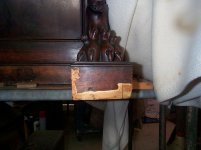
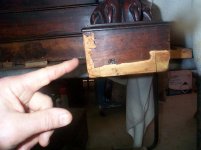
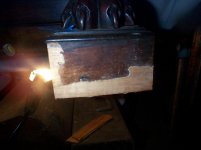
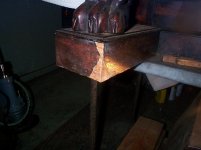
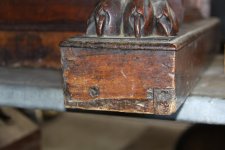
1" x 3" damaged veneer section, on the 'base' of some furniture piece by a square column on the furniture?
By the 'edge' of the base, so that you are doing an outside edge?
I'd probably say use a veneer saw and make the cut on the damaged section of the veneer on the base and run that along the grain line from opposite corner to opposite corner (assumption that you have the wood grain running 'along' the closest edge, so that you can make the long cut parallel to the grain and the 'end grain' will be at the opposite corners).
|==========|
|==========|
With some careful grain matching (size and 'shape' or pattern, generally 'color' can be taken care of with staining), a patch along the grain lines can be pretty unobtrusive. At the 'end' grain, the patch is often more noticable, hence my suggestion to run the patch from 'edge' to 'edge' of the square base.
Got some pictures of the workpiece so we can see a bit better what you are dealing with?
Do you have working room in-situ to do a 'bow-tie' type repair, but make the pattern 'master' yourself and in the size and shape you desire? If you don't have room in-situ for a router, is there room for a trim router? If not enough room for a trim router, do you have room to use a Dremel size/type tool with the router base attachment? If not room for that, is there room to mount the pattern 'master' and then use a flex-shaft and a shop-made collar to support/guide the flex-shaft head and the mini router cutter on the pattern 'master'?
Take the pattern 'master' and route out the damaged section on the workpiece. Take pattern 'master' and route out an identical recess in a work block. Fit veneer patch to work block recess (which should be identical to the routed section on the workpiece), final test fit into actual workpiece, install.
For the possibility of varying veneer depths, just make sure the replacement veneer is thicker than the original and thicker than the depth of the 'recess'. Install, let dry, then sand/scrape (cabinet scraper, not paint scraper

) to match.