Great post. I agree on a lot of your points (highlighted in bold), and I have a M18 impact wrench as well
The most hardest hitting pneumatic impacts for any given drive size is going to be heavier, more bulkier in dimension, produce more vibration, will require more air flow to start initial rotation of rotor (therefore, it'll be harder to feather the trigger for soft starts), and will likely consume more air at full throttle.
I might be in the minority, but I prefer an impact that I can hold all day long without being bothered by its weight, is quiet, has good throttle control, doesn't vibrate like it's about to explode, has good handling ergonomics and ease of control (directional lever/power settings), is compact in dimensions to get into tighter spaces, and yet has the working torque output to do 90% of the work on an automobile.
An impact wrench that satisfies those key points would be my go-to impact wrench. It's most certainly
isn't going to be that impact that's reputed to put out the highest, nut-busting torque available in the market.
Speaking of output numbers.....
There's
no standard set in place for manufacturers to conform to when they rate the torque output on their products. They company A does their rating is different from company B. The ratings are based on the most ideal conditions they can operate them in (working pressure, hose ID, length of hose, how many seconds after trigger engagement, etc) So, I don't follow manufacturers advertised output numbers as fact.
It's marketing....
Company A touts a industry leading max. torque output .... then, competitor A comes out with a product that beats that.... then competitor B comes out.....so on so forth. It's a race/war between manufacturers....and it's also marketing hype.
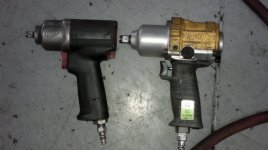
For example, I have a Ku-ken 1/2" compact model that's rated by the company to have a working range of 100-330Nm (75-245ft/lbs). It's not very high at all, but it's capable of doing most of the work I encounter on a passenger vehicle.
Recently, I had to work on a wheel bearing. The axle nut is torqued to 330ft/lbs. It's more than the working range of the Ku-ken impact, but it was able to remove it. There's no doubt that it took more impacts and time to remove the nut compared to a MG725 but it's capable of performing the job.
When it came time to tighten the new axle nut I had a new MG725 to compare it with. Comparatively speaking the MG725 is a monster in advertised numbers (810ft/lbs of forward working torque) and is considerably larger, heavier, louder, harder to control....a brute.
I impacted the nut with the Ku-ken in setting [4], the highest setting, and let it do its thing until the nut stopped moving. I then took the MG725 to finish it off, but was surprised to see that even after going full throttle for 5 full seconds the nut only turned about 5 degrees.
Ku-ken KW-1600Spro impact compared with MG-725

compared the dimensions to a 3/8" Mac/Proto

compare the dimension of the nose with a 3/8" IR (better access into tighter spots)