To avoid these ads, REGISTER NOW!

in slab conduit plan

MVWSR

Well-known member
Joined
Jan 7, 2021
Messages
63
Location
backyard
So my shop electrical plan is a 100A sub fed with 1.5" thru my slab. I'll also have atleast 4 - 1" sch40 back into slab going to determined locations on each of the 4walls. These will be the main feeds for those walls into a JB that I'll go to EMT or MC for which ever circuit. I'm thinking, wouldn't it just be easier to terminate the feed and the distribution legs counduits into a 4x4x12 tough below my subpanel, then one single 2" or ? into the subpanel, NEC allow feed & distribution in the same pipe?
As much as I wish I could have all homerun conduit or EMT's to a surface mounted panel. I'm having hard enough time figuring spacing from bottom rails on end walls vs side walls (accounting for notched edge aswell) and were I'm going to have fill capacity. TIA
 
To avoid these ads, REGISTER NOW!

rjn2649

Well-known member
Joined
Mar 4, 2018
Messages
875
Location
Il, A little west of Chicago
I would use PVC conduit underground. Depending on how long you plan on being there. I've encountered issues with conduit under a slab and the wires welding themselves (probably the wrong term) to the conduit. There is some electrolysis thing that goes on I don't know what, but, yeah after I saw that I used PVC underground for my stuff.
 

mm08822

Well-known member
Joined
Jan 13, 2012
Messages
5,895
Location
NJ
Layout of the conduits and maintaining that placement is key for a simple installation or a it becoming a little challenging.

The typical residential panel width is 14.5". In order to minimize offsets into it, all conduits should be within that width.
The next challenge is how far from the edge of the form to place them. Not sure why this would be such an unknown. Don't you have wall details? Can't you reference that from the form edge?

Use unistrut & straps to locate and hold each conduit in position. Two sets of unistrut are better ( one high/ one low) as the conduits will be more secure when getting banged around. Or use a 2x4 and straps instead of unistrut. Allow space for couplings and connectors for each. Fine tune the conduit spacing just before the pour.

I would shoot for 12" stubs above the concrete. Again controlled by your unistrut.

Have the couplings on the stub ends to ensure minimal spacing. (More is better.)
Once the panel is in place, continue each stub with emt or pvc.

Keeping these conduits separate (no 4x4 w/2"c) entering into the panel will eliminate needless excessive derating for many circuits.

See Larry4406's build pics......... https://www.garagejournal.com/forum/threads/anchoring-conduits-in-floor-before-slab-pour.440219/
 
OP
M

MVWSR

Well-known member
Joined
Jan 7, 2021
Messages
63
Location
backyard
I would use PVC conduit underground. Depending on how long you plan on being there. I've encountered issues with conduit under a slab and the wires welding themselves (probably the wrong term) to the conduit. There is some electrolysis thing that goes on I don't know what, but, yeah after I saw that I used PVC underground for my stuff.
Yeah PVC (sch40 grey) is the plan for in slab, roughed @ 20" above concrete and finished to 16" into 4x4 / tough @ panel.
My bad if "conduit" is EMT, I thought it was PVC. But yes, I'll transition to EMT & MC from my 4x4(some extended to increase allowable fill.


Layout of the conduits and maintaining that placement is key for a simple installation or a it becoming a little challenging.

Use unistrut & straps to locate and hold each conduit in position. Two sets of unistrut are better ( one high/ one low) as the conduits will be more secure when getting banged around. Or use a 2x4 and straps instead of unistrut. Allow space for couplings and connectors for each. Fine tune the conduit spacing just before the pour.

I would shoot for 12" stubs above the concrete. Again controlled by your unistrut.
Keeping these conduits separate (no 4x4 w/2"c) entering into the panel will eliminate needless excessive derating for many circuits.
No I only have generic drawings, they aren't complicated, im just stressing on being off 1" here or there would be into the space more than I want vs inside the future wall. End walls rails are different than side walls and such.
I know its my OCD & lack of experience more than anything.

I was shooting for finished height of PVC stubs (16") to 4x4x12 trough, and all distribution 4x4's to be at 18". Do these need just 1 unistrut support (midway from slab)? Or any at all since less than 20"? Then another unistrut midway between trough & subpanel, for 2" EMT (MHF) & a 2" for all the distribution THHN. Can you help me with minimum conduit spacing for straps on the unistrut? Then I can just cut form blocking to hold the stubs in forms at that distance.

I didnt account for a derating i guess because of the trough and/or 2- 2" EMT stubs between the panel and trough. I thought they were oversized.

I look over the drawing too. Thank you
 
Last edited:

Codyboy

Well-known member
Joined
Jan 31, 2019
Messages
1,638
Location
S.E. TEXAS
I thought my ocd was bad.
How thick are the walls?
Are you flush or recess mounting the panel?
Figure out "center" and stub the conduits.

Example;
When I stubbed mine , I knew the wall was an 8" girt and I planned to have the front of the QO panel flush with the front of the girt.

My square D panel is 3.75" deep so center is 1 7/8" , I'll call it 2" to be close enough (heat gun is your friend)
So with this info I know i need to be 7 1/2" from the edge of the slab (1 1/2" recessed lip on slab)
I got it close enough while fishing the 90 sweep through the rebar matrix.
It did move a little bit , I guess the concrete guys used the stub as a leaning post. Lol

But a little heat from the heat gun on the 2 1/2" stub made it erect once again.
 

u2slow

Well-known member
Joined
Nov 20, 2011
Messages
3,585
Location
BC
I had too many construction factors (separate foundation & slab) and no imaginable shop layout plan. I skipped in-slab conduit altogether. I don't regret it. Slowly adding surface EMT as I need it has worked out fine.
 

mm08822

Well-known member
Joined
Jan 13, 2012
Messages
5,895
Location
NJ
Yeah PVC (sch40 grey) is the plan for in slab, roughed @ 20" above concrete and finished to 16" into 4x4 / tough @ panel.
My bad if "conduit" is EMT, I thought it was PVC. But yes, I'll transition to EMT & MC from my 4x4(some extended to increase allowable fill.

No I only have generic drawings, they aren't complicated, im just stressing on being off 1" here or there would be into the space more than I want vs inside the future wall. End walls rails are different than side walls and such.
I know its my OCD & lack of experience more than anything.

I was shooting for finished height of PVC stubs (16") to 4x4x12 trough, and all distribution 4x4's to be at 18". Do these need just 1 unistrut support (midway from slab)? Or any at all since less than 20"? Then another unistrut midway between trough & subpanel, for 2" EMT (MHF) & a 2" for all the distribution THHN. Can you help me with minimum conduit spacing for straps on the unistrut? Then I can just cut form blocking to hold the stubs in forms at that distance.

I didnt account for a derating i guess because of the trough and/or 2- 2" EMT stubs between the panel and trough. I thought they were oversized.

I look over the drawing too. Thank you
Conduit can be many varieties, pvc, emt, grc, imc and even the flexible stuff calls itself conduit.

Call whoever and ask for the wall details.
If using pvc, height is insignificant as long as you are above floor. Larry's pics were 4-5' high, pvc is easy to trim. So again, why not hit the panel directly with each conduit?

What is your need for a 4x4 trough? Really, you can do without it, and make like simpler. Once you are above 9 current carrying conductors, derating becomes costly and a PIA. Per code, doesn't matter for conduit size, derating is based on # ccc's in it.

Conduit is considered secured for 36" between enclosure and next point of support. Your concrete acts to secure it, so you really don't need anything between floor and panel. Add it if you want.

Securing the conduits with two unistrut rails or 2x4's is to manage them for the pour. one or both could be below the floor. You just want to secure them so the masons don't disturb them.

Go buy some 2 hole straps or unistrut clamps. You will see what spacing is needed.

Forget the 4 x 4 trough....you're just adding needless complication, especially with pvc conduit.
 

Mikes61

Well-known member
Joined
Dec 25, 2023
Messages
234
Go bigger than you think you’ll need. If you think you need 1”, use 2”. Also take pictures and video and put them on ICloud.
You'll be glad you did in 5 years.
 
OP
M

MVWSR

Well-known member
Joined
Jan 7, 2021
Messages
63
Location
backyard
Conduit can be many varieties, pvc, emt, grc, imc and even the flexible stuff calls itself conduit.

Call whoever and ask for the wall details.
If using pvc, height is insignificant as long as you are above floor. Larry's pics were 4-5' high, pvc is easy to trim. So again, why not hit the panel directly with each conduit?

What is your need for a 4x4 trough? Really, you can do without it, and make like simpler. Once you are above 9 current carrying conductors, derating becomes costly and a PIA. Per code, doesn't matter for conduit size, derating is based on # ccc's in it.

Conduit is considered secured for 36" between enclosure and next point of support. Your concrete acts to secure it, so you really don't need anything between floor and panel. Add it if you want.

Securing the conduits with two unistrut rails or 2x4's is to manage them for the pour. one or both could be below the floor. You just want to secure them so the masons don't disturb them.

Go buy some 2 hole straps or unistrut clamps. You will see what spacing is needed.

Forget the 4 x 4 trough....you're just adding needless complication, especially with pvc conduit.
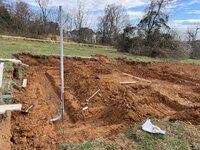
I think my reason for the trough is the circuits on that wall i can EMT down that wall. My panel will be flush mount, so I won't be able to , i suppose i could "flush" it out another 1-1.5" to allow it. But wont all the factory KO's give me problems if i try to knockout for the PVC hubs?
 

mm08822

Well-known member
Joined
Jan 13, 2012
Messages
5,895
Location
NJ
For a flush panel, then a 6x6 trough would be much easier to work with in that case. Assuming 1/2" wallcovering thickness, you would have plenty of room (~2.75" on either side of wall covering) to get conduits into/out of it.

If you keep the 2" conduits from the trough under 24" in length, then you can forego the derating in them. Your 1" conduits would still be required to derate.

You can use a holesaw to put ko's where you need them. Clamp a 2x4 as a backing while drilling enclosure to preserve any other ko's you may be partially holesawing through.
 

rjn2649

Well-known member
Joined
Mar 4, 2018
Messages
875
Location
Il, A little west of Chicago
Yeah PVC (sch40 grey) is the plan for in slab, roughed @ 20" above concrete and finished to 16" into 4x4 / tough @ panel.
My bad if "conduit" is EMT, I thought it was PVC. But yes, I'll transition to EMT & MC from my 4x4(some extended to increase allowable fill.
Probably just my little brain from being old and in Chicago. Unless someone says different my brain defaults when I hear "conduit" I just THINK EMT...
 
To avoid these ads, REGISTER NOW!
OP
M

MVWSR

Well-known member
Joined
Jan 7, 2021
Messages
63
Location
backyard
i hear yall, but "conduit" is any tube or passage that protects the wires. all of them are conduit.
but respecting the tradesman, conduit = EMT . roger that/
 

mm08822

Well-known member
Joined
Jan 13, 2012
Messages
5,895
Location
NJ
i hear yall, but "conduit" is any tube or passage that protects the wires. all of them are conduit.
but respecting the tradesman, conduit = EMT . roger that/
A raceway is any tube or passage that protects the wires.
 
OP
M

MVWSR

Well-known member
Joined
Jan 7, 2021
Messages
63
Location
backyard
mm08822 you've been most helpful.
im not the pro, but I thought I did know - rigid, EMT, ENT and MC are all conduits.
I was just trying to get back on topic instead of semantics
 

larry4406

Well-known member
Joined
Jan 27, 2006
Messages
19,148
Location
Northern Virginia
Here are some pictures of how I ran a 2" conduit for a sub-panel in a detached garage. Footing, poured 8" concrete stem wall, and 2x6 framing. The white painted rebar next to the conduit is the UFER.

Unfortunately, I do not have any of the framing pictures. I had the electrician tell me where he wanted the 16" o/c stud bay to be such that the conduit stayed vertical and aligned with his knock out of choice on the panel. The panel is ~14.5" wide and fit within a 16" o/c stud bay The stud bay wound up being an oddball (staggered) relative to the rest of the bays which were based on the overall structure and breaking properly with the sheathing.

The panel placement was somewhat critical as it had to miss a bearing point at the corner while also missing a window. The detached garage is 4 sides brick and I did not want any exterior blight on the structure.

Underground service via a 2" conduit was run along with a low voltage conduit for landscape lighting.
1761380926032.jpeg
1761381092599.jpeg
1761381042701.jpeg
1761381324236.jpeg
1761382414338.jpeg

1761382332749.png
1761382737192.png
 

dave*99

Well-known member
Joined
May 5, 2009
Messages
4,259
Location
Coastal NJ
Here are some pictures of how I ran a 2" conduit for a sub-panel in a detached garage. Footing, poured 8" concrete stem wall, and 2x6 framing. The white painted rebar next to the conduit is the UFER.

Unfortunately, I do not have any of the framing pictures. I had the electrician tell me where he wanted the 16" o/c stud bay to be such that the conduit stayed vertical and aligned with his knock out of choice on the panel. The panel is ~14.5" wide and fit within a 16" o/c stud bay The stud bay wound up being an oddball (staggered) relative to the rest of the bays which were based on the overall structure and breaking properly with the sheathing.

The panel placement was somewhat critical as it had to miss a bearing point at the corner while also missing a window. The detached garage is 4 sides brick and I did not want any exterior blight on the structure.

Underground service via a 2" conduit was run along with a low voltage conduit for landscape lighting.
1761380926032.jpeg
1761381092599.jpeg
1761381042701.jpeg
1761381324236.jpeg
1761382414338.jpeg

1761382332749.png
1761382737192.png
Looks great but wow the panoramic distortion in the photo is wild. Or your buildings are so large I can see the curvature of the Earth.
 

larry4406

Well-known member
Joined
Jan 27, 2006
Messages
19,148
Location
Northern Virginia
Looks great but wow the panoramic distortion in the photo is wild. Or your buildings are so large I can see the curvature of the Earth.
The photo is a screen shot from Google Earth street view.

That house is over 11,000 SF finished. 10' first floor, 9' second floor, and 8' finished attic. The detached garage is 24x30 with 10' first floor ceiling.
 

mike93lx

ALLIANCE MEMBER
Joined
Dec 9, 2013
Messages
37,479
Location
Richmond, VA
The photo is a screen shot from Google Earth street view.

That house is over 11,000 SF finished. 10' first floor, 9' second floor, and 8' finished attic. The detached garage is 24x30 with 10' first floor ceiling.
Ah, just the cottage? Would love to see the real digs at some point. 😉

@MVWSR i would also go straight into the panel
 
To avoid these ads, REGISTER NOW!
Top Bottom