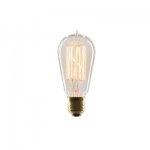
Those bulbs do look cool, but they don't put out much light and they are very expensive. A cheaper alternative that sill looks sort of vintage are the clear halogen round bulbs. They put out a lot of light too and are more efficient than standard incandescents.
I agree with the
appearance of clear, round bulbs, but the efficiency of halogens is a red herring. The best claim I've come across is "up to" 40% less energy for the same light. If you do a little research (looking at the bulb packages in the store will do fine), you'll find that standard incandescents range from about 7 lumens/Watt to 19.5 l/W. That's waaayy more than a 40% difference, so it completely swamps the halogen benefit. Halogens run their filaments hotter than standard nitrogen-filled incandescents, so their color is a bit bluer. Whether you like that is a matter of taste. But, to compare efficiency, you need to choose the bulb you like, look at the package (or website - good luck finding hard numbers), check the output in lumens, divide by power consumption in watts, and there you go.
Among all the variables, one rule holds true across the board for any given incandescent bulb type: the higher the power consumption, the higher the efficiency. For instance, a 100W bulb will put out 1700 lumens, but a 60W bulb only puts out 500. 60% of the power, but 30% of the light!
Oddly, LED's are exactly the opposite. A milliwatt range LED can easily have ten times the efficiency of an incandescent, but the watt-range LEDs are more like four times. That's why practical LED lamps are still made with multi-LED arrays.
And don't forget the difference between a lamp and a luminaire! LED's especially are bad about being rated in candelas, which is a measurement of brightness, not light output. Don't make the mistake of thinking candelas and lumens are the same thing by different names!
Standard incandescent bulbs (and CFL's, and HID's) emit light essentially in a 360 degree spherical pattern, all but the shadow of the base. LED's never cover more than half a sphere, and many have internal lenses that focus the light into a fairly tight beam - 30 degrees or so. They are lamp and luminaire in one package, so if you can only find candela ratings, they are comparable only if you measure the brightness of the other lamp you're considering IN THE LUMINAIRE you'll be using, and at the same distance the LED was tested at!
Confused yet?
It gets worse. The human eye is nonlinear. Doubling the measured brightness of a light does not make it LOOK twice as bright. So, if you're comparing two light sources that differ by, say, 20%, you won't see the difference. On the other hand, a 20% difference in energy consumption in many, frequently used, lights may make a difference you will see in your electric bill.
All this info is out there, on the web and in stores. It's tedious to wade through, but once you do, you'll be able to make better, more predictable choices.