To avoid these ads, REGISTER NOW!

infrared tube heater primary coverage

littleboss

Well-known member
Joined
Feb 2, 2018
Messages
134
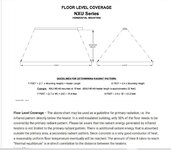
For those with infrared tube heaters. Do they really cover as much as the charts say? I am looking at a "u" tube infrared heater (NXU85) Doing the math it would provide primary coverage area of 31' wide x 48' long. Shop is 40x40. So with secondary radiation added it one heater down the middle should cover the entire shop?
 

Attachments

  • ForceRed nxu radiation pattern.JPG
    ForceRed nxu radiation pattern.JPG
    77.9 KB · Views: 27
To avoid these ads, REGISTER NOW!

4x4Pete

Well-known member
Joined
Aug 26, 2019
Messages
791
Location
Stroud
I have a 32wide x 30deep x 12 shop. A 25' tube running across the back at the ceiling moumted at 45° . There is no cool or cold areas whatsoever, even standing at the overhead doors opposite the heat. I keep it at temperature so that makes a difference as the whole shop is warmed thoroughly. Tube heaters, like infloor heat, are great when kept at temperature. If you don't want to keep the space warm, they might not be the best option.
 

mikedodge

Well-known member
Joined
Jun 27, 2017
Messages
2,784
Mine goes down the middle and everything is warm. Your measurements aren't far off, there's no point to getting a second one for that.
 

Bert_

Well-known member
Joined
Dec 24, 2016
Messages
9,722
Location
NW Iowa
You will be fine. I have a 40' tube in the front 1/3 of a 40x100 building. Works great.

Put the tube above the area you will be doing most of your work. It's really nice to turn up the heat in the morning and work under it.
 

rlitman

Well-known member
Joined
Oct 18, 2010
Messages
24,601
Location
Long Island
Many of the older Home Depot buildings around here have them between the cashiers and the exit doors and make good use of them in the winter. You can easily get a feel for how they feel as you leave in the winter.
 
To avoid these ads, REGISTER NOW!
OP
L

littleboss

Well-known member
Joined
Feb 2, 2018
Messages
134
Thanks for the responses. Anybody got any input on a straight tube heater vs "u" tube? From the specs, the "u" tubes cover more area. Have also read articles where on a long tube the temperature starts to get cold on the end away from the burner? Thoughts? Thanks
 

4x4Pete

Well-known member
Joined
Aug 26, 2019
Messages
791
Location
Stroud
I think a u tube is somewhat meant for heating a specific area. Like the door area at Home Depot. I've also seen them in industrial outdoor processes to heat a specific work area. There is a difference in intensity that you can feel in the straight tube but I haven't found it troublesome. My workbench is under the burner end. Car/work area under further end. I do maintain room temperature, it doesn't feel intense as it cyclesa few times an hour rather than a long run warming up everything.
 

rlitman

Well-known member
Joined
Oct 18, 2010
Messages
24,601
Location
Long Island
Thanks for the responses. Anybody got any input on a straight tube heater vs "u" tube? From the specs, the "u" tubes cover more area. Have also read articles where on a long tube the temperature starts to get cold on the end away from the burner? Thoughts? Thanks
The first foot or two of tube shouldn't get very hot. The next few feet put off the most heat and it tapers off from there to the far end. That's one reason why the U type is popular. It gives the most even heat pattern, plus allows the intake and vent to be on the same wall, which has two advantages. Easier sealed-combustion installation (the most energy efficient setup would be sealed combustion in a well insulated building), and more resistance to wind effects.

You get similar issues with a hydronic baseboard heat loop, where you get more BTU output per foot at the boiler supply end of the loop than you do at the return end. In that case, you put longer baseboards in the far side to compensate.

With radiant tube, how much the output differs down the tube matters depends on stuff like how high you mount it. Low down at say 10', you're going to get real toasty real fast near the hot parts, and be more comfortable near the other parts. Higher up where you are more equidistant from the tube regions, you may not notice the heat concentration as much. Still, you usually want to plan around putting the hot end where more heat is needed. FWIW, no matter how well you insulate a garage door, it's still not well insulated compared to a wall.
 
OP
L

littleboss

Well-known member
Joined
Feb 2, 2018
Messages
134
The first foot or two of tube shouldn't get very hot. The next few feet put off the most heat and it tapers off from there to the far end. That's one reason why the U type is popular. It gives the most even heat pattern, plus allows the intake and vent to be on the same wall, which has two advantages. Easier sealed-combustion installation (the most energy efficient setup would be sealed combustion in a well insulated building), and more resistance to wind effects.

You get similar issues with a hydronic baseboard heat loop, where you get more BTU output per foot at the boiler supply end of the loop than you do at the return end. In that case, you put longer baseboards in the far side to compensate.

With radiant tube, how much the output differs down the tube matters depends on stuff like how high you mount it. Low down at say 10', you're going to get real toasty real fast near the hot parts, and be more comfortable near the other parts. Higher up where you are more equidistant from the tube regions, you may not notice the heat concentration as much. Still, you usually want to plan around putting the hot end where more heat is needed. FWIW, no matter how well you insulate a garage door, it's still not well insulated compared to a wall.
Thanks. I am leaning towards the U tube design. It will fit between my shop doors (if they are opened) and as you say an easier install
 
To avoid these ads, REGISTER NOW!
Top Bottom