This a American forum, not permitted to do crazy Canukistani things like that by the NEC.you were saying?


This a American forum, not permitted to do crazy Canukistani things like that by the NEC.you were saying?
does the NEC not allow it?This a American forum, not permitted to do crazy Canukistani things like that by the NEC.
Canada eh?you were saying?
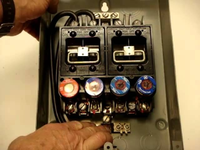
The main as well as the top row of breakers wouldn't pass here in the U.S. Handle down can't be the on position. The bottom row of breakers is fine. Turn the panel 180° and only use the bottom row and you'll be fine as long as it's rigged up so no breakers could be installed in the top row. In the picture, it appears that all of the breakers are turned off, unless panels are manufactured differently for Canada, but that would be a royal pain in the **** keeping track of what breaker could go on which row.you were saying?
The main as well as the top row of breakers wouldn't pass here in the U.S. Handle down can't be the on position. The bottom row of breakers is fine. Turn the panel 180° and only use the bottom row and you'll be fine as long as it's rigged up so no breakers could be installed in the top row. In the picture, it appears that all of the breakers are turned off, unless panels are manufactured differently for Canada, but that would be a royal pain in the **** keeping track of what breaker could go on which row.
All I know is that breaker have to be up in order to be on. Down and on is a no go. I'm not a code guru, nor will I ever be and I've never read 240.33, but will in the next five minutes. I've never seen a panel in the U.S. that could be mounted sideways and on be up with the exception of the old Zinsco's, but have never seen one of those mounted any way except vertical. I can't think of a single reason that would be beneficial in mounting sideways, speaking solely for South of your border.ok now we're heading down the rabbit hole:
240.33 Vertical Position.
Aside from the installation instructions not allowing it, now NEC 240.33 does not allow enclosures for overcurrent devices to be mounted other than vertical.www.electricallicenserenewal.com
The only conflict left is the second sentence that states “circuit breaker enclosures shall be permitted to be installed horizontally where the circuit breaker is installed in accordance with 240.81”. If understood correctly, and read along with the requirements in 240.81, technically, as long as the circuit breakers are marked with an “on” and “off” position (like most are), then the enclosure can still be mounted horizontally.
All I know is that breaker have to be up in order to be on. Down and on is a no go. I'm not a code guru, nor will I ever be and I've never read 240.33, but will in the next five minutes. I've never seen a panel in the U.S. that could be mounted sideways and on be up with the exception of the old Zinsco's, but have never seen one of those mounted any way except vertical. I can't think of a single reason that would be beneficial in mounting sideways, speaking solely for South of your border.
 www.ecmag.com
Read the second paragraph of 240.81. You posted faster than I could edit my other post.240.33 says position dont matter so long as its labeled on/off is how im reading it....
"240.33 Vertical Position. Enclosures for overcurrent devices shall be mounted in a vertical position. Circuit breaker enclosures shall be permitted to be installed horizontally where the circuit breaker is installed in accordance with 240.81. Listed busway plug-in units shall be permitted to be mounted in orientations corresponding to the busway mounting position."
deeper we go
Panelboard Orientation
Read the second paragraph of 240.81. You posted faster than I could edit my other post.
Circuit breakers shall clearly indicate whether they are in the open "off" or closed "on" position.
Where circuit breaker handles are operated vertically rather than rotationally or horizontally, the "up" position of the handle shall be the "on" position
Those are going to be the old Bulldog Pushmatic breakers. There is no up or down, only in and out. And there won't be a gotcha, the panel you posted wouldn't be allowed in the U.S.brb finding rotation reset breakers to gotcha this thread
Those are going to be the old Bulldog Pushmatic breakers. There is no up or down, only in and out. And there won't be a gotcha, the panel you posted wouldn't be allowed in the U.S.
Actually I much prefer Menards over Home Depot / Lowes, but I knew what to look for, thanks for that.I'm guessing that Lowes is what's convenient for you since that's where the MHF came from.
https://www.lowes.com/pd/Sigma-Elec...al-Conduit-Compatible-Conduit-Fitting/1092761
Code says that 15 amp duplex receptacles can be used on 20 amp circuits. Single receptacles do need to be 20 amp, but it's not likely you'll use any of those.Just a for fun question for the experts while I'm thinking about it- I've always been familiar with the horizontal slot indicating a 20A 120V receptacle. My kitchen, bathrooms and attached garage in my home (circa 2007) are wired with 20A circuits. But all outlets are standard 15A variety. My mind started to wander and honestly I've never encountered a power tool/appliance/etc. that uses an actual 20A 120V plug with the sideways prong.
Is it just for show, or does the 20A outlet actually serve some real purpose? All I see is extra dollar signs when I buy receptacle and no real benefit, but I'll put them in anyways. Chump change in the grand scheme of things, but I'd really like to know what actually uses that plug.
what is the make and model on the mini-split? or do you have a pic of the nameplate you can post here?I think I figured it out. I actually needed a 30A circuit for this size mini-split; ran #10 wire through 1/2" EMT all the way to the disconnect box, even where it exits the building. I think that's code compliant, someone correct me if I'm wrong. From the disconnect box, I'll use liquid-tite flexible conduit w/ #10 wire to the A/C condensing unit. Any problems with this approach?