To avoid these ads, REGISTER NOW!

Inspector came today

Earl

Well-known member
Joined
Feb 19, 2008
Messages
55
Location
Echo, OR
(I put this in the wrong section. If someone can move it to the Electrical/Lighting section for me I would be most appreciative. )

Finally got the wire run from the house breaker panel to the shop and was pretty impressed with my efforts as I got it done and didn't electrocute my self in the process. I figured I would have something to fix because that's just the way it works with me. Inspector was OK with my connections in the boxes but he stated the wires in the wall from where they come through to the point they enter the box need to be protected with a flexible conduit type of material. I know he said what it was but I can't remember what he called it. I'm not too concerned with the run in the house as I have a lot of room to play with due to the 6" studs. Should make it semi- easy to make the bends. But the shop was done with 2x4 suds and I'm thinking making the bend is going to be a PITA and I'm thinking the conduit/wire will protrude out past the edge of the studs making the sheet rock bulge in the area.
The inspector told me that he doesn't do much residential inspections and that he is mostly doing industrial stuff. Not sure if there is a lot of differences in codes for the house vs. industrial but I'm thinking there is probably some huge items.
Anyway, I'll add a couple of pics for a clearer idea of what I have and I'm up for any suggestions or ideas. (I'm off to the store to price the conduit and fittings. Anything to make the inspector happy so he will sign me off)
Earl

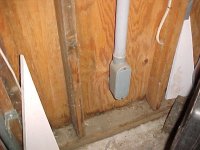
First shot is inside the house. The vertical wire close to the stud is the power going out to the well pump. The wire off to the right is the ground for the shop. I didn't know all the wires need to go through the same hole in the box. Oh, I forgot to put the metal plate on the stud to protect the wire from nails or screws, but he didn't say anything about that.

100_1075.jpg


Second shot is the panel in the shop. This is where I'm worried about the conduit making the 90 degree bend up where it comes through the wall. 2x4 studs don't give me much room.
100_1077.jpg
 
Last edited:
To avoid these ads, REGISTER NOW!

mrb

Well-known member
Joined
Dec 31, 2008
Messages
3,734
um yeah, you cant just run wires out in the open like that. If its not a cable it has to be in conduit.
 

nehog

Well-known member
Joined
Jan 2, 2010
Messages
7,935
Location
Jaffrey, NH
I saw the pictures and even before I read the comments, my thought was "that wire has got to be put in conduit!"
 

walrus

Well-known member
Joined
Nov 12, 2008
Messages
11,674
Location
Maine
On the second picture,
put an LB on the there and run it straight into the box. Leave a cut out where the cover of the lb is when you are done so that its accessable
 
OP
E

Earl

Well-known member
Joined
Feb 19, 2008
Messages
55
Location
Echo, OR
It has to be in conduit even if behind the wall? Wish I had known that before hand. I have found so much information about electrical work on the internet that I'm to the point of confusion. Hard to get the answers if you don't ask the right questions. Thanks for the responses. Time to go to the hardware store.
Earl
 

scott37300

Well-known member
Joined
May 5, 2010
Messages
3,450
Location
Wisconsin
You have a couple of options here and I don't think flexable conduit will work in your situation. The first option that I would try is either an LB or a junction box, either of these would have to be left exposed so you would drywall up to them. Run your pvc conduit into the junction box and then run another section of pvc up to the panel. A better description of how your pvc exits threw the wall would help narrow down the options.
 

jkeyser14

Well-known member
Joined
Dec 19, 2008
Messages
1,816
Location
(rural) Maryland
As already said, use an LB then run flexible conduit up to the box. The reason that has to be in conduit is that it's individual conductors which don't have an extra protective jacket on them like ROMEX.
 

Bowtie Billy

Member
Joined
Mar 8, 2010
Messages
20
Location
Webb City, MO
what size is your conduit? use a female adaptor on the end of the conduit and use a flex 90 and some metal flexible conduit to and external connector to go into the panel....
 
To avoid these ads, REGISTER NOW!
OP
E

Earl

Well-known member
Joined
Feb 19, 2008
Messages
55
Location
Echo, OR
Went to Home Depot and ACE and with the two guys I was working with (both happened to be licensed electricians) I now know what it is I need to get. Unfortunately, I have to wait until tomorrow to go to one of the electrical supply places as neither one carries big enough flexible conduit. Still learning but it seems I'm on a steep curve. Thanks for the input guys. I'm sure I'll be asking more questions before I'm done with the shop. With any luck I'll ask the right ones before I make a mistake that can't be easily remedied.
Oh, in case any of you guys were wondering why I am attempting this project on my own rather than farm it out to a electrician. I called 7 local guys (including the one that wired the house when it was built 3 years ago) and I got four responses. Lowest bid was a bit over $900. That would get me a 60amp breaker in the house, wire run to the shop and a breaker panel with a main breaker installed in it. Total length of wire needed from box to box is 40 feet. I already had the 1 1/2" PVC in the ground. I went and priced the parts and decided that with the help of my son and wife and after lurking here for a good while, that I could do it myself.
So far I don't feel too bad about the results. Yeah, I got to fix the wire protection thing but I can do that. So with the help and advice from the folks here, I believe I can do this.
Thanks again for the help.
Earl
 

rodnok1

Well-known member
Joined
Jan 27, 2005
Messages
853
Location
NC
It has to be in conduit even if behind the wall? Wish I had known that before hand. I have found so much information about electrical work on the internet that I'm to the point of confusion. Hard to get the answers if you don't ask the right questions. Thanks for the responses. Time to go to the hardware store.
Earl

yes because you have individual wires, not a feeder cable which protected by outer covering. Any contact to those wires could result in shock/short.
 

BillK

Well-known member
Joined
Aug 24, 2006
Messages
9,298
Location
Beautiful Southern Maryland
Earl,
You dont need any flex of any type in the garage. All you need is an LB and some more conduit. The LB will fit in your 2x4 wall although I dont think it is allowed to be permanently covered by code. You will probably have to have an access panel of some type in the drywall. Two pictures attached of my setup.

Just to explain the LB, the box has a cover that comes off, you can see the two screws in the picture. You pull the wires straight out though the box, then back up to the panel.

You are going to have to do the same thing at the house. Probably an LB and a few bends to get a straight shot into the box.
 

Attachments

  • lb box1.JPG
    lb box1.JPG
    56.4 KB · Views: 67
  • lb box2.JPG
    lb box2.JPG
    68.2 KB · Views: 79
Last edited:

BillK

Well-known member
Joined
Aug 24, 2006
Messages
9,298
Location
Beautiful Southern Maryland
By the way Earl .... take some of the money you saved by doing this yourself and go buy one or two of the very good books that are available on the National Electric Code and electrical wiring. That way you will be certain that the rest of the work you do is to code and safe.

I wired everything going to and inside of my 2 car detached garage also. I had to take a homeowners electrical test before they would issue the permit. After that it was a piece of cake getting it done and inspected etc. The test was basically an open book test on the code to make sure you knew how to find out the correct way to do it.
 

aabirdman

Well-known member
Joined
Dec 1, 2009
Messages
100
Location
So Cal
You could also use a straight through LB on the outside and then put back to back 45's to make an offset fitting to enter the wall and panels. That would make it a lot easier to run those conduitors in the panels. What size are they? Large conductors don't like making tight bends.
 
OP
E

Earl

Well-known member
Joined
Feb 19, 2008
Messages
55
Location
Echo, OR
BillK, we were looking at what you suggested for the shop. I had the parts in my hands and decided not to purchase becasue I wasn't sure about it. So that problem is all but fixed.
The conduit I have is 1 1/2". I didn't get a photo of the out side but if you look at the fitting at the bottom of BillK's conduit below his breaker panel, that is what I have outside the house and the shop.
Getting kinda fired up. We have a plan and a feasible way of fixing this without having to re-do everything and without having to make a major dent in the wallet. cool beans.
You guys are awesome.
Oh, I have a 2005 NEC book. Dang this thing has a ton of info in it. I'm just happy that I only have to worry about a small portion of the book for my situation
Earl
 

juicegoose

Well-known member
Joined
Aug 26, 2008
Messages
46
The other option is to not run the new conduit in the wall at all. You'll eliminate the need for an access panel in your sheetrock. Put a coupler on the outside section of pipe and run the pipe up the outside wall. Then punch out one of your knockouts in your panel from the inside and use a hole saw to cut the right diameter hole through the wall. LB into the back of your new panel and bam no need to worry about the sheetrock issue. I would assume you'll worry about how to pull the wire back so you can cut the conduit you've already glued. What we used to do in situations like this is buy some small string and tie two pieces of dowel at either end. work the string back and forth on the conduit and the friction will cut the pipe works like a charm.
 
To avoid these ads, REGISTER NOW!
Top Bottom