To avoid these ads, REGISTER NOW!

Inspector's thoughts on wire size - accurate?

jpcjguy

Well-known member
Joined
Jan 6, 2014
Messages
1,477
Location
Richmond, VA
Hi all,

Having discussions with my inspector about wire size from my house to detached garage. Distance is 225 ft. I have the 2.5" conduit in place.
I will be using a 125A breaker in my house panel to feed the garage.
Based on using some of the online voltage drop calculators, it looks like 4/0 (aluminum xhhw) is what is recommended.
So the wire would be: 4/0, 4/0, 4/0, #4

He says that is overkill. From his email: "1/0 is good for 135amps in the 90 degree column. It also meets your voltage drop percent based on more than actual usage. The choice is yours but 4/0 is overkill and this would save you money and still be code compliant. "
He also states "Also remember that you will never use close to the maximum load on the breaker. At a max at one time you may use 50 amps."

For which I replied " My biggest load being actively used would probably be my Millermatic 252 welder, but I am also thinking future and "non-planned" loads such as HVAC, full size refrigerator, one of my sons using air tools (kicking the compressor on), lights, TV/stereo, etc. Technically they could all be on or start simultaneously - pulling more amps for a short time, correct?"
 
To avoid these ads, REGISTER NOW!

benjamintmiller

Well-known member
Joined
Feb 8, 2011
Messages
284
Location
IA
I agree with your inspector on this one.

I think you're really unlikely to ever come close to using even 100 amps in your shop, let alone 135 unless you have a ton of expensive resistive heat.

Even if you somehow managed to pull 135 amps on a 1/0 conductor, you'd only have around a 7.5% voltage drop, and most induction motors are +-10% of the nominal voltage. You're right that motors pull more amps when they start -- it's not uncommon for a motor to pull 5x the rated current for a brief period of time. Breakers are thermal devices, so this doesn't trip them because the heat produced averages out to less than the breaker's capacity.

For reference, my barn also has a 225' feed. I have a larger welder than you do, a lot of lights, 3 resistive in-wall heaters, a furnace, an air conditioner, an air compressor, and a fridge. I put a 90 amp breaker on the 1/0 lines running to the barn and never expect to exceed its capacity.
 

theoldwizard1

Well-known member
Joined
Feb 22, 2011
Messages
43,129
Location
SE MI
He also states "Also remember that you will never use close to the maximum load on the breaker. At a max at one time you may use 50 amps."

For which I replied " My biggest load being actively used would probably be my Millermatic 252 welder, but I am also thinking future and "non-planned" loads such as HVAC, full size refrigerator, one of my sons using air tools (kicking the compressor on), lights, TV/stereo, etc. Technically they could all be on or start simultaneously - pulling more amps for a short time, correct?"

Concur with the inspector on draw ! You could probably get by with a 60A feed even with all of that. Worst case might be adding a second welder or plasma cutter that would be run at the same time. Even then you would likely be under 90A.

Save yourself a TON OF MONEY (buy that plasma cutter) and down size !
 

bdog

Well-known member
Joined
Oct 17, 2007
Messages
227
Having had to upgrade the wires going to my shop in the past month I say go big. When you figure the work involved the cost of the other materials, etc the wire cost just isn’t that significant in the long run. Once installed you will never under any circumstance think I wish I had used smaller wire but a day may come where if you go small you wish you went larger.

What I do in my shop and the power needs today are so drastically different and nothing I ever fathomed ten years ago when I built it.

I guess what I am saying is your inspector is probably right on the needs today but you never know what the future holds.

I am not necessarily saying go 4/0 I don’t know and haven’t looked at the chart for your needs but when feeding things like buildings I like to go up a size or two than the minimum. Maybe if 1/0 is adequate go 2/0 or 3/0? I never have used aluminum I am a copper guy so I can’t help. I ran 3/0 copper to my shop last month when 2/0 would have been adequate. I didn’t want to have to ever do it again.
 
Last edited:

Kaizen

Well-known member
Joined
Jan 9, 2015
Messages
6,948
Location
New England
I just did 2/0 for my 100 foot run and a 125amp breaker. it fit in the breaker but not the bus bar. I have a 7.5 amp compressor and i can tell you i'm glad i did not stick with 100amps. Only cost 150 bucks for all that in aluminum. I was pretty sure 1/0 would have been good but adding the rating put it at 2/0.
 
OP
J

jpcjguy

Well-known member
Joined
Jan 6, 2014
Messages
1,477
Location
Richmond, VA
I know that 4/0 will not physically fit the breaker and I have a junction box (18x18x6) that the 4/0 would be run into.
The plan was to use polaris connectors to drop to a 1/0 copper wire (which fits the breaker) for the 4 ft. run from the junction box to the breaker - they are just on opposite sides of the wall...
oh - the junction box is sized for a couple other conduits for other purposes.

still somewhat confused... :headscrat
 

sberry

Banned
Joined
Jun 18, 2005
Messages
35,747
Location
Brethren, Michigan
Its the nature of estimation,,, I will be bigger, use more than the next guy etc. What works for me will probably work for you too. I ran a welding shop from 100 with 60 of it going to welders, air on the other along with 5 pressure washer and 3 hp well.
 
OP
J

jpcjguy

Well-known member
Joined
Jan 6, 2014
Messages
1,477
Location
Richmond, VA
So looking at the local prices for aluminum XHHW:
1/0 - .45 ft
2/0 - .54 ft
3/0 - .67 ft
4/0 - .73 ft

So for three 215 ft pieces, my price differences are as follows:
1/0 to 4/0 - $181
2/0 to 4/0 - $124
3/0 to 4/0 - $40

So there are some savings (and probably much easier pulling in the 2.5" conduit) but not massive (in the scope of the entire build)
 
OP
J

jpcjguy

Well-known member
Joined
Jan 6, 2014
Messages
1,477
Location
Richmond, VA
So I am trying to understand this! :)
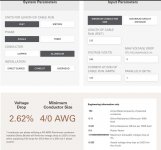
So one online calculator results are: running 4/0 for the 215 feet will result in a 2.62% voltage drop.
The other image is another calculator with the same parameters and it the voltage drop is 1.73%
So, the 2.625 is at max 125A, correct? Maybe the other result is not?

So the math supporting the 1/0 wire is based on the fact that I will not be pulling 125A continuously. thereby the voltage drop rating at max amperage is not "real world"? Using the Calculator.net calculator for 1/0 aluminum wire for 90A for 215 feet shows a voltage drop of 2.5% - within the 3%.
Am I on the right track logically?
 

Attachments

  • voltage drop.jpg
    voltage drop.jpg
    85 KB · Views: 22
  • voltage drop 2.jpg
    voltage drop 2.jpg
    105.2 KB · Views: 21

sberry

Banned
Joined
Jun 18, 2005
Messages
35,747
Location
Brethren, Michigan
The 1/0 is good here. This is a bunch of fuss over not much. So much easier to fit the breaker direct. As for future use,,, sometimes more stuff, doesn't really mean more demand and sometimes even less as a guy gets more efficient or ages.
 
OP
J

jpcjguy

Well-known member
Joined
Jan 6, 2014
Messages
1,477
Location
Richmond, VA
The 1/0 is good here. This is a bunch of fuss over not much. So much easier to fit the breaker direct. As for future use,,, sometimes more stuff, doesn't really mean more demand and sometimes even less as a guy gets more efficient or ages.

The junction box serves another purpose. It will have 2 other conduits going in the same trench to under the house. 1 is for a circuit for screened porch and the other is for possible pool. This way I only have to trench once in a particular area. So transitioning to a smaller wire to fit the breaker (1/0 max) in the junction box is not a problem.

I do appreciate all the feedback!

I was also reading that "the amount of current being carried can affect voltage drop levels. Voltage drop increases on a wire with an increase in the current flowing through the wire. Current carrying capacity is the same as ampacity."
So does this back up my theory of the southwire.com calculator doing voltage drop based on max amperage?
 

benjamintmiller

Well-known member
Joined
Feb 8, 2011
Messages
284
Location
IA
Yes, voltage drop varies with current. A 120V 1/0 cable at 50A will have a drop of about 2.9%, while the same cable at 125A will have a voltage drop of about 7.3%. This is the main reason your inspector thinks your 4/0 proposal is oversized.

You'll probably seldom pull 50A, let alone 125A through this cable. With my (very cheap) electricity rates, 125A would cost $3.30/hr to run. I couldn't imagine needing that much electricity for any length of time.
 

sberry

Banned
Joined
Jun 18, 2005
Messages
35,747
Location
Brethren, Michigan
There is a difference between undersized, bare minimum and adequate. It would be different if it really was different but the limit is 125 anyway and its for 240 not 120 and the real load demand will be about 1/2 that max.
 
Last edited:
OP
J

jpcjguy

Well-known member
Joined
Jan 6, 2014
Messages
1,477
Location
Richmond, VA
Well this has been a great lesson and thank you everyone. I think I will just go with 2/0 aluminum per ssdave suggestion - easier to work with than 4/0 and a modest upgrade. I was planning on 4/0 originally so I am saving either way!
So if the original was #4 ground with the 4/0 wire, would that stay the same?
 

justsam

Well-known member
Joined
Aug 20, 2010
Messages
1,267
Location
Penngrove, California
In the interest of "future proofing" you may want to consider the ability to charge an Electric Vehicle. Residential interfaces can require a 60 Amp circuit to deliver 48 Amps, a continuous load so 80% rule applies.

Having said that, my garage has 100 Amp service and I have the tools you and many others suggest, such as air compressor, welder, lift, etc. I have no HVAC. I have never tripped the main breaker. Also in regard to EV charging, you can set it for after midnight or some time you will not be in the shop.
 
To avoid these ads, REGISTER NOW!

Norcal

Well-known member
Joined
Mar 16, 2008
Messages
13,753
Well this has been a great lesson and thank you everyone. I think I will just go with 2/0 aluminum per ssdave suggestion - easier to work with than 4/0 and a modest upgrade. I was planning on 4/0 originally so I am saving either way!
So if the original was #4 ground with the 4/0 wire, would that stay the same?

If you increase the conductor size the grounding conductor must also be increased proportionately.
 
OP
J

jpcjguy

Well-known member
Joined
Jan 6, 2014
Messages
1,477
Location
Richmond, VA
If you increase the conductor size the grounding conductor must also be increased proportionately.
My inspector originally said for 4/0 conductors, I need a #4 ground - so going with 2/0 is actually a reducing in conductor size.....
 
OP
J

jpcjguy

Well-known member
Joined
Jan 6, 2014
Messages
1,477
Location
Richmond, VA
In the interest of "future proofing" you may want to consider the ability to charge an Electric Vehicle. Residential interfaces can require a 60 Amp circuit to deliver 48 Amps, a continuous load so 80% rule applies.

Having said that, my garage has 100 Amp service and I have the tools you and many others suggest, such as air compressor, welder, lift, etc. I have no HVAC. I have never tripped the main breaker. Also in regard to EV charging, you can set it for after midnight or some time you will not be in the shop.

Did not think about that - excellent point. Jeez....so if an electric car is a possibility in the future should that push me back up in wire size ??
 

benjamintmiller

Well-known member
Joined
Feb 8, 2011
Messages
284
Location
IA
Did not think about that - excellent point. Jeez....so if an electric car is a possibility in the future should that push me back up in wire size ??

Only if you want to charge that electric vehicle really fast. Most level 2 chargers that I've seen use a 40A circuit and deliver about 30A to the vehicle. This will completely charge a Tesla overnight.
 
OP
J

jpcjguy

Well-known member
Joined
Jan 6, 2014
Messages
1,477
Location
Richmond, VA
Only if you want to charge that electric vehicle really fast. Most level 2 chargers that I've seen use a 40A circuit and deliver about 30A to the vehicle. This will completely charge a Tesla overnight.

I guess this is chasing the technology - at some point you have to deal with what you have.....
 

pattenp

Well-known member
Joined
Jun 4, 2008
Messages
10,175
Location
Virginia - USA
Some misinformation was stated in post #1 from the inspector. 1/0 Al is 120A not 135A, because you are to use the 75deg column. The 90deg column is only used when derating conductors because of possible heat. However you can use the 1/0 Al with a 125A breaker. But I would use at least 2/0 Al which is 135A @ 75C, which would give you a 3%VD at 100A load. Just my 2 cents worth.

I'm in the Richmond area, what jurisdiction gave you the 90deg reference?
 
OP
J

jpcjguy

Well-known member
Joined
Jan 6, 2014
Messages
1,477
Location
Richmond, VA
Some misinformation was stated in post #1 from the inspector. 1/0 Al is 120A not 135A, because you are to use the 75deg column. The 90deg column is only used when derating conductors because of possible heat. However you can use the 1/0 Al with a 125A breaker. But I would use at least 2/0 Al which is 135A @ 75C, which would give you a 3%VD at 100A load. Just my 2 cents worth.

I'm in the Richmond area, what jurisdiction gave you the 90deg reference?

I planned on using the 2/0. I am in Goochland county. Any thoughts on future proofing for EV charging down the road? Would that impact the wire size choice having a continuous 30-50A draw in addition to the rest of the garage?
 

pattenp

Well-known member
Joined
Jun 4, 2008
Messages
10,175
Location
Virginia - USA
My inspector originally said for 4/0 conductors, I need a #4 ground - so going with 2/0 is actually a reducing in conductor size.....

You do not under stand the NEC when it comes to sizing the ECG when the ungrounded conductors are oversized. 4/0 Al is oversized so going to 2/0 Al is not reducing in the regards to adjust the EGC. Using 2/0 is what fits the amp rating of the feeder circuit at 125A and you use table 250.122 which is a #4 Al. Once you over size to 4/0 Al the 250.122 table is no longer used. You have to increase the #4 the same percentage in size as the 2/0 increased to the 4/0. So you have to do the math using the mil size of the conductors.
 
OP
J

jpcjguy

Well-known member
Joined
Jan 6, 2014
Messages
1,477
Location
Richmond, VA
You do not under stand the NEC when it comes to sizing the ECG when the ungrounded conductors are oversized. 4/0 Al is oversized so going to 2/0 Al is not reducing in the regards to adjust the EGC. Using 2/0 is what fits the amp rating of the feeder circuit at 125A and you use table 250.122 which is a #4 Al. Once you over size to 4/0 Al the 250.122 table is no longer used. You have to increase the #4 the same percentage in size as the 2/0 increased to the 4/0. So you have to do the math using the mil size of the conductors.

Thank you for clarifying - learning a lot here!
 

pattenp

Well-known member
Joined
Jun 4, 2008
Messages
10,175
Location
Virginia - USA
I planned on using the 2/0. I am in Goochland county. Any thoughts on future proofing for EV charging down the road? Would that impact the wire size choice having a continuous 30-50A draw in addition to the rest of the garage?

You need to do an estimated load calculation to determine the feed size, so you need to add up all loads you may have going at one time. If that total load is at 100A +- you will be good with 2/0 Al. Even at a full load of 125A the VD on 2/0 Al at 225ft looks to be about 3.7% which isn't a real problem.
 

justsam

Well-known member
Joined
Aug 20, 2010
Messages
1,267
Location
Penngrove, California
Since you are looking for recommendations, I would go with the 2/0. Any EV charging would be time shifted to take advantage of rate plans. So unless you are in the garage with all equipment running while charging your EV I see about a 9 Volt drop at 125 Amp load. This is well within equipment operational limits should this unlikely condition exist. I am not sure why the inspector advised that the voltage drop would remain compliant with NEC, as NEC has none with regard to voltage drop, as far as I know.
 
OP
J

jpcjguy

Well-known member
Joined
Jan 6, 2014
Messages
1,477
Location
Richmond, VA
Since you are looking for recommendations, I would go with the 2/0. Any EV charging would be time shifted to take advantage of rate plans. So unless you are in the garage with all equipment running while charging your EV I see about a 9 Volt drop at 125 Amp load. This is well within equipment operational limits should this unlikely condition exist. I am not sure why the inspector advised that the voltage drop would remain compliant with NEC, as NEC has none with regard to voltage drop, as far as I know.

Thanks. I went ahead and ordered 3 2/0 wires and a #4 ground.
 

Norcal

Well-known member
Joined
Mar 16, 2008
Messages
13,753
How about giving us some more explanation or information on this statement? I'm kind of hard of understanding, so I just don't get it.

My belief has always been that the 90 degree column was for certain types of conductors, that had insulation with a higher temperature rating, and that therefore could carry higher current without thermal overload causing a short or fire.

Where in the code does it state that you can only use the 90 degree column (and those wire types) for derating in hot locations?

There is no equipment made rated for conductors used at the ninety degree ampacity.
 

mm08822

Well-known member
Joined
Jan 13, 2012
Messages
5,890
Location
NJ
How about giving us some more explanation or information on this statement? I'm kind of hard of understanding, so I just don't get it.

My belief has always been that the 90 degree column was for certain types of conductors, that had insulation with a higher temperature rating, and that therefore could carry higher current without thermal overload causing a short or fire.

Where in the code does it state that you can only use the 90 degree column (and those wire types) for derating in hot locations?

Read these NEC articles for clarification:
110.14C2
310.15B Note
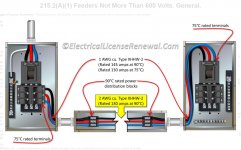
215.2A1

https://iaeimagazine.org/magazine/features/wire-temperature-ratings-and-terminations/

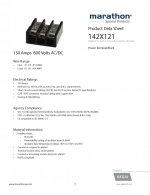
Here one instance where a conductor's 90C ampacity rating can be used with 90C terminations.
Nec_215_2_A_1_Text.jpg

Nec_215_2_A_1.JPG

Marathon_90C_Block_142x121_Page_1.jpg
 
To avoid these ads, REGISTER NOW!
Top Bottom