To avoid these ads, REGISTER NOW!

Installing a 220v outlet in the garage

sberry

Banned
Joined
Jun 18, 2005
Messages
35,747
Location
Brethren, Michigan
this all seems more complicated than needed. I don't think i would be putting in a dedicated 240v circuit for a 2hp machine. can the motor be wired for 120v? if so, just do that and wait until you actually get a welder.

even if it can't for the cost of the electrician, it is probably cheaper to put a 120v motor on the grinder.

This is true. I have a few things that could go either way and I keep them on 120. There is nothing wrong with adding a welder circuit. Use a 10/30,l the breaker could always be changed for a ****** stick if it was the case but so many more machines are now coming that only need 30 and 12 wire. The only factory cord units that need bigger than a 10 cable are 250 class migs and even those wont burn the place down with 035 wire and C25 gas.
A 252 will put out near 300A. At its rated output it has 60% duty cycle. It requires 8 wire legally and under full power for long time.
 
Last edited:
To avoid these ads, REGISTER NOW!

rnscustom

Well-known member
Joined
Mar 20, 2017
Messages
340
Location
Plympton MA
I'm learning , I usually size according to the device . I have a 50a heater with 50a plug . So 50a outlet and breaker and wire rated at least the same . I put a 50a plug on my stick machine ( no plug on it originally if I remember correctly 40+ years ago ) . Made a 25' extension for my mig and tig , 50a plug with 30a outlet and wire rated for 30a . I have room in my panel ( house is wired with a separate panel on each floor so the panel in the garage has plenty of room ) to add but things happen so it's been that way for a few years .
 

rnscustom

Well-known member
Joined
Mar 20, 2017
Messages
340
Location
Plympton MA
I thought wire size was more for Handling ( of course safety ). Electrician can run 12 all thru the house and it would be fine . If you ask one his answer would be too much work , 14 is easier . And if you plug in a little motor device you will cook the device before you will pop the breaker .
 

sberry

Banned
Joined
Jun 18, 2005
Messages
35,747
Location
Brethren, Michigan
The 14 is easier and cheaper especially if the lights and the recepts are separate. Even more so today with the advent of low wattage lighting. It makes connections with smaller wires better, way better in small fixture and junction boxes.
 

Jackpod

Well-known member
Joined
May 12, 2017
Messages
371
Location
Tonopah Arizona
Wow, a lot of real conflicting information being passed out here. some correct, some incorrect and then some totally omitted, maybe why the NEC is one of the thickest books I have. You simply can't say #12 is this, all #12 is not created equal, there is wire type, insulation type, length, voltage drop, duty cycle, environment, temperature, solid / stranded, circular mils....
 

sberry

Banned
Joined
Jun 18, 2005
Messages
35,747
Location
Brethren, Michigan
Yes, that is true and some of it is generalization and theory.
I have a 50a heater with 50a plug . So 50a outlet and breaker and wire rated at least the same .
Yes, it needs that, heater circuit is different than a tool circuit in some respects. Different types of equipment may have different requirements.
Some installers may over size the wire, use the same for different apps.
 
Last edited:

rnscustom

Well-known member
Joined
Mar 20, 2017
Messages
340
Location
Plympton MA
Just thinking general rule of thumb for most people doing general wiring , not trying to be conflicting . Someone wants to put a larger circuit that can handle his sander and maybe in the future plug a welder in . So a 30a breaker , wiring , and outlet . Can he safely make a cord to put a plug from the 30a outlet to a 20a plug . Mentioned are dedicated plugs being an exception , for welders ( duty cycle ) so are you saying I can go smaller wire and breaker for that 50a outlet ( if I'm understanding right ). Being dedicated for me what happens when I sell the house and someone plugs in something that takes the 50a load . Or am I misunderstanding . im here to learn just like everyone on this forum . Not an electrician myself . When someone asks me something I'm always ready to explain and give what knowledge I have . So many of the old timers ( don't know anyone's age here ) died too scared to teach someone for fear they would take their jobs . I called an old weatherstripper to ask how to use the bronze in a certain situation and his answer was exactly that "if I tell you I'll be out of a job " he died a couple years ago without ever teaching anyone . So I think these forums are for that uto teach
 

sberry

Banned
Joined
Jun 18, 2005
Messages
35,747
Location
Brethren, Michigan
You can use a smaller wire and breaker for a welder plug. No adapters for 30 to 20.
Part of the problem is that the directions and manuals are written for those familiar with code and nema.
 
Last edited:

Jackpod

Well-known member
Joined
May 12, 2017
Messages
371
Location
Tonopah Arizona
Not trying to be difficult but there are l630p to l620r adapters available. For the average user, if you stay within published ranges and not try to go with a smaller wire or a different type plug you should be fine. if you want a 50 amp receptacle use #8, 30 amp use #10, 20 amp use #12. If you generalize then most any type load at that rating should be ok. As sberry stated there are different types of loads, if your welder is 50 amp but the service cord is only #12, still wire the outlet with #8 that way if the next owner of the house wants to plug in a different type load that does actually need the load capacity of #8 it is there. Electrical wiring has to be installed to be "flexible" because the types of devices can vary. In my shop (speaking 120V in this example) I have 2 30 amp circuits above the rafters with drop downs that hang 7ft above the floor (3 on each circuit) each dropdown has an L530R I then have different pigtails 8ft long with an L530P on one end, and then they vary on the other, a couple have 20amp standard receptacles and then I have a couple that terminate into a duplex box with 4 15 amp receptacles. I use the pigtail that best suites which equipment I am using at that time. All the big box stores have a chart stating what size wire for what ampacity. Being to specific imposes limitations. Keep it standard for most all applications
 

Attachments

  • l630-adapter.jpg
    l630-adapter.jpg
    51.3 KB · Views: 16

Jackpod

Well-known member
Joined
May 12, 2017
Messages
371
Location
Tonopah Arizona
rnscustom, LOL well I am one of those older guys and was fortunate when I was young to learn from the older guys. 224 days until retirement for me :)
 

rnscustom

Well-known member
Joined
Mar 20, 2017
Messages
340
Location
Plympton MA
I'm close to retiring too , 10 more years and counting , I was very fortunate too ( just an example of what we're all running into trying to find skilled help ) . My shop teacher and the guy that taught me even more , I ran his shop for twenty years . He always told me " don't ever forget we're all amatures every day " but that's for a thread that maybe someone else could start .
 

rnscustom

Well-known member
Joined
Mar 20, 2017
Messages
340
Location
Plympton MA
By the way I'm new here , I'll go back and forth in a discussion just till I'm satisfied I learned something but mostly to see everybody's little sayings in their responses . The one that applies to me the most is " of all the things I've lost I miss my mind the most " so true . There may have been a better one but I've forgotten it already
 

sberry

Banned
Joined
Jun 18, 2005
Messages
35,747
Location
Brethren, Michigan
Are you plugging things in to a 30A that come with 15 end? There are a few pieces that may tolerate this but for the most part this is a no no.
Some welders, some heavy chop saws and some comps may need a heavier breaker, these will have a 14 cord or better.
 

sberry

Banned
Joined
Jun 18, 2005
Messages
35,747
Location
Brethren, Michigan
Here is something to ponder. I can't think of anything that may be plugged in would actually need a heavier wire other than a kiln or 250 mig. Ovens use 4 wire although I spose an air compressor might qualify to use the heavier circuit and wire except for the fact it the HP rating would exceeded the recept. This is why they allow underwiring for welders, it's not really much a problem. If it was they would mandate 6 on all 50. A buzzer welder actually allows 12 single circuit in pipe. Not many think it's a great idea, even legal and safe there is a great deal of V drop and it would add up at the allowed 80 ft. 10 is such an improvement, 10 volts or more difference, between 10 and 8 only a volt or 2. Not so the operator could even tell and plenty of allowance for exceeding duty cycle.
 

sberry

Banned
Joined
Jun 18, 2005
Messages
35,747
Location
Brethren, Michigan
It can be difficult to explain some of this as there is overlap or difference in the nature of circuit design and protection. It is not accurate to say that the breaker is there only to protect the wire for thermal and not for the connected equipment. This is rudimentary and doesn't consider interdependent systems for lack of better wording. Yes, there are specifics but no point in getting to those if the basic principle isn't clearly understood.
 

rnscustom

Well-known member
Joined
Mar 20, 2017
Messages
340
Location
Plympton MA
No , only circuit I have like that is the 50a for the heater , I did it originally for the welder ( which I'm guilty of following the 50 amp on the welder not realizing any exceptions ) but it worked out well when I decided to stop eating my brain away with the #2 fuel heater and go electric . Now I hardly heat the space . Will do a dedicated breaker eventually , plenty of space . Lots of good info here , thanks
 

pattenp

Well-known member
Joined
Jun 4, 2008
Messages
10,175
Location
Virginia - USA
Jackpod, a 50A outlet for general use wired with #8 needs to be wired with type THHN in conduit. If cable is used such as NM-b it needs to be #6. Your statement in post 49 saying to use #8 for 50A is misleading.
 

sberry

Banned
Joined
Jun 18, 2005
Messages
35,747
Location
Brethren, Michigan
I am not sure how much general use there is for 50. A 6 certainly covers all the bases especially if it was 4 wire as you could hook a range to it. If it has a motor on the appliance that didny come factory cord would be limited to 3 hp. A heater could certainly work as could a 250 mig. But it still doesnt help with lower breaker circuits. Since a lot of guys here are planning there is no better way than to leave means to add circuits for special equipment as needed. There are other ways but they often result in a lot of parked wire.
As a matter of principle I really don't use anything that would overheat a 10. In a residential setting I could easily get by on a couple 10 wire circuits and a couple 120v for garage.
I can run any wire I want but really use as much 120v as I can. I bieve anything I own that could be wired either way I have on low and even light welding is now done with it away from the shop machines.
 
To avoid these ads, REGISTER NOW!

Matt Matt

Well-known member
Joined
May 11, 2017
Messages
523
Location
Ontario
- A circuit is mainly to protect the building.
-A circuit is built up of breaker, wire and outlet.
-A circuit should have a minimum of 125% more amps than the FLA of the machine, but not to exceed 250% of the FLA.
-A circuit should at no time have flush or surface mount wiring that is not armoured or in conduit. Armoured wire such as AC90 & TECK90 is exceptable for surface mount . Romax(white household wiring) needs to be buried in studs and behind drywall or interior board.

- 50 amp breaker feeding #6g wire to either 6-50 or 14–50 outlet.
- 40 amp breaker feeding #8g wire to either 6-50 or 14–50 outlet.
- 30 amp breaker feeding #10g wire to either 6–30 or 14–30 outlet.
- 20 amp breaker feeding #12g wire to either 6–20 or 14–20 outlet.

Now, I know a lot of the Tesla guys use a 50 amp breaker on #6g wire with a 14-50 plug.

I don't have any standard 20 amp household plugs in any of my shops. I do have a lot of 5–15's.
I also have:
14–50
5-50
L6–20
L6–30
L15–20 ,600v wiring
L17–30 ,600v wiring
C-H AR-348,600v wiring
And maybe a couple more I missed.

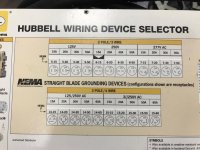
The trick is to pick your outlets wisely. When you get up into the latter half of the plug outlets I have in my shop, the female outlets start getting pricey.

Here is the Hubbell reference slide.
 

Attachments

  • IMG_6697.jpg
    IMG_6697.jpg
    139.3 KB · Views: 31
  • IMG_6699.jpg
    IMG_6699.jpg
    156.9 KB · Views: 29
Last edited:

sberry

Banned
Joined
Jun 18, 2005
Messages
35,747
Location
Brethren, Michigan
12 can feed 15 outlets on 20 breakers too.
Lots of appliance do not need all the current an outlet could supply but the purpose is also to PREVENT it from being stuck in higher current circuit.
A 15 has a plug cannot be plugged in to a 30, this isn't an accident. The plug is a current limiter to some extent, a guy adapts it differently and defeats this fundamental safety feature.
 
Last edited:

sberry

Banned
Joined
Jun 18, 2005
Messages
35,747
Location
Brethren, Michigan
This is done very limited on dedicated circuits where there is single outlet to a specific piece of equipment with start issues. It's done with this in mind. It's quite rare and needs thourough understanding. I saw one the other day for a hidden sump pump installed by master. I have one outlet on whole property like this.
Outlet to breaker, no splices for anyone to assume they could tap this circuit, no other outlets on it.
I think my helper pulled 10 to it, not always a great idea as it tends to make the problem worse. It wasn't suffering from low run current but too much at start.
 

Attachments

  • chop saw only.JPG
    chop saw only.JPG
    30.3 KB · Views: 22
Last edited:

Matt Matt

Well-known member
Joined
May 11, 2017
Messages
523
Location
Ontario
Its not just a good idea but one of the fundamental principles being defeated. Outright code violation .
I'm not completely sure what you were referring to in this statement. Are you referring to one of the posts you made earlier? (Or a post of someone else) If so, why not put it all in one post instead of three. It makes for a confusing reading.
:headscrat
 

Jackpod

Well-known member
Joined
May 12, 2017
Messages
371
Location
Tonopah Arizona
12 can feed 15 outlets on 20 breakers too.
Lots of appliance do not need all the current an outlet could supply but the purpose is also to PREVENT it from being stuck in higher current circuit.
A 15 has a plug cannot be plugged in to a 30, this isn't an accident. The plug is a current limiter to some extent, a guy adapts it differently and defeats this fundamental safety feature.

Now you are getting into local and state codes. In Arizona you can't have more than 12 receptacles on a branch and the inspectors frown at you if you have more than 10. The reason for this the average person does not know what receptacles are on which branch (even if they did they wouldn't understand) and numerous devices are randomly plugged in where ever, the reason there are varying levels of plug / receptacle pairs is so IF the wiring is rated for 15, you can't plug a device that has a higher draw into it, like a 20 amp device. Take your standard duplex receptacle, a 15A has the 2 vertical and ground, then look at the 20A the neutral has the sideways wedge which will allow a 20A plug to be inserted as well as a 15A. This is assuming that someone didn't replace the original 15 with a 20 and there really is #12 in the walls and a 20A breaker. This is designed to minimize fie hazard. Same applies to higher ampacity and then once you get into 220V it is again a level of different styles of connectors. Also in Arizona new construction they prefer you only use 14 for lights and 12 for receptacles, even if you are installing 15A receptacles. It is all about protecting against overloads and fire, not about the endpoint device
 

manwithtools

ALLIANCE MEMBER
Joined
Aug 24, 2015
Messages
13,975
Location
Lebanon, TN
I'm not completely sure what you were referring to in this statement. Are you referring to one of the posts you made earlier? (Or a post of someone else) If so, why not put it all in one post instead of three. It makes for a confusing reading.
:headscrat

Can we share the popcorn? :spit::spit:
 

n20junkie

Well-known member
Joined
Aug 22, 2010
Messages
538
Location
Grand Island, NY
People always mess up welder plugs.


I will say this. My 95 amp draw, 400 amp output welder cam from Miller Electric with a 6-50 plug factory installed.


Welders are not a constant load, and the breakers are not sized like a constant load.
 

rnscustom

Well-known member
Joined
Mar 20, 2017
Messages
340
Location
Plympton MA
I think I learned some , 12 on all outlets is a good rule , my house has two bedrooms on the same circuit those rooms have small window ac units and one also has a small heat unit for a tagu . Lights will dim for a second every so often .
 

Jackpod

Well-known member
Joined
May 12, 2017
Messages
371
Location
Tonopah Arizona
mscustom,
Yeah that happens, remember each of the receptacles on the same branch circuit are cumulative and startup current is higher than run current on heaters and ac units

Tagu as in Monitor? They can get pretty good sized
 

sberry

Banned
Joined
Jun 18, 2005
Messages
35,747
Location
Brethren, Michigan
The reason for a 20 plug is to prevent it from being plugged places someone doesn't want it plugged in to. 15 are allowed on 20 circuits. It simply says don't plug it in a place not dedicated for it. One of its main uses is for cleaning equipment. Not every piece with that plug actually needs 20 but rather prevents the cleaning lady from using generals, using circuits with other lab equipment on it, on occasion with heavy appliances it keeps them to dedicated circuits, you can use them on generals too as long as no one minds the potential for a trip. It just says, feel free to plug here.
 

sberry

Banned
Joined
Jun 18, 2005
Messages
35,747
Location
Brethren, Michigan
Jack, it is also about the end point device. Many/most 15A do not have additional internal protection and rely on the breaker for fault protection. I can tell from this conversation that SOME of the elements circuit design are not completely understood here. The focus is on overload and skips short circuit protection which is the other half for lack of better wording. The plug/recept system both allows and prevents. About the only place a breaker truely prevents overload is on general circuits where there are multiple outlets could be used at the same time. A single recept on a 20A breaker with a 15 plugged in to it is not depending on the breaker but it's protection for the wire is due to the fact that the applied load is limited. This principle is distinct in the case of a 200 mig again. The 50 breaker does not protect the wire or cord to the machine, the possible or applied load or additional thermal following protects the wire AHEAD of it in the same way a 200A breaker protects the incoming service wire. Un fused taps protected in this fashion.
 

sberry

Banned
Joined
Jun 18, 2005
Messages
35,747
Location
Brethren, Michigan
I'm not completely sure what you were referring to in this statement. Are you referring to one of the posts you made earlier? (Or a post of someone else) If so, why not put it all in one post instead of three. It makes for a confusing reading.
:headscrat

I am trying to explain this forward and backward with limited success. Many of the masters simply give up on it and move on or focus on questions with yes/no answers.
 

6PTsocket

Well-known member
Joined
Mar 12, 2014
Messages
4,593
I'll double check that, but is that enough protection? Or is there a danger using the motor on a 50a circuit?
Don't you plug a 9 Watt (60 watt equivalent) led table lamp that draws .075 amps into 120 volt receptacle that is on a 20 amp breaker. The breaker and receptacle in this case are sized for the maximum current it can supply. It does not make a device draw any more than it is supposed to. A 120 volt grinder plugged into a receptacle can be pulling a lot less than the the 20 amp breaker that is protecting the line. The breaker is protecting the line that is wired for that amount of current, max. On a dedicated line the breaker can be sized to protect the device but that is often not the case with smaller stuff. I would have no problem putting a 50Amp plug on a grinder so I could plug it into a dedicated welder receptacle But that is me. I am sure I will get opposing opinions.

Sent from my SM-G900V using Tapatalk
 

Matt Matt

Well-known member
Joined
May 11, 2017
Messages
523
Location
Ontario
I am trying to explain this forward and backward with limited success. Many of the masters simply give up on it and move on or focus on questions with yes/no answers.

There is an edit button. The best of the best (even masters) sometimes edit their responses. I'm just informing you sometimes I get lost with your responses. Maybe this is your style, but I get lost... but I see why you're over 23000 posts/5.25/day.
 
Last edited:

Hot Rod Grampa

Well-known member
Joined
Jul 7, 2017
Messages
812
Location
Near Cooperstown New York
Hi All. Newbie here with no posts but 40 years experience. Just to weigh in for a moment. Code is a good thing to use as the Bible. It is what could save you from financial disaster. Many things will work that are not up to code. But if it all goes wrong and an inspection reveals there is wiring that was done without inspection and was not up to code the insurance company can walk away. Read the fine print. To the op, you can put in multiple 240v outlets on the same breaker as long as all the parts are rated for that amperage. Set it up for the highest anticipated you may need. 60 amp welder is good. Use 60 amp wire. Then make up an adaptor for your grinder. As long as it is a plug in adaptor you are ok. I have commercial shops with multiple outlets on the same circuit. They move welder from station to station rather than long cords. Much safer. After you finish have it inspected.
 
To avoid these ads, REGISTER NOW!
Top Bottom