To avoid these ads, REGISTER NOW!

Installing Dryer in Workshop- Wire Size? In Conduit? or not...

Joe Piro

Well-known member
Joined
Feb 26, 2021
Messages
164
Location
South Carolina
I am installing an older dryer that I had in storage. I think this problem is a lot easier than a lot of the posts I have read here, but it's still a mystery for me.
I have tried to figure it out from the code book, but I need your help.
My questions are:
What size breaker do I need? (30 amp?)
What size wire should I run? (8 or 6 AWG?)
Should the wire be inside PVC conduit or metal conduit?
I can get conduit into the 32 foot chase through an outside air inlet, in ten foot sections. Are joints permissible?
I intend to convert the dryer to a 4 wire cord. Aren't all new electric dryers 4 wire plugs?
Ten years ago I lost a house to fire (and a lot of tools too!) so I don't want to cut any corners.
Details are as follows:
There is a plan attached and some photos that show the following.
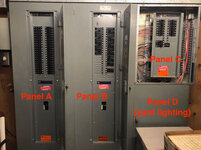
The 3 story house was originally renovated 30 years ago to be commercial offices. There are four electrical panels: A,B, C, and D.
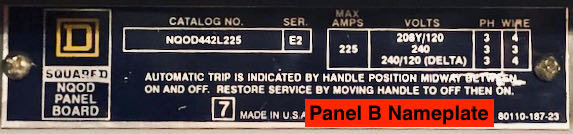
There is 3 phase power: Panel A (225 amps)(various receptacles and recessed lighting) is almost full but may have a couple of spares. Panel B (225 amps) is all 3-phase for hot water and chilled water pumps, an (obsolete R22) air cooled AC chiller and some heat pumps. Panel D is relays and a time clock for outdoor lighting. So I think I have to use Panel C (100 amps) which has some outdoor lighting but has the most available room.
All panels are Square D Type NQOD (see photos of panel nameplates for details)
The Whirlpool dryer is in excellent condition, but it's about 35 years old (stored for 30 years) and has a three wire cord. The nameplate says the motor draws 4 amps, and heater and accessories draw 23 amps.
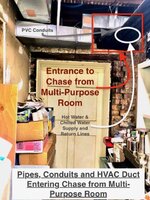
I have to run from the raceway above the panels for about 17 feet exposed. Then through a brick wall into an approximately 20 inch wide by 9 inch high chase for 10 feet. Then make a left turn in the chase for 32 feet. Then drop down to a proposed surface mounted outlet on the wall. The chase is 7 ft 3 in above the finished floor (ceilings are 8 ft high). The proposed route is the green dashed line on the attached plan.
There is an HVAC duct in the ten foot section of the chase, but not in the 32 foot section. The final 8 feet of the 32 foot run contain a small ac unit above the ceiling with a free return so I guess that makes it a plenum for 8 feet. However I disabled the unit which is not needed.
Thanks again. You are life savers!
.
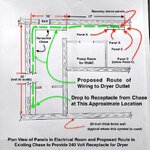
Dryer Wiring Route A.jpegGJ Dryer Chase from Multi-Purpose Room.jpegGJ Dryer Panels ABC.jpegPanel A Nameplate (1).jpegGJ Dryer Panel B.jpeg
GJ Dryer Panel C.jpeg
 
To avoid these ads, REGISTER NOW!

Bert_

Well-known member
Joined
Dec 24, 2016
Messages
9,766
Location
NW Iowa
Don't assume a panel is full just because there is breaker in it. Panel boards are often ordered full of breakers even if they aren't all needed.

Definitely check your voltage before connecting the dryer.
 

wyliesdiesels

Well-known member
Joined
Aug 14, 2012
Messages
20,066
Location
Modesto, CA
Almost all dryers are 30a 120/240v... so off the bat you need #10 NM-b and 30a breaker....

I am installing an older dryer that I had in storage. I think this problem is a lot easier than a lot of the posts I have read here, but it's still a mystery for me.
I have tried to figure it out from the code book, but I need your help.
My questions are:
What size breaker do I need? (30 amp?)
What size wire should I run? (8 or 6 AWG?)
#8 and #6 are way too large
Should the wire be inside PVC conduit or metal conduit?
totally depends on the install type and building. Can you run NM-b? If not then you need either conduit with THWN (can be PVC or EMT) or MC....
I can get conduit into the 32 foot chase through an outside air inlet, in ten foot sections. Are joints permissible?
I intend to convert the dryer to a 4 wire cord. Aren't all new electric dryers 4 wire plugs?
no theyre not because older houses only have 3-wire receptacles...
There is 3 phase power: Panel A (225 amps)(various receptacles and recessed lighting) is almost full but may have a couple of spares. Panel B (225 amps) is all 3-phase for hot water and chilled water pumps, an (obsolete R22) air cooled AC chiller and some heat pumps. Panel D is relays and a time clock for outdoor lighting. So I think I have to use Panel C (100 amps) which has some outdoor lighting but has the most available room.
total hodge podge on the panels.... could be either 120/240D or 208Y/120.... if 120/240D you need to make sure you dont connect to the stinger leg (usually B phase) otherwise you can burn up the controls in your dryer since the stinger leg is 208v to neutral..... if the latter, then your dryer's heating coil will never operate at max temp....

can you check the main service to see what voltage you have?
 
Last edited:
To avoid these ads, REGISTER NOW!

wyliesdiesels

Well-known member
Joined
Aug 14, 2012
Messages
20,066
Location
Modesto, CA
Don't assume a panel is full just because there is breaker in it. Panel boards are often ordered full of breakers even if they aren't all needed.

Definitely check your voltage before connecting the dryer.
Ive seen dryers run on 208y/120 but they dont get up to max temp ever due to reduced voltage on a resistive load
 

Norcal

Well-known member
Joined
Mar 16, 2008
Messages
13,769
Yes 208 is fine, the person doing laundry doesn't always like it because you loose 30% of the heat, but it not hurting anything. But on the chance he has a 240v delta I would check it
A lot of dryers have dual rating w/ a reduced KW rating for 120/208V, for the 1st time I noticed the data plate for my new dryer & is rated 26A @ 120/240V, & 24A @120/208V, for the Whirlpool manufactured Maytag, the 26A surprised me since 24A what I always considered the max for a 30A circuit. Since the heat will cycle, it would not be a continuous load of 3 hrs or more & the timer will have shut off the dryer long before that. A straight 240V load on the high leg & another phase of a 240V 3Ø supply is fine if the 2-pole breaker is not a slash rated 120/240 one, but as noted in the above quote & other quotes, a bad idea on a 120/240V load.
 
OP
J

Joe Piro

Well-known member
Joined
Feb 26, 2021
Messages
164
Location
South Carolina
Thanks for the advice and questions too. So I checked further and now the question is: Is the best place for the new dryer circuit on Panel A, Panel B, or Panel C ?
New information follows =>

Please excuse my absence since you last gave advice on April 1st. My day job is teaching and the end of the school year is always hectic.
I have inspected my electric panels with the covers removed, which show the actual input wiring.
Based on the following that you provided, I realized I did not know enough to understand what I was doing. I could follow the instructions safely, but I'm not happy if I don't understand what I'm doing so I spent some time reading about Wye and Delta 3 phase transformers. (I also learned about the "six handle rule." This is interesting stuff!)
Said to use a QOB230 breaker & 10AWG wire, use EMT, PVC likely to sag
and
agreed: Almost all dryers are 30a 120/240v... so off the bat you need #10 NM-b and 30a breaker....
and
could be either 120/240D or 208Y/120.... if 120/240D you need to make sure you dont connect to the stinger leg (usually B phase) otherwise you can burn up the controls in your dryer since the stinger leg is 208v to neutral.
So, based on what I learned I made more measurements and now here is the question.
In which panel do I install the breaker for the new circuit for my dryer???

Panel A
is a Single Phase Center Tapped 120/240 volt panel. If I read it right, a lot of people call that "split phase." As it turns out it is clearly what the pre 2008 NEC referred to as a "Lighting and Appliance Panel" with exactly 42 spaces which was the pre 2008 limit. All the breakers are 20 amp. Spaces 22 and 42 are spares. All the others are connected mostly to baseboard receptacles or recessed lights on three floors of the house. I could move circuits 24 to 40 all up one space and then I would have two empty spaces at the bottom right (40 & 42) for the new 30 amp breaker.
Panel B is "Open Delta 120-240 with a 210 volt high leg service." (This is the "stinger leg" one of you warned me about.) I called the power company and asked and that's what they said we have.
There is plenty of room on the left and I just have to be sure to plug the new breaker in to connect to Black and Red (tape) input and not to the orange (tape) supply which is 208 to ground and will fry the dryer controls.
Panel C is a sub-panel of Panel B and has plenty of empty space and is only connected to Black and Red (so no wild leg).
Is there any reason NOT to connect the dryer into a sub-panel?
As far as balancing the load is concerned:
First: Panel A:
Most of the rooms on the second and third floors are un-occupied most of the time, so there is hardly any power used on most of the circuits.
Second: Panel B: The big 3 phase breakers serve R-22 HVAC split systems, an R-22 chiller, and chilled water and HW pumps. They are not in service at this time and will probably be re-designed, replaced, renovated, etc. So at least for now there is hardly any load on Panel B. (The water heater is on Panel B.)
Third: Panel C: is outdoor pole lights, security lights and and a few outdoor receptacles. They are roughly balanced although most are turned off most of the time.
So the question is??? Is the best place for the new dryer circuit on Panel A, Panel B, or Panel C ?

I really appreciate your taking the time to help me solve this.

If you are at all interested, I was fascinated to learn that this house is served by two transformers on the pole at the street.
One provides one phase and the other provides the other two phases ( I think...???)
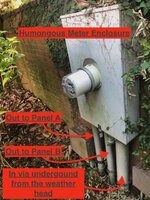
There is only one meter, but Panel A and Panel B have separate underground conduits from the meter to the house.
I don't know what is inside the meter enclosure, but it is a big one (photo below). In the photo you can see three big conduits.
One comes underground from the weather head and two go out to the house, one to Panel A and one to Panel B.
I also learned that if you look up and see three wires above the transformers on the pole, then the neighborhood has three phases. Some neighborhoods only have two wires. For balance purposes different neighborhoods may have different phases.
If I am wrong about these conclusions, please correct me.

Meter Service Entrance.jpg
 
Last edited:
To avoid these ads, REGISTER NOW!
Top Bottom