To avoid these ads, REGISTER NOW!

installing garage doors before or after concrete?

stangkid14

Well-known member
Joined
Dec 23, 2007
Messages
152
Location
Allentown,PA
Does it really matter if the garage doors on a pole building are installed before the floor is poured? As long as the workers put up some 2x's where the grade of the floor will be they should be able to get the doors where they need to be right? and the doors should have some adjustment correct? thank you!
 
To avoid these ads, REGISTER NOW!

Zeke

Well-known member
Joined
Aug 13, 2009
Messages
17,176
Location
Long Beach CA, the sewer by the sea.
The doors themselves are virtually infinitely adjustable if you're talking about a sectional. The fine tuning is done with the opener. If you need to contain heat or keep leaves and critters out, put 'em up! The placing and finishing may booger up your lower tracks a bit so tape them off and allow a trowel to pass under.
 

6t7gto

Well-known member
Joined
Dec 6, 2005
Messages
522
Location
bedford,ohio
Keep the bottom of the tracks blocked with something (until the floor is poured)so the door cannot go so low as to come out of the track.
ask me how I know this.
 
OP
S

stangkid14

Well-known member
Joined
Dec 23, 2007
Messages
152
Location
Allentown,PA
thanks guys thats all I needed. As long as i keep those boards at concrete grade and tape off the tracks I should be good.
 

Stuart in MN

Well-known member
Joined
Sep 8, 2005
Messages
23,058
Location
Minneapolis
My concern would be the door tracks getting beat up or covered with concrete during the pour if you put them up first.
 

404

Well-known member
Joined
Aug 23, 2014
Messages
3,463
Location
Mass
From experience, the rails will be embedded in the concrete and the adjustment will NOT be correct. Expect to saw the rails at floor level to adjust.

"some" builders love this to cut costs.
 

Zeke

Well-known member
Joined
Aug 13, 2009
Messages
17,176
Location
Long Beach CA, the sewer by the sea.
From experience, the rails will be embedded in the concrete and the adjustment will NOT be correct. Expect to saw the rails at floor level to adjust.

"some" builders love this to cut costs.

'Some' builders should have an instrument level on the job to know where the elevations are. Even it the rails were low and into the slab, why cut them? Seems like a finishing nightmare but a great anchor.
 

QUIKSVT

Well-known member
Joined
Sep 8, 2007
Messages
88
Location
Hilliard, OH
Had my door on before the concrete. The finishers set the concrete about 1" lower than what was marked. Now have issues that need addressed. Hopefully can adjust with opener, but the door seems very tight when closed all the way.
 

upndown

Well-known member
Joined
Dec 5, 2010
Messages
3,107
Location
Desert Hills/Peeples Valley AZ.
Doors can be installed either way. In AZ we're kinda spoiled, most homes are built on a slab, garage floor is already in. I just made sure that the builder or whomever marked on both door jambs where they wanted the bottom section to sit. I would then nail 2x's at that line, set and level the bottom section and install. Another thing I did is raise the track 1/2" to keep off the floor for the concrete guys. Now if I had to go back because someone screwed up, it wa on the builders dime.

It's not a good idea to set the tracks in concrete, it's doesn't help make it more secure! It can be a problem if the concrete heaves or for any serious service down the road.
 
To avoid these ads, REGISTER NOW!

upndown

Well-known member
Joined
Dec 5, 2010
Messages
3,107
Location
Desert Hills/Peeples Valley AZ.
The doors themselves are virtually infinitely adjustable if you're talking about a sectional. The fine tuning is done with the opener. If you need to contain heat or keep leaves and critters out, put 'em up! The placing and finishing may booger up your lower tracks a bit so tape them off and allow a trowel to pass under.

:headscrat..To which doors are you referring to? Been doing doors for a lot of years, and I've never seen an infinitely adjustable door? There is No fine tuning a door with the opener! The only things adjustable on an opener are the up and down limits as well as the sensitivity. They are designed to open and close your door, That's It !:dunno:
 
Last edited:

CNGsaves

Well-known member
Joined
Sep 26, 2012
Messages
13,233
Location
KS and OK
One more thing to go wrong putting in garage door before the concrete. It's already a crapshoot whether the concrete guys will screw something up, why put one more obstacle in their way ??? ;)

I'd always choose AFTER . . . but specify the notch in concrete so that garage door seals better and prevents any blown in dirt, leaves, etc. In general, the notch is better all around as it keeps garage warmer/cooler in addition to keeping out dirt.
 

FRITZ OHIO

Well-known member
Joined
Feb 10, 2014
Messages
45
Location
NE Ohio
hmm I am having second thoughts now
Pour the concrete floor first. It is a lot easier to adjust a door than to try to get your cement finisher to work to the door bottom - almost impossible to do this. Another trick - see below.

We build a lot of buildings for our business and always make up a 3"x3" or 4"x4" heavy-duty angle iron with rebar welded to the inside of the angle extending back into the building and into the concrete about 2 or 3" below the finished floor elevation (6" thick concrete). Rebar has a 90 degree end to hold into the concrete. We weld one such piece of rebar every 2 ft. of door opening. We also angle the angle iron slightly so that the cement at the outside of the door opening will be about 1" or 1.5" below finished floor elevation at the inside of the door opening, which should be level at that point. This means that the angle of the concrete starts at the inside edge of the door jamb and angles towards the outside edge of door jamb so that any water will run downhill and away from the door. We usually temporarily nail a piece of insulation or wood to the side of the door jamb to help guide the cement finishers to keep the floor in proper angle. Most door jambs are about 12" wide, so this gives us a nice slope with the 1.5" drop.

Sometimes we use a notch and the angle iron which also works well. It is also a good idea to dig out the slag/dirt around the door opening to allow for a thicker cement at that critical location

Bonus when using the 3" or 4" angle iron - forklifts and other equipment will not knock off chunks of concrete at the opening. When installing a slag, cement or blacktop drive, this will **** up with the outside edge of the angle. With the proper floor and properly adjusted overhead door, there will be no water or dirt leaks at the door and also no mice! I do not have a picture of the above setup, but if someone would like me to do so, I can take a picture later this week.

Fred
 

FRITZ OHIO

Well-known member
Joined
Feb 10, 2014
Messages
45
Location
NE Ohio
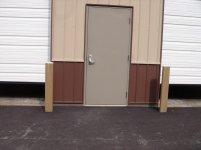
We also install heavy duty steel posts (filled with concrete and painted orange) at each side of every overhead door and on corners of building to prevent vehicles, trailers, etc. from hitting the door jambs.

Picture below shows these.

Fred
 

Attachments

  • DoorPosts.1100.jpg
    DoorPosts.1100.jpg
    93.8 KB · Views: 40

zable9

Well-known member
Joined
Dec 4, 2014
Messages
78
Location
Greater Seattle area
Pour the concrete floor first. It is a lot easier to adjust a door than to try to get your cement finisher to work to the door bottom - almost impossible to do this. Another trick - see below.

We build a lot of buildings for our business and always make up a 3"x3" or 4"x4" heavy-duty angle iron with rebar welded to the inside of the angle extending back into the building and into the concrete about 2 or 3" below the finished floor elevation (6" thick concrete). Rebar has a 90 degree end to hold into the concrete. We weld one such piece of rebar every 2 ft. of door opening. We also angle the angle iron slightly so that the cement at the outside of the door opening will be about 1" or 1.5" below finished floor elevation at the inside of the door opening, which should be level at that point. This means that the angle of the concrete starts at the inside edge of the door jamb and angles towards the outside edge of door jamb so that any water will run downhill and away from the door. We usually temporarily nail a piece of insulation or wood to the side of the door jamb to help guide the cement finishers to keep the floor in proper angle. Most door jambs are about 12" wide, so this gives us a nice slope with the 1.5" drop.

Sometimes we use a notch and the angle iron which also works well. It is also a good idea to dig out the slag/dirt around the door opening to allow for a thicker cement at that critical location

Bonus when using the 3" or 4" angle iron - forklifts and other equipment will not knock off chunks of concrete at the opening. When installing a slag, cement or blacktop drive, this will **** up with the outside edge of the angle. With the proper floor and properly adjusted overhead door, there will be no water or dirt leaks at the door and also no mice! I do not have a picture of the above setup, but if someone would like me to do so, I can take a picture later this week.

Fred

Yes please
 

FRITZ OHIO

Well-known member
Joined
Feb 10, 2014
Messages
45
Location
NE Ohio
Yes please

Hello Zable9,

Here are some pictures showing how we handle the overhead door openings, with concrete poured first and finished floor level at the inside edge of overhead jamb, with concrete sloping from that point to the outside edge of overhead door jamb. The drop in this example is about 1.5" in the 12" width of the door jamb.

As mentioned previously, we use a heavy angle iron across the outside edge of the concrete to minimize damage to the edge of the concrete. In the photo, our blacktop butts up to this angle iron and then continues to slope so that water is directed away from the building. We never install our overhead doors until concrete has been poured and cured for a few days. We always have a tight fit across the bottom and never any leakage. We also set certain "ground rules" for our door installers to accomplish this.

Another thing that we use on our overhead doors that are often not suggested by the door companies are "high rise tracks". Normally the tracks turn at a 90 degree angle just above the top of the door opening. We run our overhead door tracks up just under the bar joists where they turn. Reason: Forklifts can easily catch these tracks if installed in conventional way. The difference in cost is minimal.

Another picture shows our man door with the heavy metal posts at each corner of the overhead doors (saves a lot of damage). Last picture shows our water detention pond that was required by the EPA. Water from both buildings drains into this pond and slowly goes into a catch basin where the water flow is reduced from an 8" pipe to a 3" opening. This allows the water to flow slowly out of the pond to the property line so as not to flood neighbor's land. Lots of these are required in our area and engineering drawings are required.

Fred
 

Attachments

  • Door2.jpg
    Door2.jpg
    85.6 KB · Views: 62
  • Door5.jpg
    Door5.jpg
    79.8 KB · Views: 50
  • DetentionPond1.jpg
    DetentionPond1.jpg
    111.3 KB · Views: 46
  • Door3.jpg
    Door3.jpg
    88.9 KB · Views: 49

Kev442

Well-known member
Joined
Jan 15, 2009
Messages
5,386
Location
Wi
I installed my garage doors two years before concrete. When the concrete got done, the doors were opened and clamped open. Then the verticals were removed and the concrete poured.
Reinstallation and adjustment were up to me. Any concrete company that pours around the rails and embeds them is a hack.
 

hippie2cams

Well-known member
Joined
Jul 15, 2012
Messages
384
Location
Huffman,TX
well it seems we do not agree, I think why worry about keeping a dirt floor clean? pour the concrete then have the door set. Job well done. thankyou
 
To avoid these ads, REGISTER NOW!
Top Bottom